


On Monday, November 16, 2026, global equities slipped ahead of two key tests for AI-linked stocks: Nvidia’s quarterly results after Tuesday’s close, and the first trades in Anthropic, the maker of Claude, two days later. Between Jensen Huang’s departure and a grinding slide in Nvidia’s shares, investors are asking whether the AI rally can hold up.
🔑 Key takeaways
- Nvidia has shed roughly $1.9 trillion in market value since early October, its longest losing streak since October 2012.
- Nasdaq 100 futures were down 0.95% on Monday morning, ahead of the earnings release.
- Analysts expect 90% earnings growth for the fiscal third quarter, on revenue of $109 billion.
- Markets now price in a Federal Reserve rate hike in December.
Nvidia faces its worst stretch since 2012
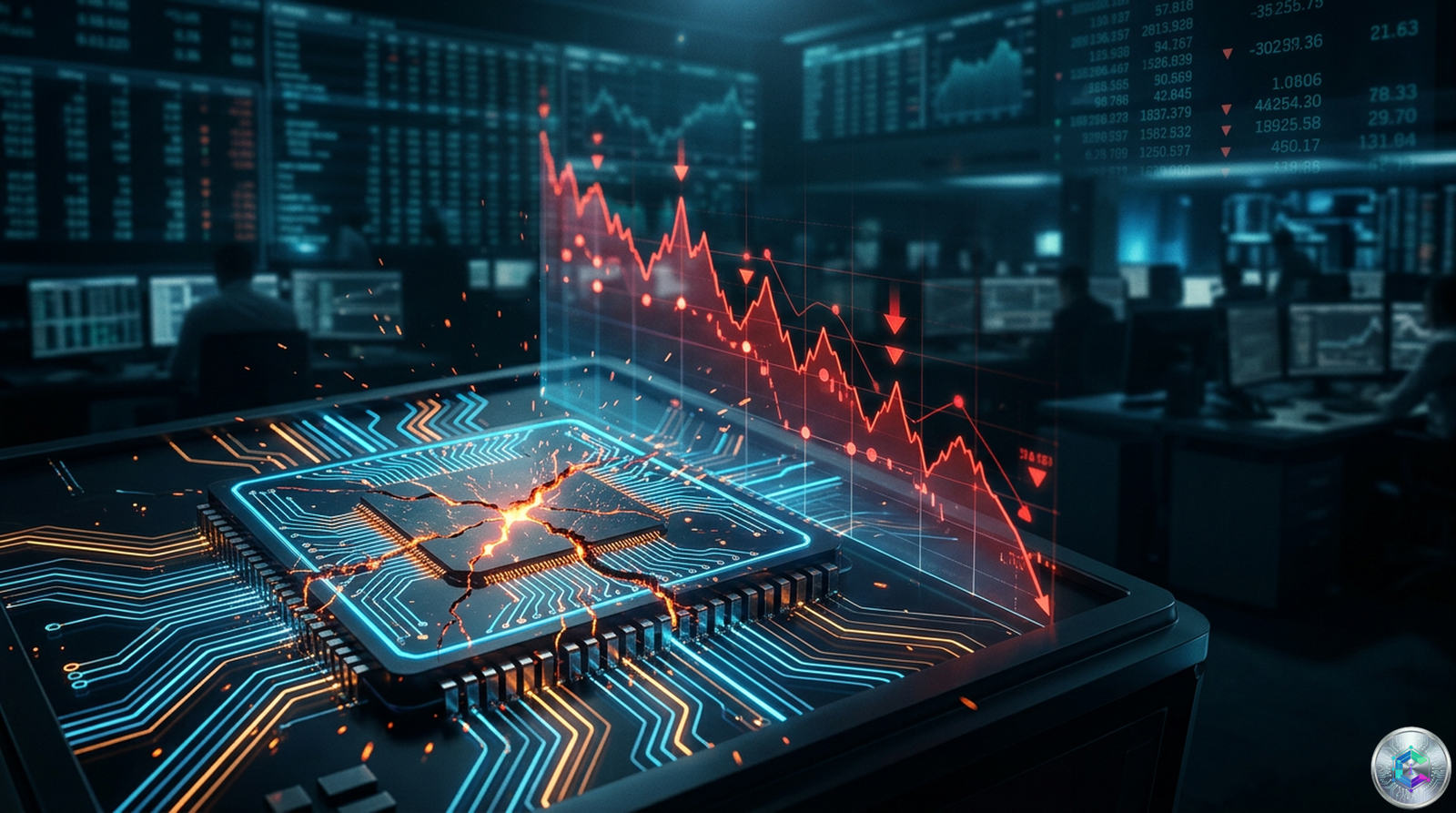
Nvidia has lost about $1.9 trillion in market capitalization between early October and Friday, falling from roughly $5.8 trillion to $3.9 trillion, according to LSEG data. As of November 13, the stock was on its longest run of weekly losses since October 2012. After a rebound of about 2% before Friday’s open and a 1.45% gain early in the session, the shares remained below $170. The previous day they had touched roughly $150. Over the week the stock was down 11%, and over the month 19%.
Barron’s describes the slide as the worst month for the stock in a year and weighs whether the dip offers a buying opportunity, in a preview published ahead of Tuesday’s after-hours report. The debate is less about product quality than about whether the company can sustain its growth trajectory without its founder at the helm.
Huang’s departure, described differently by each source
Sources do not describe Huang’s exit in the same way. Reuters reports that he resigned from the board and as chief executive. Barron’s uses the phrase “sidelined”, while Charles Schwab refers to a “departure”. Reuters links the resignation to revelations about extramarital relationships, including one with a businesswoman whom the United States suspects of spying for Beijing. The Financial Times reported on Monday that Huang was considering a return as chief executive.
Huang had led the company for 33 years and wielded considerable influence with the US and Taiwanese governments, where most of Nvidia’s chips are manufactured. That geographic and political dependence makes any succession more sensitive than an ordinary leadership handover.
Risks flagged by Schwab
- New congressional investigations into the company’s governance.
- Possible US restrictions on Nvidia product sales in China and, more broadly, across Asia.
- Succession difficulties at the top of the company.
- A possible departure of other senior executives.
“Although Nvidia still has an excellent product and the stock’s valuation is low, there is great uncertainty over the future direction of the company and the risk of disrupting relationships with customers.”
Nathan Peterson, Director of Derivatives Research, Schwab Center for Financial Research
A resilient broader market, but AI stocks under pressure
The broader market had nonetheless held up. At midday Thursday, advancing S&P 500 stocks outnumbered decliners by four to one. Since October 6, the day of the index’s record high, the S&P 500 had fallen 2.8%, against roughly 30% for Nvidia. The PHLX Semiconductor Index remained about 29% below its June 22 peak, while still up 48% for the year.
| Indicator | Level | Change |
|---|---|---|
| Nvidia, share price | Below $170 | About -11% on the week |
| Nvidia, market value | $3.9 trillion | Versus about $5.8 trillion in early October |
| S&P 500 since October 6 | Record-high reference | -2.8% |
| Nasdaq 100 futures (06:56 ET) | Down 267.25 points | -0.95% |
| PHLX Semiconductor Index | About 29% below June 22 peak | +48% year to date |
Early Monday, Dow E-mini futures rose 0.15%, S&P 500 futures fell 0.35% and MSCI All-World slipped 0.4%. The STOXX 600 barely stayed in positive territory after its 2.5% gain and record highs the previous week. In Asia, technology stocks took heavy losses, with declines near 5% in Taiwan and 3% in South Korea. In Europe, ASML, Infineon and Siemens were the main drags on the STOXX 600.
In pre-market indications, Intel and Advanced Micro Devices each fell 5.2%, Broadcom slid 3.7% and Micron lost 5.3%. Infrastructure plays tied to AI fell further: CoreWeave down 7.3%, Nebius down 7.2%, IREN down 6.4%, Applied Digital down 5.9% and Core Scientific down 6.3%. Two Reuters dispatches on the same day, however, give different pre-market levels for Nvidia: -2.7% in one, -0.4% in the other. The gap, which may reflect different quotation times, is not explained.
Earnings on November 17: high expectations, heavy implied volatility
Analysts expect 90% earnings growth for the fiscal third quarter, on revenue of $109 billion. Tuesday’s release will show whether the new leadership can keep the company’s optimistic outlook for the following fiscal year.
Options markets imply a move of roughly plus or minus 7% on the day of the results. Chris Weston, head of research at Pepperstone, argues that the quarterly numbers may not carry their usual significance: “Nvidia could well deliver a result far above expectations and raise its outlook tomorrow, but investors are increasingly trying to value a company in 2028 and 2029 potentially without the individual who architected its competitive advantage.”
Anthropic’s initial public offering drew more institutional interest than SpaceX’s, according to people familiar with the matter. Ipek Ozkardeskaya, senior analyst at Swissquote, notes that investors buying Anthropic may sell existing technology holdings to make room, meaning a successful listing will not necessarily lift every AI stock.
“Sentiment is too fragile to absorb a bad IPO from a name this important. Nvidia’s problems do not bode well for the rest of the AI complex, which makes a strong debut for Anthropic even more important.”
Chris Beauchamp, Chief Market Strategist, IG
The Fed, inflation and bonds: the macro backdrop
The US producer price index released on November 13 at 9:25 a.m. Eastern rose 0.3% month on month, against a consensus of 0.4%. Its core component, excluding food and energy, rose 0.3%, in line with expectations. On an annual basis, the headline index reached 6.5%, its highest level since November 2022, while the core component stood at 5%, the highest since early 2023. Food prices rose the most since February, while energy prices fell.
Collin Martin, head of fixed income research at Schwab, sees monetary policy tightening: “We expect a rate hike next month, at the December meeting, and another in early 2027. Inflation is simply too strong at the moment.” The same day, the CME FedWatch Tool assigned a 100% probability to a hike of at least 25 basis points in December, and 15% to a 50-basis-point hike.
On Monday, fed funds futures indicated that a 25-basis-point hike in December was practically locked in, while the probability of a 50-basis-point move stayed just below 10%. Markets priced in at least three rate hikes by next December, with a possible fourth. Federal Reserve Chair Kevin Warsh was scheduled to speak in San Francisco, and minutes from the October meeting are due Wednesday. According to Bank of America Global Research, they should reveal a deeper split over holding rates than the 10-to-2 vote in favour of the status quo suggested.
“We expect one more hike from the Fed and the ECB in December, but see no reason to expect a series. The path beyond December would depend on the war.”
Mohit Kumar, Strategist, Jefferies
In fixed income, the 10-year US Treasury yield fell 3 basis points to 5.121%, after a 29-basis-point rise the previous week and a return above 5%. That move followed the heaviest weekly Treasury sell-off since April of the previous year, linked to Donald Trump’s “Liberation Day” tariffs. One point requires verification: the Reuters text simultaneously refers to a fall in the bond price, which is inconsistent with a falling yield. Readers should check this against the primary source. The dollar reached its highest level since April of the previous year against a basket of currencies, while Brent crude slipped 1% to $95 a barrel.
Conclusion: a confidence test rather than a breaking point
This week hinges on three variables: whether Nvidia can confirm its outlook after its founder’s exit, how Anthropic’s listing is received, and where the Federal Reserve goes with inflation still elevated. Results above expectations, combined with a maintained outlook, could spark a rebound in AI-linked shares without erasing the governance risk. A cautious guidance or greater uncertainty over succession would instead extend the pressure on semiconductor stocks.
The central scenario remains tied to macro conditions. If the Fed does raise rates in December and the Middle East conflict keeps Brent above $80, valuations of growth stocks will stay under strain. Markets will have to balance economic fundamentals that still look solid against the risk of a sharp repricing of yield expectations.
Sources
- Reuters, “Stocks dip as caution sets in before Nvidia earnings”, November 16, 2026
- Barron’s, analysis of Nvidia shares and buying opportunity, November 2026
- Financial Times, report on Jensen Huang’s possible return, November 16, 2026
- Charles Schwab Center for Financial Research, market commentary, November 2026
- LSEG, Nvidia market capitalization data, October-November 2026
- Bank of America Global Research, note on Federal Reserve minutes, November 2026
- CME FedWatch Tool, rate hike probabilities as of November 13, 2026
Cet article est publié à titre informatif et éducatif. Il ne constitue en aucun cas un conseil en investissement. Faites vos propres recherches (DYOR) avant toute décision.

