

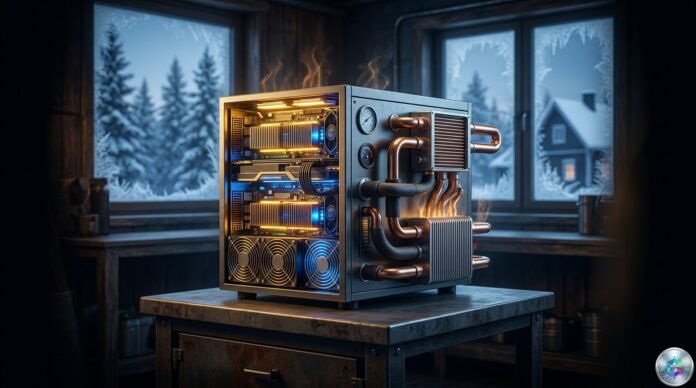
In Finland, the heat produced by bitcoin miners is now replacing oil and gas boilers in several households. SunBit says its systems add no net energy bill as long as bitcoin stays above roughly $70,000. This analysis breaks down the numbers, the limits of the model and the debate it has triggered ahead of the 2028 halving.
🔑 Key takeaways
- SunBit operates 30 “Bitcoin Boilers”, 29 of them in Finland and one in the Netherlands.
- The operational break-even sits at about $70,000 per bitcoin, roughly 15% below the $81,500 price observed.
- Installation costs range from $20,400 to $31,400, with payback estimated between three and six years.
- The 2028 halving will cut the block reward in half and bring mining revenue down to about 7 cents per kilowatt-hour.
A boiler that also mines bitcoin
The principle is simple heat recovery. The machine captures the heat generated by mining in a water circuit, up to 60 degrees Celsius, then feeds it into radiators and underfloor heating, much like a conventional boiler. In a 180-square-metre house in Nokia, the owner fully disconnected from the district heating network. If mining revenue covers the electricity consumed, the heating adds no net energy cost. Profitability, however, remains tied to the bitcoin price, electricity prices and competition among miners.

SunBit delivered its first production batch in 2025. Of the 30 systems in service, 29 are in Finland and one is in the Netherlands, at Lekkum, the company’s first export. The installations replaced or reduced the use of gas, oil, wood or district heating. The owner buys the machines, installs them where the old boiler stood, pays the electricity and keeps the bitcoin mined. Units sit in a basement or a soundproofed adjoining room, since mining rigs are loud.
The calculator’s economic model
The calculator is based on a 495-terahash version of the Bitmain Antminer S21 XP Hydro, a water-cooled unit running Braiins OS, a third-party firmware tuned by SunBit. Running continuously at about 5.3 kilowatts, it consumes roughly 46,400 kilowatt-hours a year. At 11 cents per kilowatt-hour, electricity costs about $5,200 annually.
| Parameter | Assumption or result |
|---|---|
| Bitcoin price | $82,000 |
| Total network hashrate | 1,040 exahashes per second |
| Annual machine output | about one-twelfth of a bitcoin |
| Gross revenue without service | about $6,800 |
| Net revenue with service | about $6,100 |
| Annual electricity cost | about $5,200 |
| Surplus with service | about $900 before depreciation |
After the optional service’s 10% fee, the owner would keep about $6,100, minus a deduction of roughly 0.5% for the mining pool. The service includes continuous monitoring, optimisation against Finland’s spot electricity price, an app and a grid-balancing function. Without the service, the owner keeps the full one-twelfth of a bitcoin, worth about $6,800.
“Heating works independently of the market, and only the payback period changes”
Elmeri Suomi, Founder and CEO, SunBit
Systems already running
The documented cases show how varied the setups are. In Kotka, a port of about 50,000 people in southeast Finland, a 200-square-metre house pairs the miner with its oil boiler. In Tampere, a former manor dropped wood heating for mining, using a 1,500-litre water tank held between 50 and 60 degrees. In Vimpeli, a 3,000-square-metre industrial hall combines the system with an air-to-water heat pump and absorbs the surplus from a 30-kilowatt solar array.
Two figures stand out. The first comes from a pilot client running an Antminer S21+ Hydro rated at 358 terahashes, which mined about 0.039 bitcoin in one year, worth roughly $3,160 at the quoted price, while displacing about 2,000 litres of heating oil annually. SunBit could only access these data because the client was a pilot. The second concerns a detached house burning 2,300 litres of oil a year at $2.19 per litre, a bill near $5,000. Under SunBit’s assumptions, a miner could generate about $6,000 of annual revenue and $920 net after electricity, for a base installation cost of about $20,200, paid back in three and a half years before maintenance and financing.
- The old oil boiler can remain available during the coldest days.
- Later clients use their own pool accounts, which limits how much data can be checked.
The 2028 halving, the turning point
Bitcoin will cut its mining reward at the next halving, expected in spring 2028, from 3.125 to 1.5625 bitcoin per block. SunBit’s calculator does not model this event, as the company refuses to guarantee any future price or difficulty. Suomi says every client is briefed on the halving. At unchanged parameters, mining revenue would fall from about 13 cents to 7 cents per kilowatt-hour, against an electricity price of 11 cents.
| Scenario | Mining revenue per kWh | Electricity per kWh | Net heating cost |
|---|---|---|---|
| Before halving | about 13 cents | 11 cents | close to zero |
| After halving | about 7 cents | 11 cents | about 4 cents |
A system installed during winter 2026-2027 would have about 18 months at current margins before the reward cut. On this model, heating would stay free after the halving only if bitcoin exceeded about $131,000, roughly 60% above Friday’s price. The $70,000 threshold is therefore the break-even point before 2028, not the profitability threshold after it.
“The trade-off is that the economics depend on the bitcoin price and network difficulty, unlike a heat pump”
Elmeri Suomi, Founder and CEO, SunBit
Contested efficiency and a heated debate
The comparison with heat pumps is the core of the debate. A heat pump delivers 2.5 to 3 kilowatt-hours of heat per kilowatt-hour of electricity, while a miner delivers only one. For a home consuming 25,000 kilowatt-hours of heat a year, SunBit estimates the running cost of an air-to-water heat pump at about $1,100, versus $3,170 for district heating. Used only during the hours the home needs heat, the miner would produce about $490 more than its electricity cost. In some systems, more than half the heat never reached the house and was rejected by an outdoor dry cooler, mainly from late May to mid-September in the south. Deep winter lasts about 100 days in the southwest and 200 days in Lapland.
“A miner’s output does not depend on outdoor temperature”
Elmeri Suomi, Founder and CEO, SunBit
Critics are blunt. Bitcoin mining accounted for an estimated 0.5% of global electricity consumption in 2024. Johanna Fornberg of Greenpeace argues that a miner’s heat is comparable to that of an electric water heater: one unit of energy yields one unit of heat, against two to three for a heat pump. Eric Bosworth, founder of Thermal Energy Insights, notes that mining could require more fossil thermal generation in Finland, but that heat from an operation already planned should be “certainly recovered and sent to a district whenever possible”.
Industrial players have taken a different route. MARA Holdings feeds residual heat from its miners into the Satakunta and Seinäjoki networks, serving about 80,000 people, with water leaving the machines at 50 to 78 degrees Celsius. The company estimates it has avoided nearly 5,000 tonnes of greenhouse gas emissions over 1.5 years of operation. Hashlabs runs six sites connected to urban networks, while Terahash Energy supplies an industrial zone and nearby homes through its Genesis project. After the energy price spike that followed Russia’s invasion of Ukraine, mining was also pitched as a cheaper alternative to gas-fired plants.
An earlier home example from 2021 is also instructive. An Austrian blogger used four AMD R9 390 GPUs to mine Ethereum, drawing about 900 watts together, in a house heated entirely by electricity. With 4.8 kilowatts of solar panels, he reported earning $3.80 a day and covering about half his heating bill. He estimated the setup would stay profitable as long as Ethereum was worth about $900.
Conclusion: profitability indexed to bitcoin
SunBit’s model turns an energy constraint into an economic advantage, provided bitcoin stays high and network difficulty does not climb too quickly. In a bullish scenario, above $131,000, heating would remain nearly free after the halving. In a central scenario, margins shrink sharply and payback depends on installers’ ability to optimise against electricity prices. In a bearish scenario, below the $70,000 threshold, the system becomes loss-making without support from a heating network.
The underlying question remains climate justification. The heat is real and can displace fossil fuels, but it cannot match a heat pump’s efficiency. For investors and households alike, the main risk is not technical. It depends on the bitcoin price, network difficulty and the payback horizon chosen.
Sources
- CoinDesk, November 8, 2026
- KuCoin News
- Grist
- haschek.at blog, 2021
- CryptoNews
- Medium, 2022 guide to six heating systems
Cet article est publié à titre informatif et éducatif. Il ne constitue en aucun cas un conseil en investissement. Faites vos propres recherches (DYOR) avant toute décision.

