

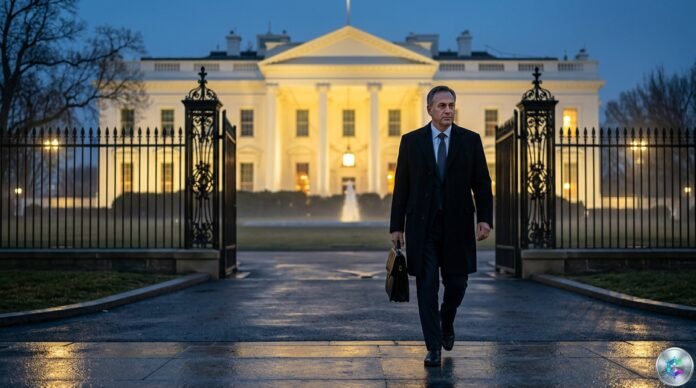
David Sacks, a former PayPal executive turned influential investor, served from January 2025 to March 2026 as the White House AI and Crypto Czar. His exit closes a tenure defined by an openly deregulatory agenda and by persistent questions about conflicts of interest.
🔑 Key takeaways
- Background: co-founder of Yammer and former PayPal COO, Sacks runs Craft Ventures, whose assets under management reach $3.3 billion.
- Tenure: announced on December 5, 2024, in office from January 20, 2025, he departed on March 26, 2026 after using his 130 days of service.
- Doctrine: “let them cook”, meaning lightly constrained private innovation under “minimally burdensome” rules.
- Controversy: a White House memo revealed in March 2026 reportedly shows more than $200 million in digital asset holdings sold.
A career from PayPal to Craft Ventures
Born in Cape Town on May 25, 1972 and moved to the United States at age five, David Oliver Sacks studied economics at Stanford, where he met Peter Thiel. He joined Confinity in 1999 alongside Peter Thiel, Max Levchin and Luke Nosek, then ran several functions at PayPal, from product management to fraud prevention. The company went public in February 2002, rising more than 54% on its first trading day, before eBay acquired it in October 2002 for $1.5 billion.
After the PayPal sale, Sacks founded Geni.com and co-founded Yammer with Adam Pisoni in 2008. The enterprise social network, used by more than eight million people within four years, was bought by Microsoft in July 2012 for $1.2 billion. In January 2016, Sacks became interim CEO of Zenefits after regulatory and financial problems. Over ten months, he negotiated with US insurance regulators, launched a redesign called “Z2” and introduced a self-service software model.
In 2017, he co-founded Craft Ventures in San Francisco with a first fund of $350 million. Further raises of $500 million in 2019 and $1.3 billion in 2021 lifted assets under management to $2 billion. The 2023 launches of Ventures IV and Growth II added $1.3 billion more, bringing the total to $3.3 billion. The portfolio includes SpaceX, Anduril, Palantir, Meta, Airbnb and Lyft. Sacks has also hosted the All-In podcast since 2020 and organized a fundraiser for Donald Trump at his home in June 2024.

A mandate built on deregulation
Announced by Donald Trump on December 5, 2024 as “White House A.I. & Crypto Czar”, Sacks was tasked with making America the “clear global leader” in artificial intelligence and cryptocurrencies. His remit also included safeguarding free speech online, steering policy away from Big Tech bias and censorship, and building a legal framework that gives the crypto industry the clarity it has requested. He was also to lead the Presidential Council of Advisors for Science and Technology (PCAST), a federal advisory committee of experts.
He took office on January 20, 2025 as a “special government employee”. That status capped his work for the administration at 130 days per year, paid or unpaid, and exempted him from Senate confirmation hearings and certain financial disclosure requirements.
| Date | Event | Detail |
|---|---|---|
| December 5, 2024 | Appointment announced | Announced by Donald Trump, then president-elect |
| January 20, 2025 | Start of tenure | Special government employee status |
| July 2025 | AI summit in Washington | Sacks took part in the event |
| March 2026 | White House memo | More than $200 million in digital asset holdings sold |
| March 26, 2026 | End of tenure | 130 days used, moved to PCAST co-chair |
Shortly after his swearing-in, speaking at a Crypto Ball, he summed up the direction of his mandate:
“The war on crypto is over”
David Sacks, White House AI and Crypto Czar
Before taking office, Sacks and Craft Ventures sold their direct cryptocurrency holdings to avoid potential conflicts of interest, while keeping investments in crypto startups. According to The Block, he took part in discussions on the public management of cryptocurrencies and evaluated a US strategic digital asset reserve. He backed the expansion of a Strategic Bitcoin Reserve and argued that a stablecoin bill could create trillions of dollars in demand for US Treasury bills. In December 2025, he rejected fresh conflict-of-interest allegations. The sources do not document any market reaction directly tied to his appointment or departure.
A “let them cook” doctrine meets safety advocates
Sacks summarizes his position as “let them cook”, meaning private players should innovate quickly under “minimally burdensome” regulation. The administration’s framework rests on three pillars:
- Private innovation: let the sector push technical limits and curb the spread of state-level rules.
- Energy and infrastructure: let AI companies build data centers faster, including by supplying their own electricity, without raising residential power rates.
- Exports: the third pillar, with no further detail in the sources reviewed.
In an interview published by Politico on May 1, 2026, he argued that a US slowdown would not halt AI development but would simply shift it to other countries, notably China, which he said employs about half of the world’s AI developers. He added:
“If the unreleased models are scary enough that you think you should slow down, I support your decision to be responsible. But stop pretending you need anyone else’s permission.”
David Sacks, former White House AI and Crypto Czar
On safety, he called independent model evaluations requested in September 2026 by more than 100 researchers, including Geoffrey Hinton and Stuart Russell, “pseudoscience”. After Dario Amodei, CEO of Anthropic, proposed slowing development for safety reasons, Sacks denounced an “election-season psyop” and an attempt at “regulatory capture”. Sam Altman, Demis Hassabis and Elon Musk had backed Amodei’s proposal. On the federal front, a December order aims to block state AI laws and tasks a federal task force with challenging them. In May 2026, Sacks reportedly persuaded Trump to drop an order that would have subjected models to government review.
Criticism and conflicts of interest
The appointment drew sharp criticism over conflicts of interest, the absence of Senate confirmation and limited transparency. Isabel Sunderland, technology reform policy lead at Issue One, said:
“David Sacks advising President Trump on AI shows exactly how our political system serves the wealthy and well-connected instead of everyday Americans.”
Isabel Sunderland, Issue One
Sacha Haworth of the Tech Oversight Project described him as an “out-of-touch Silicon Valley radical”. A Bryson Gillette Insights poll for the Future of Life Institute found that 85% of Republicans backed strong presidential action for safe AI development. According to the Wall Street Journal, Scott Bessent and Susie Wiles reportedly advised Trump to adopt more controls, but the president reportedly followed Sacks on the issue.
What comes next after Sacks
His March 26, 2026 exit does not mean a full withdrawal. Sacks became PCAST co-chair and says he can now make recommendations on “an expanded range of technology topics”, beyond AI. He also said he would keep defending the administration’s AI framework, published the week before.
Three scenarios stand out. The first extends the current line: private innovation, energy infrastructure and limits on state rules remain priorities. The second implies a shift if pressure on AI safety or conflicts of interest intensifies in Congress. The third sees stablecoin legislation and the strategic digital asset reserve take a larger place on the crypto agenda. The sources do not settle the question, and no market projection is offered.
Sources
- The Block, David Sacks profile
- The American Presidency Project, Trump statement of December 5, 2024
- CNBC, March 26, 2026
- The Guardian, September 20, 2026
- Wikipedia, David Sacks
- Politico, full transcript of the May 1, 2026 interview
Cet article est publié à titre informatif et éducatif. Il ne constitue en aucun cas un conseil en investissement. Faites vos propres recherches (DYOR) avant toute décision.

