

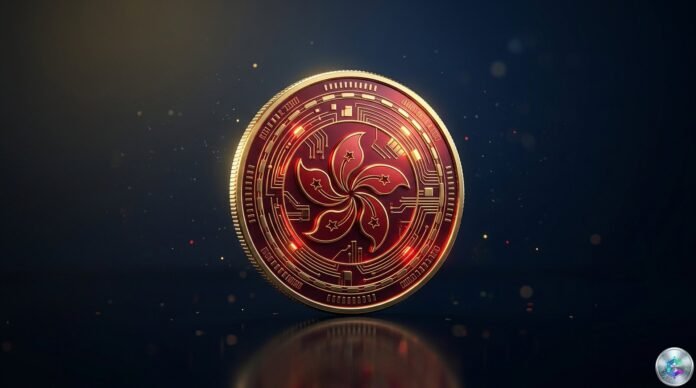
HSBC is moving deeper into digital assets with RedCoin, its first Hong Kong dollar stablecoin aimed at retail customers. Issued under a licence from the HKMA and fully backed by high-quality liquid assets, it will reach users through PayMe and the HSBC Hong Kong app from 23 October 2026, paying no yield.
🔑 Key takeaways
- Commercial launch of RedCoin, a retail stablecoin pegged to the Hong Kong dollar, set for Friday 23 October 2026.
- Issuance under licence FRS02, granted on 10 April 2026 by the HKMA under the Stablecoins Ordinance.
- Distribution built into PayMe (more than 100,000 merchants) and the HSBC HK app (3.3 million users across the ecosystem).
- No public details yet on the blockchain, token standard, proof-of-reserve frequency or redemption fees.
A Strict Regulatory Framework as the Starting Point
HSBC unveiled the product name, “HSBC RedCoin”, on 30 September 2026, ahead of a phased rollout within PayMe and the HSBC Hong Kong app. The commercial launch was then set for Friday, 23 October 2026. The issuer is The Hongkong and Shanghai Banking Corporation Limited, a wholly owned subsidiary of HSBC Holdings plc.
The bank received its stablecoin issuer licence on 10 April 2026, reference FRS02. Thirty-six candidates applied in the first wave. Only two were initially approved: HSBC and Anchorpoint Financial Limited, a joint venture of Standard Chartered Bank Hong Kong, HKT and Animoca Brands. The Hong Kong Monetary Authority (HKMA) has therefore chosen a deliberately narrow field.
The legal framework is the Stablecoins Ordinance (Cap. 656), in force since 1 August 2025. It requires issuers to manage and custody reserves rigorously, maintain stabilisation and redemption mechanisms, verify the identity of holders and comply with anti-money laundering supervision.

Reserves, Redemption and Product Positioning
Each RedCoin must be fully backed at all times by high-quality, highly liquid assets held in segregated accounts. The product is designed to be redeemed one-for-one against Hong Kong dollars. No yield or interest is offered, which sets it apart from interest-bearing savings products.
The table below places RedCoin within HSBC’s tokenised offering:
| Product | Issuer | Segment | Status |
|---|---|---|---|
| RedCoin | HSBC | Retail | Launch on 23 October 2026 |
| Tokenised Deposit Service | HSBC | Professional clients | Live since 2024 |
| HKDAP | Anchorpoint Financial | Institutional clients | Phased rollout since August 2026 |
Maggie Ng, Group Managing Director of HSBC Hong Kong and head of retail banking and wealth management, frames the product as a natural step forward:
“Money, assets and information are moving from traditional infrastructure to always-on digital networks that are data-rich and increasingly programmable.”
Maggie Ng, Group Managing Director, HSBC Hong Kong
Asked about the launch, she described RedCoin as “the logical next step” rather than a leap into the unknown. John O’Neill, HSBC’s Group Head of Digital Assets and Currencies, said the bank plans to add products and extend RedCoin to “high-volume use cases for businesses and institutions”. The rollout is phased: first retail payments, customer education, scam prevention and direct redemption; then business-to-business payments, treasury operations, high-volume payment flows, settlement of tokenised corporate assets and settlements linked to tokenised asset transactions.
An Integrated Distribution Strategy
The strategy rests on controlling both the issuance and the channels that carry it. HSBC is the issuer of RedCoin and the owner of PayMe, its main point of contact with consumers. Wallets can be activated directly inside an app people already use, without going through an exchange or a third-party wallet.
PayMe lets users pay more than 100,000 merchants. The ecosystem reachable through PayMe and the HSBC HK app counts 3.3 million users. A market source estimates that PayMe reaches about 40% of the Hong Kong population, without presenting it as the sector’s leading player.
Initial use cases are person-to-person transfers and payments between individuals and merchants. Subject to regulatory approval, RedCoin could also be used to subscribe to tokenised investment products in the HSBC HK app. The Tokenised Deposit Service, live since 2024 and aimed at professional clients, remains a separate high-volume instrument.
Anchorpoint Financial, the other initially approved issuer, began a phased rollout of its own stablecoin, HKDAP, to institutional clients in August 2026. RedCoin therefore takes the opposite approach, targeting retail.
Customer Survey and Open Questions
An online survey of 1,060 Hong Kong clients aged 18 to 64, conducted from 18 to 28 June 2026, found that 74% of respondents would use stablecoins or identified at least one use case. The most cited applications were digital asset trading and tokenised investment products (57%), followed by person-to-person transfers (53%). Cross-border transfers and merchant payments were each cited by 52%.
Understanding gaps remain significant: 26% of respondents believed stablecoins are issued by a government, and 10% believed they generate interest. Only 60% correctly defined them as digital assets backed by fiat currency.
The most cited trust factors were regulatory protections (62%), education (55%), fraud protection (53%) and ease of converting stablecoins into cash (51%). HSBC has accordingly placed education and scam prevention at the heart of its first phase.
As of 30 September 2026, several technical elements have not been published: the blockchain used, the token standard, the smart contract address, the frequency of reserve attestations, redemption fees and access conditions for third parties. The bank also warns against stablecoins claiming the RedCoin name outside official channels, echoing HKMA warnings about fake tokens that use the names of licensed issuers.
Outlook: A Real-World Test
The 23 October 2026 launch marks RedCoin’s transition from a regulated project to a commercial offering. It is the first retail stablecoin from one of the two licensed issuers in Hong Kong. The sources reviewed mention no exchange listing, no issuance volume, no transaction volume and no specific market reaction at launch.
Three scenarios stand out. In the base case, adoption grows through person-to-person transfers in PayMe, where a base of 3.3 million users offers rare distribution leverage. In a more cautious scenario, weak product understanding and the absence of public technical data slow conversion. In an expansion scenario, business and tokenised use cases justify a move up-market, provided regulatory approval follows. HSBC also builds on prior experience: participation in HKMA projects since 2022, including the e-HKD+ pilot and Project Ensemble, digital bonds through HSBC Orion, and the HSBC Gold Token for retail clients.
Sources
- The Block, 23 October 2026
- Yahoo Finance, RedCoin distribution
- Coinpedia via TradingView, RedCoin naming
- HSBC Hong Kong, stablecoins page
- Bitcoin Foundation, RedCoin launch
- Eco, what is HSBC RedCoin
This article is published for information and education purposes only. It does not constitute investment advice in any way. Do your own research (DYOR) before making any decision.

