

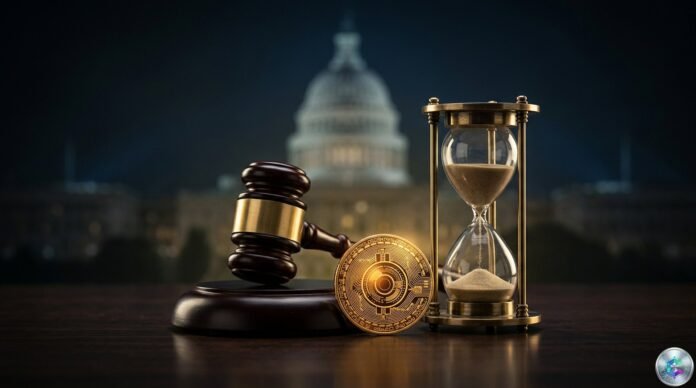
Treasury Secretary Scott Bessent has urged the Senate to pass the CLARITY Act when it returns from its August recess, warning that further delay would signal weak American leadership in digital assets. Yet odds of enactment in 2026 remain low, with the 60-vote procedural threshold the central obstacle.
🔑 Key takeaways
- Bessent is calling on the Senate to vote on the CLARITY Act when Congress resumes work the Monday after the August break.
- The House passed the bill in July 2025, and the Senate Banking Committee approved it in spring 2026 by 15 votes to 9.
- The bill must clear a 60-vote procedural barrier, which requires substantial bipartisan support.
- Galaxy now puts 2026 passage odds at 10%, down from 75% on May 22, 2026, while prediction markets sit near 16%.
- Key sticking points include stablecoin yield, ethics rules for officials and how oversight is split between the SEC and CFTC.
A public push to restart the legislative process
On September 9, 2026, Treasury Secretary Scott Bessent posted on X a message addressed directly to senators. His ask was straightforward: accept the procedural motion (the vote that opens debate on a bill) and keep the legislative process moving rather than letting the text stall. For Bessent, a failure to act would carry consequences beyond domestic politics.
“When the Senate returns from the August recess, I strongly urge everyone to stay at the negotiating table, accept the procedural motion and continue the legislative process.”
Scott Bessent, U.S. Treasury Secretary
He argued that inaction would send a troubling signal to allies and adversaries alike, suggesting the United States was unwilling to lead on digital assets or to forgo strengthened national security tools against misuse. The bill is also framed as a way to stop “bad actors” who exploit the technology while keeping legitimate activity under a defined framework.

A legislative path that is already well advanced
The CLARITY Act, short for the Digital Asset Market Clarity Act, aims to establish the first comprehensive federal regulatory framework for digital assets in the United States. The bill has already cleared several major milestones, summarized below.
| Milestone | Result | Timing |
|---|---|---|
| House of Representatives vote | Passed | July 2025 |
| Senate Banking Committee vote | 15 for, 9 against | Spring 2026 |
| Galaxy passage probability | 10% | Current (75% on May 22, 2026) |
| Prediction market probability | 16% | For 2026 |
Bessent says staff on the Senate Banking and Agriculture committees have spent “thousands of hours” negotiating bipartisan revisions. He has also accused Senate Democrats of delaying the vote for political reasons, and suggested they fear retaliation from Senator Elizabeth Warren and her self-described “anti-crypto army”. Those accusations underscore the partisan tension surrounding the bill.
On substance, Bessent argues that Titles II and III would significantly expand compliance obligations for digital asset intermediaries, bringing them closer to standards applied to traditional financial institutions. The bill would also shield decentralized software developers by codifying Treasury policy that they are not subject to registration requirements under the Bank Secrecy Act (the U.S. anti-money-laundering statute).
Obstacles that remain
Despite growing support, the bill still faces several fault lines. Three of them account for most of the negotiation.
Stablecoin yield
The most contentious issue is whether stablecoin issuers should be allowed to pay interest to holders. The question touches bank regulation, monetary policy and the very definition of a stablecoin. Banks and crypto companies hold divergent views, and no compromise has emerged.
Ethics rules
Some senators want stricter conflict-of-interest rules for government officials who hold digital assets. A new draft under discussion since July 2026 would bar officials from promoting cryptocurrencies or profiting from them.
The 60-vote threshold
The bill needs 60 votes in the Senate to overcome a possible procedural filibuster, which demands substantial support from both parties. Rumors circulating in the press suggest Democrats regret the absence of amendments and want changes to the text. These reports have not been officially confirmed.
Disagreements extend beyond the banking sector. The Fraternal Order of Police, which previously opposed the Blockchain Regulatory Certainty Act, now supports it. The National Sheriffs’ Association shifted from active opposition to a position of “neutrality” on September 3, 2026.
Oversight split between the SEC and the CFTC
The CLARITY Act divides oversight of digital assets between two federal agencies based on the economic nature of each token:
- The Securities and Exchange Commission (SEC) would oversee tokens that look and function like securities.
- The Commodity Futures Trading Commission (CFTC) would oversee tokens that function more like commodities. Most crypto assets would therefore fall under its jurisdiction.
The bill also introduces disclosure requirements for digital asset platforms, anti-money-laundering standards and registration pathways for companies with their regulators. For industry participants, these provisions would provide regulatory visibility that is currently lacking.
Adoption odds and international competition
The outlook for passage remains limited. Galaxy has repeatedly lowered its 2026 estimates, with the current probability standing at 10%, compared with 75% on May 22, 2026. Prediction markets put the odds near 16%. These figures contrast with Bessent’s framing of the bill as reaching the “1-yard line”, a metaphor he used in July 2026 to signal a near-final stage.
Bessent also links the bill to international competitiveness. He warned that unclear U.S. rules have already pushed economic activity abroad, as entrepreneurs gravitate toward jurisdictions with defined frameworks. Singapore and the United Arab Emirates have actively courted digital asset firms with tailored licensing regimes.
President Donald Trump has also endorsed the legislation. In August 2026, he said that for the United States to remain the “undisputed leader in Bitcoin and cryptocurrency”, it must adopt this “very, very powerful legislation”. In his campaign, Bessent also invoked the bitcoin creator, a communication choice that presents the bill as a strategic imperative.
“America will be the leader or it will not. It is not more complicated than that. I believe Satoshi said it best: ‘If you don’t believe me or don’t get it, I don’t have time to convince you, sorry.'”
Scott Bessent, U.S. Treasury Secretary
Markets generally reacted positively to Bessent’s public statements. Bitcoin’s price and shares of listed crypto companies such as Coinbase recorded upward moves coinciding with his interventions. These moves signal interest in the bill but do not establish causation. Meanwhile, the crypto sector has significantly increased its lobbying and advocacy spending.
Conclusion: scenarios to watch
The CLARITY Act now enjoys broader institutional support than before, with some police organizations backing it and the sheriffs’ association moving to neutral. However, the 60-vote threshold and disputes over stablecoin yield and official ethics keep uncertainty high.
Three scenarios stand out. A bipartisan deal on stablecoin yield and ethics rules would enable a successful procedural vote and rapid progress. A prolonged standstill, consistent with Galaxy’s and prediction markets’ current odds, would extend the impasse. A procedural failure would push the bill into a less predictable political calendar. The procedural vote and stablecoin-related amendments will be the key indicators to monitor.
Sources
- Cointelegraph: Treasury Secretary Bessent urges CLARITY Act passage
- Yahoo Finance: Treasury Secretary invokes Bitcoin creator
- TradingView: Cointelegraph, Bessent urges CLARITY Act passage
- Crypto Briefing: Bessent on CLARITY Act passage
- Bitcoin Magazine: Scott Bessent urges CLARITY Act action
- CryptoRank: Scott Bessent urges CLARITY Act action
Cet article est publié à titre informatif et éducatif. Il ne constitue en aucun cas un conseil en investissement. Faites vos propres recherches (DYOR) avant toute décision.

