

H100 GPU rental rates have collapsed 88% between January 2024 and September 2025, with regional gaps of up to 80% on AWS. For operators who financed GPU fleets betting on a stable hourly rate, this downturn upends the economics of their contracts. Luxor and CME Group are fielding the first derivatives to offer a hedge.
🔑 Key takeaways
- H100 instance rental price fell 88% between January 2024 and September 2025
- Major hosters buy GPUs up to 3 years in advance, locking in supply
- Luxor, born in Bitcoin mining, launches cash-settled compute derivatives
- CME Group announced on August 11 futures on H100 and B200 rental indices
- Basis risk and counterparty risk remain the main blind spots of these hedges
GPU rental rates collapse: -88% in 21 months
Cast AI’s data, reported by Techzine, paints an unambiguous picture: the H100 instance rental rate fell to 12% of its January 2024 level by September 2025. For end users, the magnitude varies sharply by geography: picking the right AWS region saves up to 80% on the bill, evidence of delivery concentration in a handful of US states.
| Period | H100 rental price index | Cumulative change |
|---|---|---|
| January 2024 | 100 (base) | — |
| December 2024 | ~55 | -45% |
| September 2025 | 12 | -88% |
This rate compression stems partly from the procurement strategy of hyperscalers. AWS, Azure, GCP and neoclouds such as CoreWeave and Crusoe are building exascale data centers in the United States and buying GPUs up to three years in advance. Laurent Gil, co-founder and president of Cast AI, sums up the situation:
“GPU prices don’t follow logic; GPU availability and pricing are a mess.”
Laurent Gil, co-founder and president of Cast AI
For Gil, this advance purchasing pulls the industry back to a classic data center model, far from the elasticity promised by cloud computing.
AI hosters: an economic model under pressure
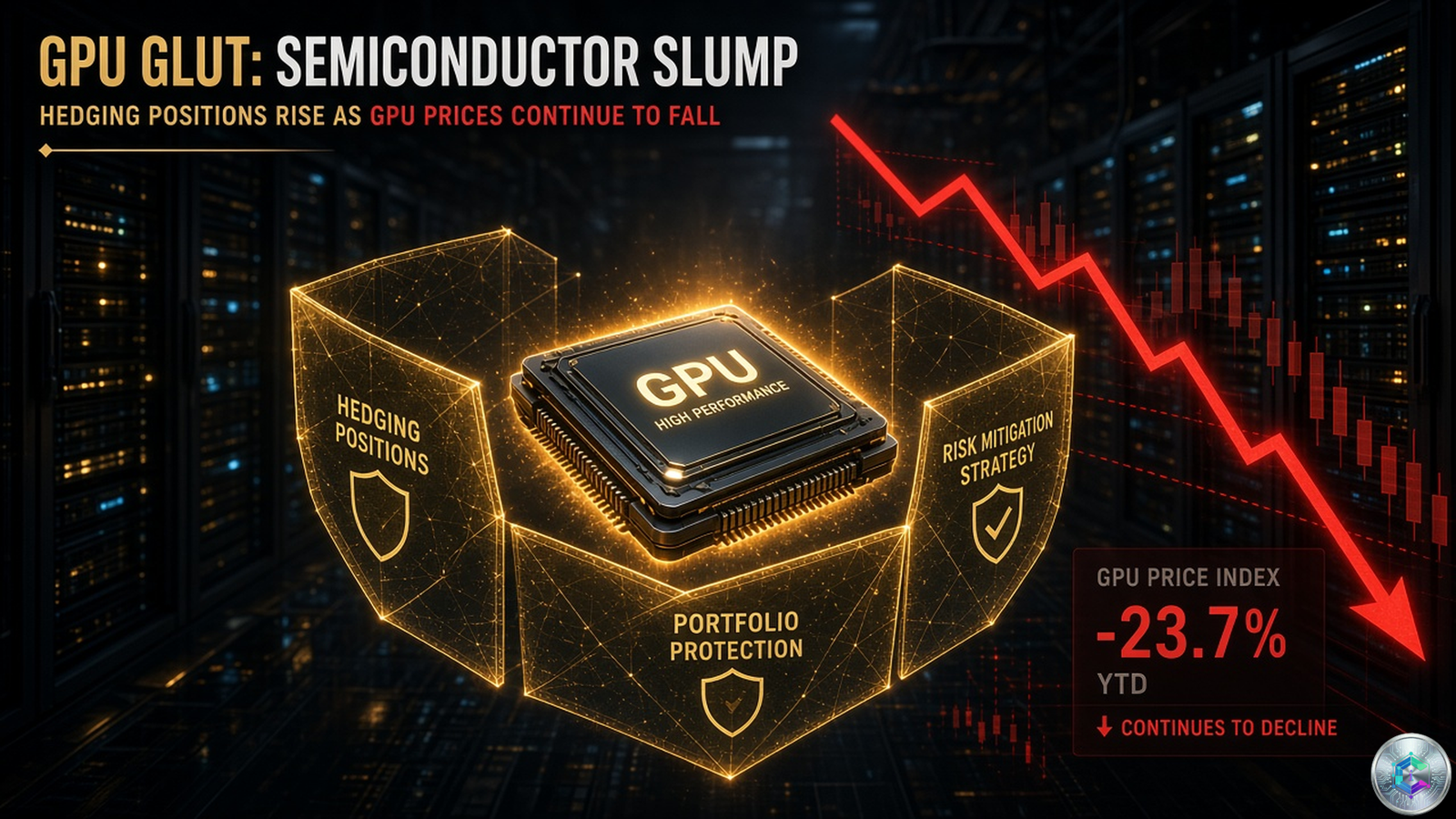
The financial trap is easy to reconstruct. An operator financing a GPU fleet on a five-year, $2-per-hour rate suddenly sees the spot market offering the same machine at $1.25. The hardware works perfectly, AI demand stays strong, yet per-hour revenue falls below the break-even point long before the equipment is paid off.
The situation echoes the headache faced by Bitcoin miners, who also commit heavy capital before knowing their revenue. The key difference: on Bitcoin, every miner runs the same hashing task, and the value of the work is identical for all. In AI, two clients can assign radically different values to access that looks identical on the spec sheet.
A customer committing to continuous access for twelve months is not buying the same service as a lab willing to see its jobs interrupted when the provider needs the machines. This value stratification complicates the construction of representative price indices — and therefore the design of effective hedges.
Luxor and CME Group: the pioneers of compute derivatives
Two players are positioning themselves on this emerging market. The first, Luxor, has a track record in financial services for Bitcoin miners. The company is now turning to AI with derivative contracts on compute prices, according to its statement to CryptoSlate.
The approach is that of an intermediary: Luxor links compute capacity owners with end clients while offering cash-settled derivative products. The market is still in its infancy: Luxor disclosed neither trading volume nor reference customer, a sign that no liquidity pool has formed yet.
The second player, CME Group, is betting on an exchange-traded version. On August 11, the platform announced futures contracts on H100 and B200 GPU rental indices, with a launch targeted for October 5, subject to regulatory approval. The contracts rely on GPU rental indices supplied by Silicon Data, a compute metrology specialist.
CME’s arrival, a reference venue for regulated derivatives, is a credibility signal. But launching a contract isn’t enough: the platform still needs enough operators and clients to converge on the instrument to drive liquidity.
The mechanism: bidirectional hedging
Compute derivatives rely on a payment indexed to a reference rate, with no physical exchange of capacity. An operator expecting to rent 1 million GPU hours per month at $2 per hour, generating $2 million in expected revenue, can sign a contract designed to protect that rate.
| Scenario | Reference index | Actual rental revenue | Derivative payout | Operator total |
|---|---|---|---|---|
| Stable | $2.00/h | $2,000,000 | $0 | $2,000,000 |
| Downside | $1.50/h | $1,500,000 | +$500,000 | $2,000,000 |
| Upside | $2.50/h | $2,500,000 | -$500,000 | $2,000,000 |
The contract works both ways: if the index rises to $2.50, the operator owes $500,000 to its counterparty while collecting more from its own customers. It gives up the upside in exchange for a floor. On the AI buyer side, a company fearing a spike in compute costs can take the opposite position: it gets paid when the index rises, helping cover heavier rental bills.
Basis risk and counterparty risk: the blind spots
Two structural risks could stall these new products. The first, basis risk, stems from the gap between the index being hedged and the price actually charged. If an operator negotiates at $1.25 while the reference index only drops to $1.50, the derivative’s $500,000 payout lifts real revenue from $1.25 million to $1.75 million — a gap remains despite a contract working as designed.
Index providers such as CCIR are trying to refine their methodology by isolating characteristics like interruptibility and commitment duration. But the figures rely on publicly listed rates, which don’t always reflect private discounts negotiated between hyperscalers and large clients.
The second risk is counterparty risk. Even a well-calibrated contract leaves the operator dependent on the other side’s ability to pay when rental revenue falls. If that counterparty also draws most of its revenue from AI infrastructure, lower compute prices can damage both companies at the same time — exactly when one expects support from the other. Collateral, required to offset this risk, creates an additional funding need: cash locked as margin can’t simultaneously pay current bills. Luxor has not published its AI collateral terms or described the procedure in case of default, leaving operators in the dark.
Conclusion: a derivatives market in search of liquidity
The arrival of AI compute derivatives responds to a real need: the 88% volatility observed on the H100 since January 2024 makes any GPU investment model risky without a hedging mechanism. Luxor is opening the way with an over-the-counter offering still in its infancy; CME Group is banking on standardization through regulated futures on H100 and B200 indices.
Success will hinge on the ability of reference indices to track prices actually paid by clients, and on the emergence of a diversified counterparty pool. Without that, compute derivatives will remain a theoretical tool, useful on paper but insufficient to reassure operators still hesitant to commit billions to new GPU fleets. In the short term, the depth of the CME market scheduled from October will serve as the first large-scale test.
Sources
This article is published for informational and educational purposes only. It does not constitute investment advice. Do your own research (DYOR) before making any decision.

