


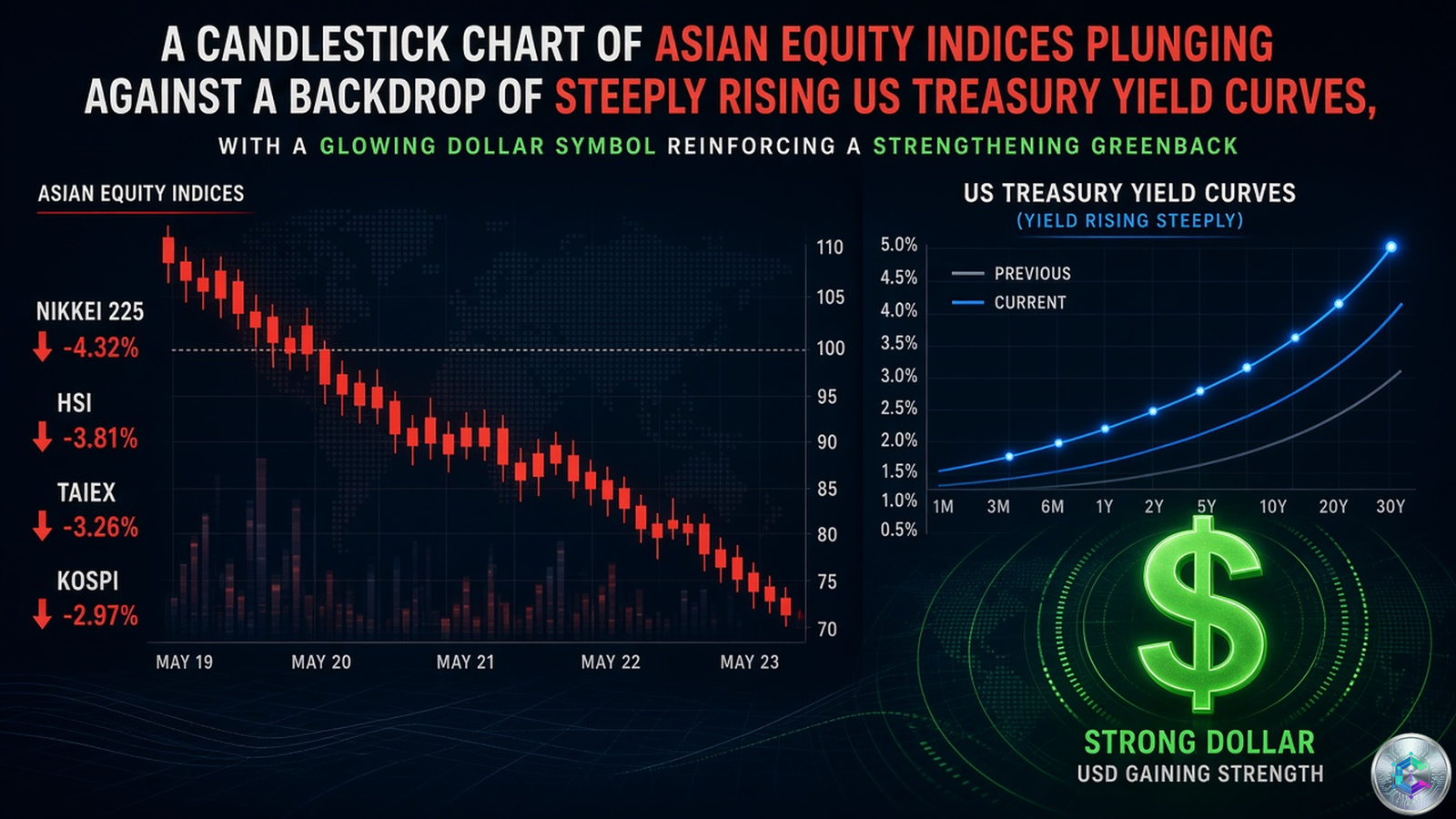
Asian equity markets closed in the red on Friday, October 2, roiled by violent swings in sovereign bonds and foreign exchange as investors repositioned ahead of the highly anticipated US nonfarm payrolls report. The US 10-year Treasury yield briefly hit 5.34% — its highest level since 2002 — before paring gains, while the euro sank below $1.13 and the yen remained under heavy pressure against a strengthening dollar.
🔑 Key takeaways
- MSCI Asia-Pacific ex-Japan falls 0.5% on Friday, on track for a 1.7% weekly loss.
- US 10-year yield touches 5.34%, highest since 2002, before easing to 5.25%.
- Euro drops to $1.1215, lowest since May 2025; the dollar index climbs to 102.09.
- France-Germany 10-year spread widens to 149 bps, widest since the 2012 eurozone debt crisis.
- Implied odds of an October Fed hike drop to 25% from 69% a week earlier.
Asia: Nikkei and Hang Seng under pressure, Shanghai still closed
It was a punishing session for Asian equity markets. The MSCI Asia-Pacific ex-Japan index shed 0.5% on the day and is on track for a weekly loss of 1.7%. In Tokyo, the Nikkei 225 fell 0.7%, though it still posts a weekly gain of +3.1% after Wednesday’s rally. Hong Kong bore the brunt of the move, with the Hang Seng dropping 2.7% on its reopening after a public holiday. Mainland Chinese exchanges (Shanghai and Shenzhen) remain shut until Wednesday for the Golden Week holiday.
| Index | Daily move | Weekly move |
|---|---|---|
| MSCI Asia-Pacific ex-Japan | -0.5% | -1.7% |
| Nikkei 225 (Tokyo) | -0.7% | +3.1% |
| Hang Seng (Hong Kong) | -2.7% | n.a. |
| Mainland China stocks | Closed | Closed |
Bonds: US 10-year flirts with 5.34%, France rattles Europe
The US Treasury market endured one of its wildest sessions of the year. The 10-year yield hit 5.34% early in the session — a level not seen since 2002 — after posting the largest quarterly gain in 32 years. It then retraced to 5.2512% in Asian trade. The 2-year yield, which had dropped 10 bps overnight, added 1 bp to 4.8039%. The 10-year itself rose 2 bps to 5.2575%, after touching 5.3445% the prior day, a 24-year high.
Across the Atlantic, the situation is even more strained for French debt. The spread between the French OAT and the German Bund at the 10-year tenor widened to 149 bps, the widest since the 2012 eurozone debt crisis. The French 10-year yield slipped 4 bps to 4.892%, while the benchmark German Bund fell 6.5 bps. Investors are piling into the relative safety of Bunds at the expense of the bloc’s more indebted sovereigns.
“The Fed is now myopically focused on inflation and price pressures; a hot wage number could prove particularly influential for US rates, Treasuries, and the dollar.”
Chris Weston, Head of Research at Pepperstone
FX: dollar reigns, euro at multi-month low, yen under pressure
The US dollar consolidated its safe-haven status. The dollar index (DXY), measured against a basket of six currencies including the euro and Swiss franc, stood at 102.09, up 0.6% overnight and at its highest since April 2025. It is heading for a third consecutive weekly gain (+1.1%). The euro fell to $1.1215, its lowest since May 2025, before rebounding to $1.1235. The single currency also weakened against the yen (-0.8%) and the Swiss franc (-1%).
The yen remained under pressure, trading around 158.13 per dollar, up 0.3% on the day. Tokyo’s core inflation data, released Friday, accelerated to 2.7% year-on-year in September, bolstering the case for another rate hike by the Bank of Japan. The widening monetary-policy gap between the Fed and the BoJ continues to weigh on the Japanese currency.
Oil and US jobs: two releases that could move everything
Crude prices remained supported by Middle East tensions: the United States has reinforced its military presence in the region while China has suspended exports of refined petroleum products. US WTI traded at $92.84 a barrel, steady after a nearly 3% jump overnight, while Brent held above $102. Other sources cite WTI closer to $89.69 and Brent around $100, illustrating the intraday volatility.
All eyes are now on the US nonfarm payrolls report due later in the session. Consensus expects 90,000 jobs added in September with the unemployment rate steady at 4.1%. Average hourly earnings will be especially closely watched after the latest ISM survey showed a sharp rise in prices paid, flagging fresh cost pressures.
Rate markets have already started to recalibrate: implied odds of an October Fed hike have collapsed to just 25% from 69% a week earlier, following relatively dovish remarks from two Fed officials. A December move, however, remains fully priced in by traders.
“I would not call it a crisis yet, but it looks like something that has the potential to become one. If this continues for a few more weeks, we will be talking about a bond market crisis.”
George Lagarias, Chief Economist at Forvis Mazars
Europe and US futures: a technical bounce ahead of the data
European equities tried to bounce in early trade, with the Stoxx 600 up 0.8% even though the index is still on track to lose roughly 1% on the week. US futures tracked the move: Nasdaq +0.3% (up to +0.7% on some feeds) and S&P 500 +0.1% (up to +0.4%), buoyed by the retreat in Treasury yields after Wall Street’s late-session rebound on Thursday.
The geopolitical backdrop remains a major risk factor. The renewed tensions between the United States, Israel, and Iran continue to support energy prices, complicate the inflation trajectory, and strain already-fragile public finances. In Japan, long-term yields have hit multi-decade highs, a reminder that the global monetary normalization cycle is far from painless.
Conclusion: a Friday stress test for the Fed and the euro
Friday’s session promises to be decisive. A stronger-than-expected US jobs print could reignite pressure on Treasuries, the dollar, and risk assets, pushing the 10-year yield back above 5.30%. Conversely, a soft number would confirm the Fed’s implicit pivot already priced into money markets and offer relief to global equities. In Europe, the trajectory of the OAT-Bund spread remains in focus: a sustained move beyond 150 bps would tip the situation into the bond-crisis territory flagged by several economists. For traders, the challenge is now to calibrate the scenario of a “higher for longer” Fed against a global economy showing increasingly visible imbalances.
Sources
- Reuters – Global markets wrapup, October 2, 2026
- Yahoo Finance – Asian shares fall on wild swings in bonds, FX
- Global Banking and Finance – Asian shares fall on bond, FX swings
- Business Recorder – Asian shares fall before US jobs data
- DevDiscourse – Global markets, Asian shares fall
- TradingView – Reuters wrap, Asian shares fall
This article is published for informational and educational purposes only. It does not constitute investment advice. Do your own research (DYOR) before making any decision.

