


Government bond yields have surged to multi-decade highs across global markets, as U.S.-Iran conflict in the Strait of Hormuz revives inflationary pressures and challenges the anticipated trajectory of central bank policy rates.
🔑 Key Takeaways
- The U.S. 10-year yield reached 4.7880%, a 20-month high
- Brent crude rose 2.2% to $92.38 per barrel
- UK 10-year gilt yield hit 5.2341%, highest since June 2008
- German 10-year bund set a new 52-week high at 3.3546%
- Markets now price in at least one Fed rate hike by year-end
Synchronized Global Bond Yield Surge
Bond yields climbed sharply across major markets on Tuesday, with borrowing costs in Japan and the UK reaching multi-decade records, while U.S. Treasury yields soared. In the United States, the 10-year Treasury yield rose to a 20-month high of 4.7880%, gaining three basis points. The policy-sensitive 2-year yield stood at 4.28%, just below the war-era peak of approximately 4.30% established days earlier. This yield sits well above the Fed’s target range of 3.50 to 3.75%, a clear signal that markets anticipate rate hikes ahead.
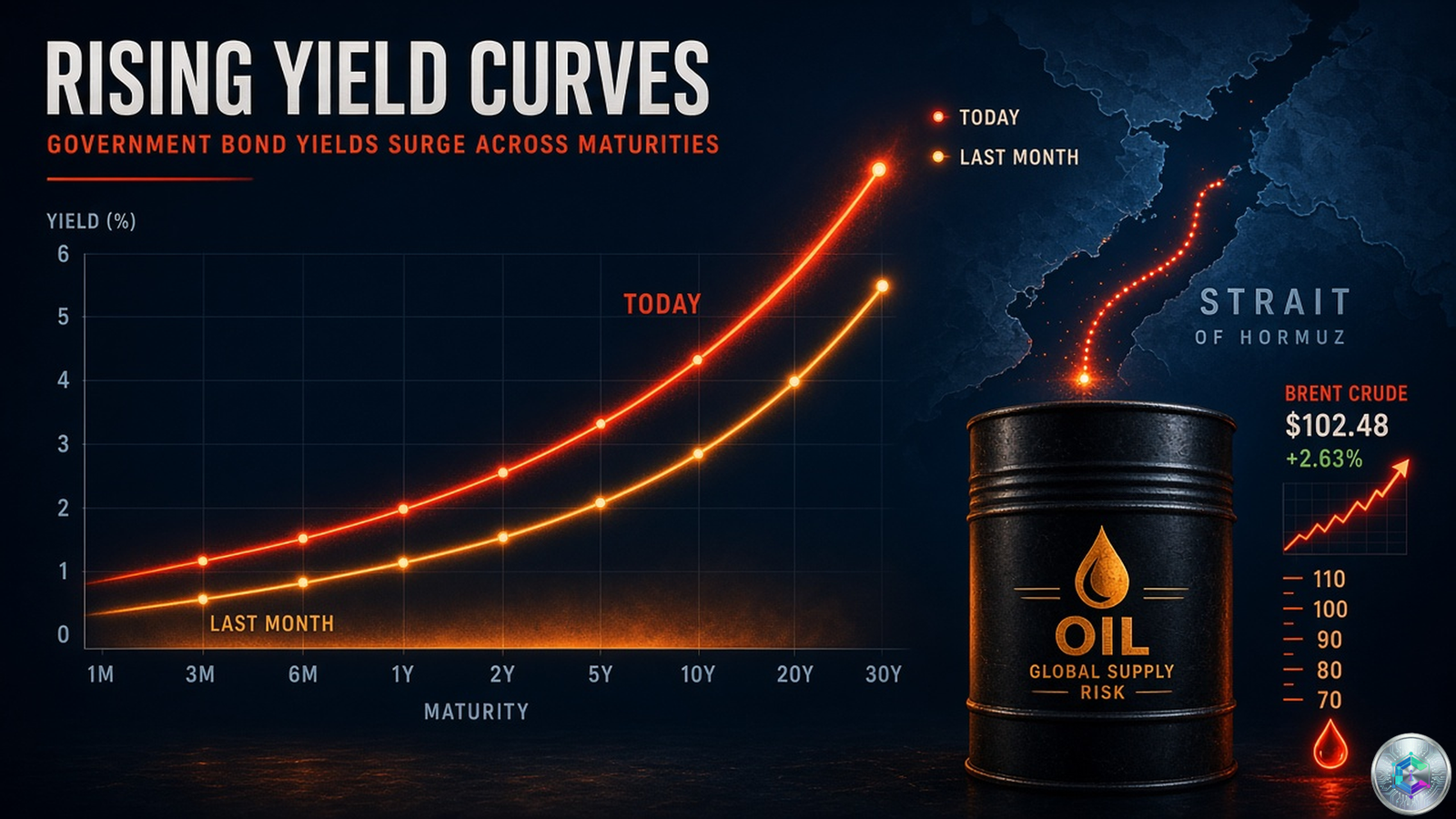
In Europe, the German 10-year bund yield gained more than three basis points to 3.3546%, establishing a new 52-week high. The 2-year bund reached 2.9496%, its highest since July 2024. In the UK, the 10-year gilt yield climbed more than nine basis points to reach 5.2341%, its highest level since June 2008 during the global financial crisis. The 30-year gilt yield soared to 5.8856%, its highest since March 1998. In China, the 10-year sovereign yield crossed the 3% threshold for the first time since 1996.
| Market | 10-Year Yield | Highest Since |
|---|---|---|
| United States | 4.7880% | 20 months |
| Germany | 3.3546% | 52 weeks |
| United Kingdom | 5.2341% | June 2008 |
| France (2-year) | Since April 2024 | — |
U.S.-Iran Escalation Drives Oil Prices Higher
This surge in borrowing costs follows U.S. and Iranian retaliatory strikes in the Strait of Hormuz over recent days, pushing energy prices higher and bringing inflationary pressures back to the forefront of investor concerns. Brent, the global oil benchmark, traded approximately 2.2% higher at $92.38 per barrel, while WTI crude futures rose 2.61% to $88.05.
“The six-month conflict, combined with a Supreme Court ruling on tariffs that would have removed approximately 40% of additional tariff revenues, added to the pressure on bonds.”
Steve Englander, Standard Chartered
Steve Englander, head of G10 FX research and North America macro strategy at Standard Chartered, told CNBC’s “Squawk Box Europe” that yields along the curve would remain under upward pressure. U.S. Treasury Secretary Scott Bessent dismissed concerns about rising U.S. yields during an interview with CNBC on Monday. Speaking on the sidelines of the G20 finance ministers’ meeting in Asheville, North Carolina, Bessent stated that the U.S. bond market remained “the best-performing market” globally.
“I think ‘best performing,’ as Bessent said, is not the same as ‘performing well.’ Everyone has a deficit problem — I don’t think there’s any reason to celebrate.”
Steve Englander, Standard Chartered
Strait of Hormuz: A Strategic Chokepoint Under Pressure
Geopolitical tensions between the U.S. and Iran intensified in early February, when strikes against Iran began, reversing a downward trend in yields. The collapse of the U.S.-Iran peace agreement and the resumption of military strikes in the Gulf region have revived the bond market’s focus on inflationary risk. The U.S. military carried out its eleventh consecutive day of attacks against Iran on Tuesday.
Secretary of State Marco Rubio stated that the U.S. remained open to diplomacy but that attacks would continue if Iran persisted in its efforts to control shipping through the Strait of Hormuz, a strategic point for Middle Eastern energy exports. President Trump also indicated this week that he was prepared to intensify U.S. military action by bombing Iranian nuclear facilities again. The risk of a wider war further restricting oil shipments intensified after Houthi rebels in Yemen threatened to block vessels transiting from Saudi Arabia through the Bab al-Mandab Strait, south of the Red Sea. Approximately 4% of global oil shipments are at stake, according to consulting firm Kpler.
Outlook for Central Banks and Markets
Short-term inflation expectations have recently recovered, but medium and long-term expectations have only modestly increased, suggesting the Federal Reserve does not need to tighten its monetary policy significantly at this time. The federal funds futures market does not anticipate any rate changes at the next monetary policy meeting on July 29, but at least one rate hike is now priced in for the remainder of the year.
The conflict and rising oil prices have also influenced monetary policy expectations for the European Central Bank and the Bank of England, both of which could raise rates in the coming months in response to expected higher inflation in Europe. In the euro area, the environment remains volatile. According to the European Commission’s Spring 2026 Economic Forecast baseline scenario, growth is expected to slow to 1.1% and inflation to average 2.7% in 2026-2027, driven by energy prices and relatively rapid normalization of supply conditions.
“Two external risks dominate the outlook and could mutually reinforce each other: prolonged geopolitical tensions and a brutal reallocation of U.S. assets in a context of high uncertainty.”
European Commission, Spring 2026 Economic Forecast
In an adverse scenario, the eurozone could slip into recession with growth of 0.1% and inflation of 3.6% on average over the same period. The rise in UK borrowing costs comes as British Prime Minister Andy Burnham is expected to tell legislators that increased public oversight was the only solution to revive the country’s growth. Burnham is considering legislation to facilitate the renationalization of struggling utility companies.
Conclusion
The synchronized rise in bond yields across developed markets reflects growing investor concerns about states’ fiscal sustainability and the potential impact of a prolonged geopolitical conflict on global inflation. With the Fed potentially forced to maintain a restrictive stance longer than expected and the ECB caught between the hammer of weak growth and the anvil of imported inflation, central banks are navigating treacherous waters. The resolution of the Middle East crisis will largely determine the trajectory of bond markets in the coming months. Investors will need to carefully assess their exposure to long-duration assets and monitor oil price movements as a leading indicator of inflationary pressures.
Sources
- CNBC – Bond Yields Soar as Iran Tensions Revive Inflation
- Yahoo Finance – U.S. Stocks Tumble as Bond Yields Rise
- Investing.com – Iran Tensions Revive Inflation Worries
- Charles Schwab – Bond Market, Iran and Inflation
- ESM – Euro Area: Volatile World, Resilience Under Strain
This article is published for informational and educational purposes only. It does not constitute investment advice in any way. Conduct your own research (DYOR) before making any decisions.

