


Georgia ranks among the U.S. states most exposed to President Trump’s second-term tariff regime, having paid $20.1 billion between early 2025 and June 2026.
🔑 Key takeaways
- Georgia paid $20.1B in tariffs, equivalent to $4,771 per household.
- The Supreme Court struck down IEEPA-based tariffs in February 2026 (6-3 ruling).
- Georgia-headquartered firms have claimed or received $1.5B in refunds.
- National refund pool: $166B, with $127B realistically eligible via CAPE.
- Capital Economics projects inflation could climb to 4.5% by late 2025.
A frontline state in the tariff war
According to an analysis by Trade Partnership Worldwide, compiled by the National Taxpayers Union Foundation and reported by Axios, Georgia paid $20.1 billion in tariffs linked to Trump’s trade measures between January 2025 and June 2026. On a per-household basis, the burden amounts to roughly $4,771 — among the highest figures in the country relative to state size.
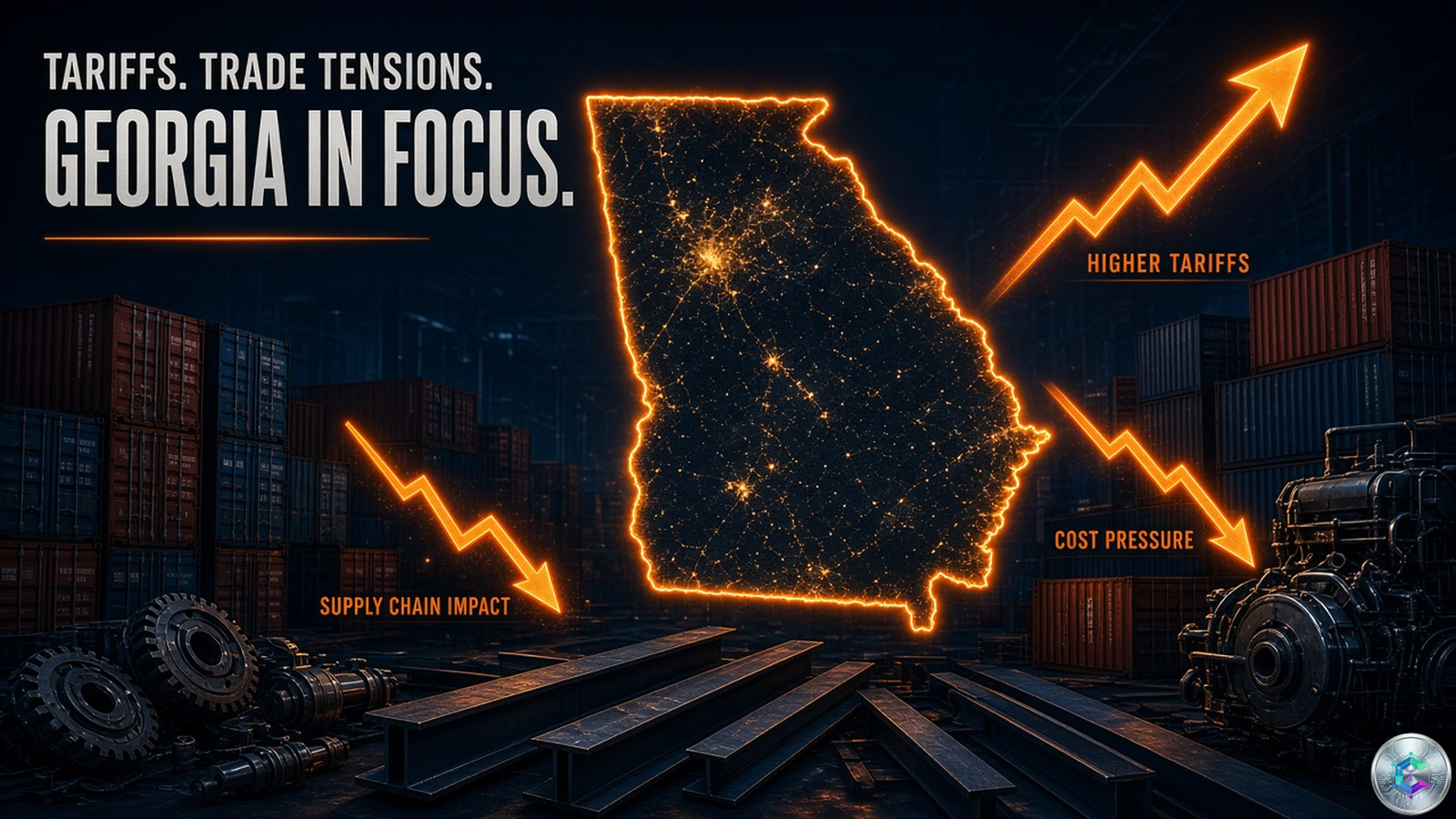
The state’s industrial makeup explains this exposure. Automotive manufacturing, deeply embedded in Georgia, is among the most penalized sectors. Nationally, duties on vehicles, parts, steel, aluminum and copper have pushed new-car prices up by more than 8%, according to the Yale Budget Lab. Bank of America estimates the bill could reach $10,000 per vehicle if automakers fully pass through tariff costs to end consumers.
Supreme Court ruling reopens the refund window
The legal turning point came in February 2026, when the Supreme Court struck down the bulk of the IEEPA-based tariffs in a 6-3 ruling. Following the decision, Georgia-headquartered public companies have requested or secured refunds totaling $1.5 billion, according to the Atlanta Journal-Constitution.
| Company | Refund requested or received |
|---|---|
| Home Depot | $730M |
| UPS | $500M |
| Carter’s | $132M |
Nationally, importers can now claim approximately $166 billion in duties declared unconstitutional. On April 20, 2026, U.S. Customs and Border Protection opened the CAPE portal (Consolidated Administration and Processing of Entries) to process these claims. Of that total, $127 billion is realistically eligible under the initial CAPE deployment. Legal interest accrues at roughly $650 million per month, according to the U.S. Court of International Trade, with refunds expected within 60 to 90 days provided claims are clean.
“That is a significant amount.”
Ernie Tedeschi, Director of Economics, Yale Budget Lab
Household pressure and lurking inflation
American families have shouldered nearly a year of price increases on groceries, electronics, apparel and shipping, costing an average of about $1,700 per household according to the Joint Economic Committee. The Yale Budget Lab pushes the estimate to $3,800 in lost annual purchasing power, once all tariff policies and foreign retaliatory measures are factored in.
Apparel and footwear, overwhelmingly produced in China, Vietnam, Sri Lanka and Bangladesh, are projected to rise by 10% to 20%. Under Trump’s “reciprocal” duties, Chinese imports face a 34% levy, lifting the effective rate to at least 54% once existing 20% tariffs are included. Vietnam is taxed at 46%, Sri Lanka at 44% and Bangladesh at 37%.
“It is disastrous for the garment industry worldwide, but especially for the small countries specialized in apparel manufacturing.”
Denise Green, Associate Professor at Cornell University
On inflation, Capital Economics projects a jump to 4.5% by late 2025, versus 2.8% in February. The White House disputes those projections. Spokesperson Kush Desai dismissed the models as “alarmist” and insisted that “the predictions of alarmist experts did not materialize during President Trump’s first term.”
The Ottawa-Washington standoff and rebate bills
Canada retaliated by imposing, effective September 8, tariffs of up to 50% on roughly $20 billion of U.S. goods, targeting steel, aluminum, machinery, electronics, lumber and dairy. Georgia exports $6.8 billion annually to Canada, of which 36% is machinery and equipment (plastics, refrigeration equipment, paper, carpets, tractors, aircraft components, automobiles). Prime Minister Mark Carney has pledged to escalate the response; Trump has threatened additional duties on Canadian vehicles and steel starting January 1.
In Congress, several bills aim to redistribute refunds to consumers. The Speedy Tariff Refund Act, led by Senators Wyden, Markey and Shaheen, remains stalled in committee. Senator Heinrich’s Tariff Refunds for Working Families Act proposes $1,200 per married taxpayer earning under $180,000, plus $600 per child. Representative Cuellar is pushing for $231 billion in direct payments through the American Consumer Tariff Rebate Act.
Trump himself floated two rebate programs — a “tariff dividend” of $2,000 per person (estimated cost: $450B) and a “DOGE dividend” of $5,000 per household later trimmed to $380 — before abandoning both. In an April 21 CNBC interview, he urged companies to forgo refunds, warning: “If they don’t do that, I will remember them.” Apple, Amazon and Walmart did not file claims, even though Citi estimates Walmart’s potential refund at $10.2 billion, Target’s at $2.2 billion and Nike’s at $1 billion.
Conclusion: partial relief, lasting uncertainty
The base case combines mechanical price relief in sectors where refunds materialize with renewed inflationary pressure on goods still covered by residual duties (Section 301, Section 122). The political push for direct household checks — revived by Democrats and a handful of Republicans such as Josh Hawley — still lacks a majority. Looking further out, Ernie Tedeschi warns that some price increases “can take up to five years to fully show up,” keeping the inflation trajectory firmly tied to White House decisions and federal court rulings.
Sources
- Axios — Georgia’s $20B tariff bill
- Moneywise — $166B tariff refunds
- CNBC — Trump trillion-dollar tariffs
- NBC New York — Most exposed goods
- KCRA — States hit by Canada tariffs
This article is for informational and educational purposes only. It does not constitute investment advice. Do your own research (DYOR) before making any decision.

