


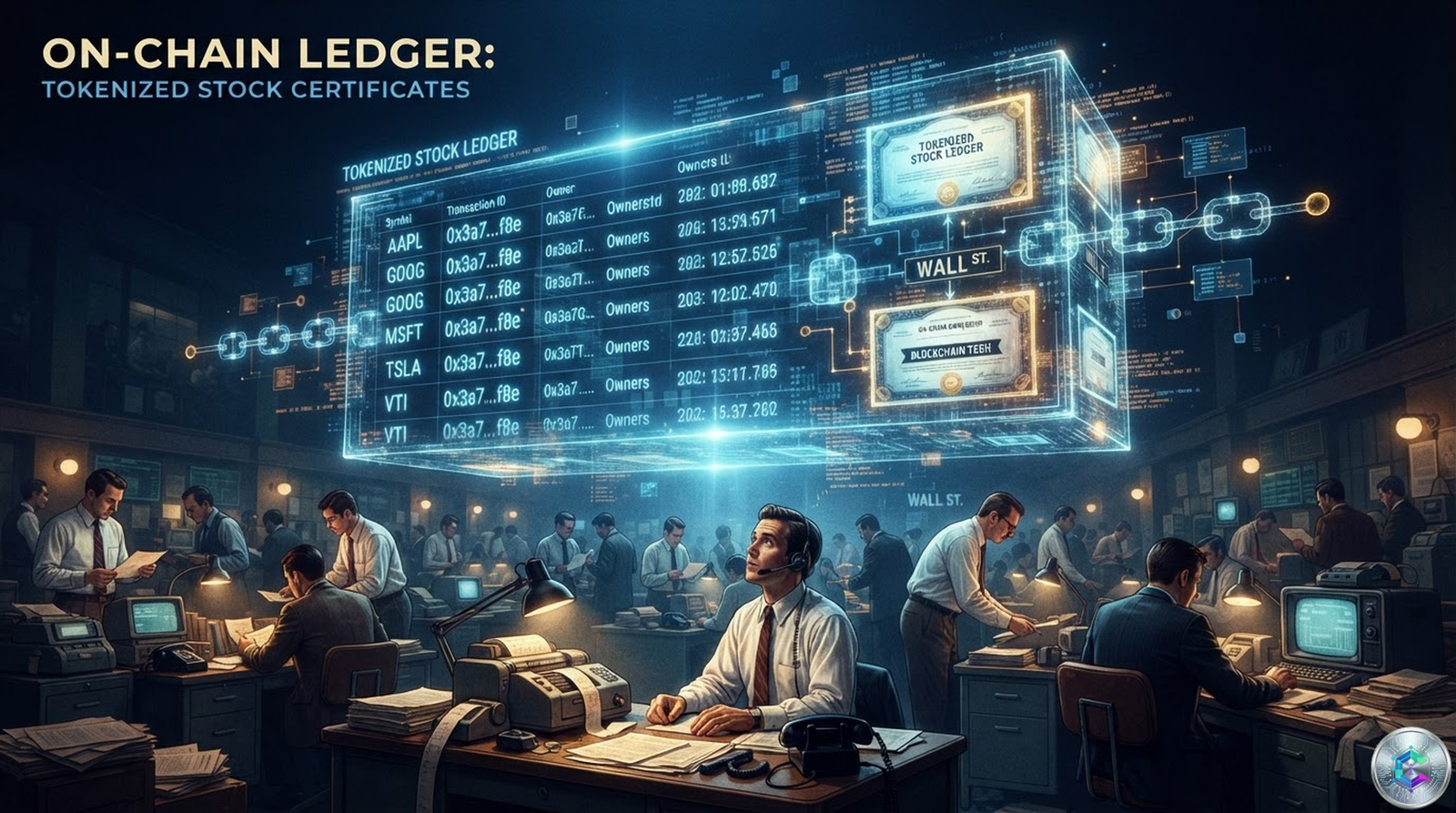
The tokenized stocks market, now worth roughly $2 billion, risks recreating a digital version of the paper certificate crisis that paralyzed Wall Street in the late 1960s. Joris Delanoue, CEO of Fairmint, an on-chain securities infrastructure provider, is raising the alarm before fragmentation turns into systemic failure.
🔑 Key takeaways
- The global tokenized stocks market reached about $2.4B on Aug 19, 2026, up from under $500M at end of Q1.
- Fairmint’s CEO warns of a “digital paper crisis” echoing the 1968 settlement breakdown.
- July trading volumes jumped +288% but remain heavily concentrated on a single Nasdaq 100 product, QQQB.
- Interoperability between exchanges, transfer agents and on-chain registries remains the sector’s main friction point.
- The SEC has not yet issued its innovation exemption, and Robinhood cannot offer Stock Tokens in the US.
A historical parallel with the 1968 crisis
In the 1960s, the surge in US equity trading overwhelmed a market still reliant on clerks handling paper stock certificates. Back offices fell behind, certificates went missing, and settlement failures piled up. The New York Stock Exchange was even forced to close on Wednesdays for part of 1968 to let firms catch up. The crisis ultimately triggered a complete overhaul of post-trade infrastructure, including the creation of centralized securities depositories and the Depository Trust Company.
“The main question today is whether we are recreating the paper crisis, but as a digital crisis.”
Joris Delanoue, CEO of Fairmint
According to Delanoue, the same ingredients are present again: explosive volume growth combined with fragmented registries split across exchanges, special purpose vehicles (SPVs), token wrappers and proprietary platforms. Distribution has been prioritized over record-keeping and compliance.”
The central question of legal ownership
For Fairmint’s CEO, the immediate danger is not the technology itself but the fragmentation of ownership registries. As tokenized stocks multiply, exchanges, SPVs and proprietary ledgers risk producing divergent versions of the same accounting truth.
“A token is not equity, but equity can be a token. When equity is a token, that token has the same protections, guarantees and trust that you had in the previous system.”
Joris Delanoue, CEO of Fairmint
This nuance matters: several tokenized stock products only offer economic exposure to an underlying share, not legal ownership. If the issuer or SPV collapses, the investor can lose voting rights, dividends and any priority claim on assets. The promise of on-chain transparency disappears as soon as the legal link between token and underlying equity is unclear.
A growing but fragile market
The global tokenized stocks market has surged from under $500M at end of Q1 2026 to about $2.4B on Aug 19, 2026, according to figures cited by BeInCrypto. The number of holders rose +101% to 1.4 million, while monthly transfer volume hit $24.3B.
| Metric | Value | Change |
|---|---|---|
| Distributed value of tokenized stocks | $2.4B | +6.6% over 30 days |
| Number of holders | 1.4 million | +101% |
| Monthly transfer volume | $24.3B | — |
| July trading volumes | — | +288% |
| July volume ex-QQQB | $2.03B | -30% vs June |
Yet this growth masks extreme concentration. According to SoldiOnline, a large share of activity flows through a single token backed by the Nasdaq 100: QQQB. Without it, monthly equity token volumes would have fallen to roughly $2.03B, about 30% below June. Such reliance on a single product is a further warning sign of market maturity.
Global demand for US equities
“People have underestimated the global demand to efficiently own a piece of an American company, and even more so the Magnificent Seven stocks.”
Joris Delanoue, CEO of Fairmint
The Magnificent Seven (Apple, Microsoft, Alphabet, Amazon, Nvidia, Meta, Tesla) crystallize that appetite. Providers including xStocks, Robinhood and Dinari have scrambled to serve it. But for Delanoue, distribution is not the issue: what investors actually own after buying a token is.
Interoperability, the sector’s central challenge
Fairmint’s CEO warns against closed ecosystems in which crypto exchanges, traditional venues and infrastructure providers each maintain their own standards. This fragmentation directly threatens smaller players.
“If they don’t solve interoperability, fragmentation will kill the smaller players.”
Joris Delanoue, CEO of Fairmint
Fairmint has open-sourced its on-chain securities standard so trading systems, issuers, broker-dealers and transfer agents can connect to it. The company itself acts as a SEC-registered transfer agent, with the blockchain serving as the authoritative shareholder registry. It claims more than $1.6B in equity processed natively on-chain since 2019.
According to Delanoue, the opportunity mirrors what Wall Street faced after the paper crisis: building shared infrastructure that competing market participants can rely on. The difference is that the previous solution was centralized; blockchain offers the chance to build a distributed foundation — provided the sector agrees on shared standards before fragmentation itself becomes a systemic crisis.
Regulatory lag in the US and Europe
European authorities have also flagged the risks of tokenized stocks. According to Marketscreener, the relevant European regulator warned that such products risk creating misunderstandings among investors, since some offerings provide only economic exposure without the rights attached to actual shares.
On the US side, the situation remains in limbo. The SEC has not yet issued its innovation exemption for tokenized stocks. Vlad Tenev, CEO of Robinhood, called the absence of Stock Tokens in the US the “most obvious gap” in his company’s tokenization strategy.
| Platform | Distributed value | Assets |
|---|---|---|
| Ondo | $882.9M | — |
| xStocks | $561.7M | — |
| bStocks | $532.2M | — |
| Robinhood | $32.2M | 191 |
Robinhood, the world’s sixth-largest tokenized stocks player with $32.2M across 191 assets, cannot therefore offer its Stock Tokens on its home market. If Washington delays clarifying the regulatory framework, the US risks letting other jurisdictions capture both institutional and retail demand.
Conclusion: avoiding the crisis before it forms
The tokenized stocks market is entering a decisive phase. With $2.4B in distributed value and trading volumes up +288% in July, momentum is real but maturity is lagging. Concentration on QQQB, opaque SPV structures and the absence of an interoperability standard are sketching the contours of a potential systemic crisis.
Two scenarios emerge. In the optimistic one, the sector agrees on common standards and pushes regulators to publish clear exemptions, turning tokenization into a transparent, interoperable infrastructure layer. In the pessimistic one, the “paper crisis” of the 1960s repeats in digital form: fragmented registries, legal ownership conflicts and a collapse in trust. The window to choose is narrow, and the next growth cycle will be measured as much by infrastructure quality as by volumes.
Sources
- CoinDesk — Tokenized stocks risk repeating Wall Street’s 1960s paper crisis
- Yellow.com — Azioni tokenizzate spiegate
- Marketscreener — European regulator warning on tokenized stocks
- BeInCrypto — Robinhood CEO on tokenized US stocks gap
- University thesis — Giannetti Alessandro (Unipd)
- SoldiOnline — July market signals
This article is for informational and educational purposes only. It does not constitute investment advice. Do your own research (DYOR) before making any decision.

