

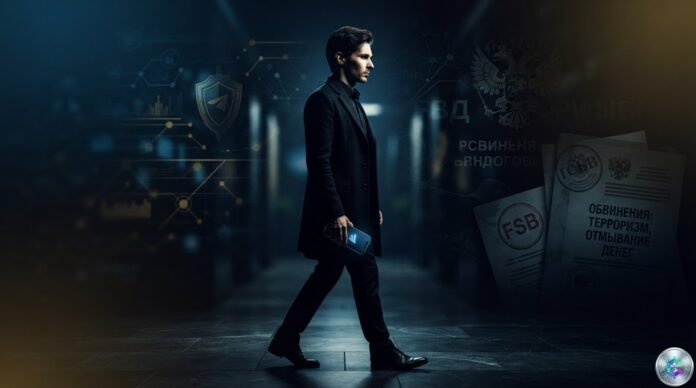
Russia’s Federal Security Service (FSB) has indicted Pavel Durov, founder and owner of Telegram, for facilitating terrorist activities and issued an international arrest warrant against him — a major legal escalation amid the Ukraine conflict and a prolonged block of the messaging app in Russia.
🔑 Key takeaways
- The Russian FSB indicted Pavel Durov on July 29, 2026 under Article 205.1 of the Russian Criminal Code (« facilitation of terrorist activity »).
- An international arrest warrant has been issued against the Telegram founder, currently based in Dubai.
- Telegram has been blocked in Russia since August 2025; cumulative fines exceed 100 million rubles (~$1.26M).
- Durov is also facing a French proceeding since his arrest at Paris-Le Bourget airport in August 2024.
- If convicted in Russia, he faces life imprisonment.
An indictment for « facilitating terrorist activity »
According to Interfax news agency, the FSB announced on Wednesday, July 29, 2026, that it had formally indicted Pavel Durov as part of a criminal investigation opened under part one of Article 205.1 of the Russian Criminal Code. This charge, which covers « facilitation of terrorist activity, » carries a maximum penalty of life imprisonment if the defendant is found guilty.
In an official statement, the FSB accused Telegram’s management of failing to remove numerous channels, chat groups, and bots that allegedly « were actively used by Ukrainian intelligence services, terrorist and extremist organizations to plan and coordinate acts of sabotage and terrorism, mass killings, and computer fraud » in Russia.
« Ukrainian security services used a popular dating chatbot on Telegram to lure and recruit Russians for sabotage and terrorism activities. »
FSB, statement of July 29, 2026
The agency claims these activities caused « numerous human casualties, » including women and children, as well as « material damages estimated in the billions of rubles. » According to the FSB, 46 users of this dating chatbot, aged 12 to 22, have been arrested across Russia since July 2025 for assaults on law enforcement, arson, and other offenses. Last week, the U.S. National Security Advisor had separately warned that teenagers were being recruited on Telegram to carry out attacks in Russia.
Telegram and Durov’s response
Telegram did not immediately respond to requests for comment. However, shortly after the arrest warrant announcement was published, Telegram’s official X account posted an image of Pavel Durov making an obscene middle-finger gesture, signaling an openly defiant stance toward Russian authorities.
This stance is not new. In late February 2026, in a message concerning the opening of the Russian criminal investigation, Pavel Durov stated:
« Every day, the authorities invent new pretexts to restrict Russians’ access to Telegram, seeking to suppress the right to privacy and freedom of expression. A sorry spectacle of a state that fears its own population. »
Pavel Durov, February 2026
In April 2026, Mr. Durov posted on Telegram that a summons for « suspect PV Durov » had been delivered to an apartment in Russia where he had lived 20 years earlier. « They must suspect me of defending Articles 29 and 23 of the Russian Constitution, which guarantee freedom of expression and the right to correspondence privacy. Proud to be guilty! », he wrote.
Telegram blocked in Russia and cumulative fines
Russia began restricting Telegram’s operations in the country in August 2025. The app currently does not function without a VPN or other circumvention tools. Kremlin spokesman Dmitry Peskov stated on July 27, 2026, that contacts with Telegram regarding the restoration of its operations existed, but that the app’s own representatives had not been very active in this dialogue.
Since the start of 2026, Russian courts have imposed more than 100 million rubles in fines on Telegram (approximately $1.26 million, €1.1 million), according to law enforcement sources cited by Interfax. These penalties were primarily imposed for non-compliance with Russian content legislation.
Biographical context and parallel proceedings
Pavel Durov, born in Russia but now based in Dubai, founded Telegram with his brother Nikolai in 2013. The platform currently has more than one billion users and is widely used on both sides of the Russia-Ukraine conflict, making its moderation particularly sensitive. Durov had previously founded VKontakte, Russia’s leading social network, before selling his stake in 2014 under pressure from the authorities and leaving Russia that same year.
Mr. Durov holds French and Emirati citizenship. He is also facing a French proceeding since his arrest at Paris-Le Bourget airport on August 24, 2024. On August 28, 2024, he was formally placed under investigation on twelve charges, including complicity in distributing child sexual abuse material and drug trafficking on Telegram due to insufficient moderation. Released under judicial supervision with a €5 million bail and a ban on leaving France, he subsequently had his travel restrictions fully lifted in November 2025.
Comparison of judicial proceedings against Pavel Durov
| Proceeding | Jurisdiction | Key date | Main charge | Status |
|---|---|---|---|---|
| FSB (Russia) | Russia | July 29, 2026 | Facilitation of terrorist activity (Art. 205.1) | International arrest warrant issued |
| French investigation | France | August 24, 2024 | Complicity in CSEM distribution, drugs | Formally investigated, travel ban lifted Nov. 2025 |
| Telegram block | Russia | August 2025 | Non-compliance with content legislation | App blocked, +100M RUB in fines |
What impact for the crypto and Web3 ecosystem?
Although the Russian indictment focuses on terrorism charges rather than cryptocurrencies directly, the case has implications for the crypto ecosystem. Telegram has long been a major hub for crypto communities, ICOs, and more recently for projects tied to The Open Network (TON), the blockchain originally linked to the messenger. The prolonged block in Russia is already depriving many users of an essential channel to access these services. The personal targeting of Durov could also intensify regulatory pressure on messaging platforms hosting crypto activities, while the European Union finalizes its DMA (Digital Markets Act) and MiCA frameworks.
For Russian users, the situation reinforces dependence on VPNs and alternative messengers — a terrain on which some decentralized protocols are seeking to position themselves. For Durov, the combined French and Russian proceedings, combined with the prospect of life imprisonment if convicted, make this one of the most consequential legal files ever opened against a tech executive.
Conclusion
The FSB’s indictment of Pavel Durov marks a new stage in the confrontation between Moscow and Telegram, against the backdrop of the war in Ukraine and content moderation tensions. While the international arrest warrant risks seriously complicating the Telegram founder’s travel, its effective execution will depend on the judicial cooperation of the countries where he travels — including France and the UAE — and on the evolution of the geopolitical context.
In the short term, Russian Telegram users will continue to depend on VPNs, while the parallel French proceedings remain a factor of legal uncertainty for Durov. In the medium term, this case could accelerate the migration of crypto communities and sensitive communications toward truly decentralized alternatives, redrawing the map of messaging platforms worldwide.
Sources
- The Block
- Wikipedia — Arrest and indictment of Pavel Durov
- Meduza
- Deutsche Welle (DW)
- Canberra Times
- Yahoo Finance
This article is published for informational and educational purposes. It does not constitute investment advice. Do your own research (DYOR) before making any decisions.

