

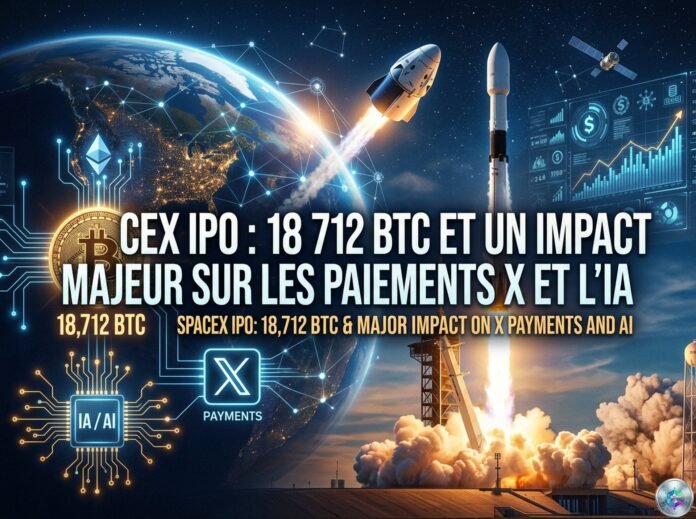
SpaceX’s S-1 filing, submitted on May 20, 2026, resolves years of speculation about Bitcoin holdings while detailing a vertically-integrated tech conglomerate spanning orbital data centers to X Payments, with profound implications for crypto markets.
🔑 Key Takeaways
- SpaceX holds 18,712 BTC with a market value of approximately $1.29 billion.
- X Payments, launched in beta in November 2025, threaten crypto wallets and stablecoins.
- A $45 billion AI compute deal with Anthropic over three years.
- Combined valuation of $1.25 trillion after the xAI acquisition.
The Numbers Behind the Filing
SpaceX aims to raise capital in what is expected to be the largest IPO in history. The company has confidentially filed with the SEC and is targeting a June 8 roadshow start, with Goldman Sachs as lead underwriter alongside Morgan Stanley, Bank of America, Citigroup, and JPMorgan Chase.
Financial results from the prospectus reveal a company in aggressive growth mode — still burning cash at scale. Q1 2026 revenue came in at $4.69 billion, up 15% year-over-year, while full-year 2025 revenue reached $18.67 billion, a 33% increase. But net losses persist: $4.28 billion in Q1 2026 and $4.94 billion for the full year 2025.
The capital expenditure picture tells the real story. Q1 2026 CapEx exceeded $10 billion — more than double the year-prior level — with $7.7 billion earmarked for artificial intelligence. AI cost of revenue climbed 29% in 2025 to $2.18 billion, while R&D costs for AI surpassed $5 billion, representing a more than 300% increase. That R&D bucket includes $1.67 billion in GPU depreciation and $1.44 billion in infrastructure and cloud expenses. Contractual commitments for 2026–2027 total $25.45 billion, with 95% allocated to AI infrastructure.
The combined entity — including Starlink, xAI, and X — was valued at $1.25 trillion following the xAI acquisition in February 2026. Bloomberg subsequently reported a revised valuation of $2 trillion or higher, with a fundraising target of up to $75 billion. If completed, the offering would surpass Saudi Aramco’s $29 billion 2019 debut as the largest IPO in recorded history.
The Bitcoin Position: 18,712 BTC and Counting
The S-1 filing resolves a long-running open question: does SpaceX hold Bitcoin? Yes, and in meaningful size.
As of March 31, 2026, SpaceX holds 18,712 Bitcoin, acquired at an average price of approximately $35,324 per coin. The historical cost basis sits at $661 million, while fair market value at quarter-end was roughly $1.29 billion. The position is held with unnamed third-party custodians, and the filing states no plans exist for further acquisition or sale of the holdings.
Under fair-value crypto accounting rules, the decline in Bitcoin’s price from over $126,000 at the end of 2025 to approximately $70,000 in Q1 2026 produced a mark-to-market loss that passed directly through the earnings statement — a dynamic that will make SPCX shares sensitive to Bitcoin price movements in ways most corporate filings never are.
By global corporate rankings, SpaceX’s 18,712 BTC places it among the top 10 corporate Bitcoin holders, alongside Strategy (MicroStrategy) with 843,738 BTC — the undisputed leader — and Tesla with 11,509 BTC.
| Company | BTC Held | Note |
|---|---|---|
| Strategy (MicroStrategy) | 843,738 | Leader |
| SpaceX | 18,712 | New Entrant |
| Tesla | 11,509 | Established |
For crypto investors, the Bitcoin exposure is now a tradable equity instrument. SPCX will function as a quasi-Bitcoin proxy with leverage to the broader SpaceX ecosystem — Starlink, X, and xAI — all under one listed vehicle.
X Payments: An Everything App Threatening Crypto Rails
The prospectus adds significant texture to X’s evolution from social network to financial platform.
X launched its Money product in beta in November 2025, directly competing with stablecoin issuers, crypto wallets, and consumer finance applications. The strategy is distribution-first: instead of building a standalone crypto wallet and hoping users find it, X embeds financial tools inside an existing platform with hundreds of millions of users already onboarded.
The competitive contrast is stark. Traditional crypto approaches stablecoin payments through standalone wallet apps, relying on faster settlement and lower costs to win adoption. X’s approach leverages a pre-existing user base, native UX, and regulatory infrastructure already in place. The onboarding complexity that dogpiles crypto adoption is bypassed entirely by building payments into a platform people already use for communications, media, and commerce.
The prospectus estimates the total addressable market for digital advertising on X at $600 billion — one segment of a combined $28.5 trillion TAM that includes enterprise applications ($22.7 trillion), AI infrastructure ($2.4 trillion), Starlink broadband ($870 billion), and Starlink mobile ($740 billion).
The critical question for crypto markets: if X eventually introduces digital asset rails or stablecoin settlement within its existing regulated payments layer, it would immediately become one of the world’s largest distribution networks for digital assets. That prospect is simultaneously a competitive threat to standalone wallets and a potential catalyst for stablecoin adoption at unprecedented scale.
X’s Q1 2026 advertising revenue declined by $100 million, but subscription revenue rose by $177 million in the same period and by $365 million across full-year 2025 — recovering from a $595 million advertising decline in 2024. The subscription trajectory suggests X is successfully building recurring revenue even as ad markets remain difficult.
AI Compute: The Asteroid for Bitcoin Miners
SpaceX’s AI ambitions are where the filing gets most interesting for investors in Bitcoin mining equities.
The company has signed a binding compute agreement with Anthropic worth nearly $45 billion over three years — $1.25 billion per month through May 2029. Anthropic will use all compute capacity at SpaceX’s Colossus 1 data center in Memphis, Tennessee. Either party may terminate with 90 days’ written notice. The filing states SpaceX intends to sign identical compute resource leases with other third-party enterprises moving forward.
The global AI compute infrastructure market is estimated at approximately $2.4 trillion. Public Bitcoin miners have already drawn up to 70% of top-line revenue from AI data hosting by year-end 2025, having secured over $70 billion in cumulative GPU agreements through early 2026.
SpaceX’s competitive advantages over terrestrial miners are substantial: a larger capital base, a broader technology platform, and a potentially transformational infrastructure bet — solar-powered data centers in orbit, using Starlink’s laser-mesh network to bypass terrestrial grid bottlenecks entirely. Orbital data centers could be operational as early as 2028, pending FCC approval for a satellite constellation goal of up to 1 million units.
The prospectus notes that xAI was « not built right first time around » and is being rebuilt from the foundations up — a direct acknowledgment from the company itself. All 11 original xAI co-founders have departed, with the last two leaving in late March 2026. New hires include Andrew Milich and Jason Ginsberg, who scaled Cursor to a $2 billion revenue run rate, and Devendra Chaplot, co-founder of Mistral AI. A joint venture called Terafab — between Tesla, SpaceX, and xAI — is targeting 2-nanometre semiconductor process technology with 100,000 wafer starts per month output, valued at $20–25 billion.
The structural risk for Bitcoin miners is real: if SpaceX’s deep pockets and orbital infrastructure ambitions drive a wedge into the AI hosting market that miners have been counting on to support valuations, the « AI pivot » that has been a tailwind for miner equities could become a crowded and contested trade.
« Miners will need to prove that they can offer cost, speed, or reliability advantages that larger competitors cannot easily match. Otherwise, the AI pivot that helped support their valuations could become a more crowded trade. »
Source: SpaceX S-1
Ownership, Governance, and the Musk Factor
Elon Musk controls 85% of voting shares in SPCX through a dual-class share structure. He holds 849.5 million Class A shares and 5.57 billion Class B shares, which carry 10 times the voting power of Class A. No other entity holds more than 5% of the company.
Among the notable shareholders: Antonio Gracias and his Valor Equity firm hold 503.4 million Class A shares, representing 7.3% of the company. Gwynne Shotwell, SpaceX’s President and COO, holds 5.46 million Class A shares plus 7.1 million Class B shares. Luke Nosek of Founders Fund holds 33 million shares. Shotwell’s 2025 compensation was $85.8 million, mostly in options, on a base salary of $1.08 million.
Musk has been awarded 1 billion performance-based restricted shares, but the vesting condition is a permanent human colony on Mars with at least one million inhabitants. The award structure effectively ties Musk’s personal compensation to the company’s most ambitious long-term mission — and makes the shares almost certainly worthless to any holder expecting conventional performance milestones.
Related party transactions disclosed in the filing include $131 million in Tesla Cybertruck purchases during 2025, $697 million in Tesla Megapack purchases across 2024–2025, and a $20 billion equipment lease from Valor to xAI. xAI repaid $1.7 billion to Valor between January 2025 and February 2026. Valor also received $1 million annually from X in both 2024 and 2025 for services rendered.
Perspective and Scenarios
The SPCX filing reshapes several crypto investment frameworks simultaneously. First, it creates a formal, equity-traded vehicle with material Bitcoin exposure — joining MicroStrategy and Tesla as the only U.S. public companies with Bitcoin on the balance sheet. Second, X Payments represents the most credible « distribution threat » to standalone crypto wallets since PayPal integrated crypto. Third, the AI compute arrangement with Anthropic and the orbital data center thesis put SpaceX in direct competition with Bitcoin miners for the GPU hosting revenue that has been a structural support for miner valuations throughout 2025 and early 2026.
For investors evaluating the crypto market through an equity lens, SPCX is now the most information-dense single stock to watch. The June roadshow and subsequent public filing will offer the first detailed look at how SpaceX management intends to allocate capital across these converging mandates — and what that means for Bitcoin, stablecoin adoption, and AI infrastructure competition.
Sources
- CryptoSlate — SpaceX IPO Bitcoin exposure puts X payments and AI compute in focus
- CNBC — SpaceX (SPCX) IPO: Live updates
- FinTech Weekly — SpaceX Has Filed for What Could Be the Largest IPO in History
- Investing.com — SpaceX IPO: Everything You Need to Know
- Leverage Shares — SpaceX IPO Sparks Market Frenzy
This article is published for informational and educational purposes only. It does not constitute investment advice. Do your own research (DYOR) before making any decisions.

