

US Crypto Adoption Rebounds to 12% in March 2026
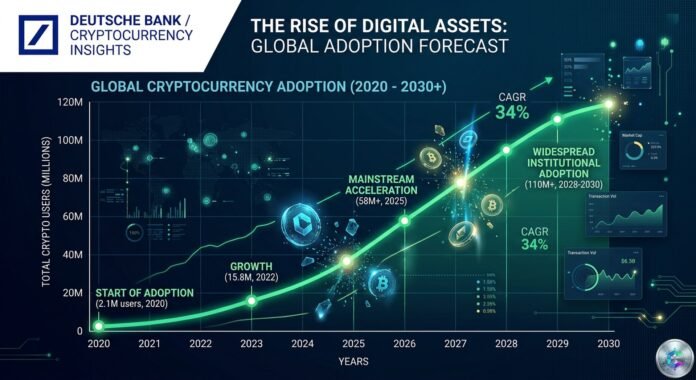
According to a survey conducted by Deutsche Bank among 3,400 consumers in the United States, the United Kingdom, and the European Union, American participation in the cryptocurrency market surged to 12% in March 2026, up from 7% in February. This rebound marks a return to mid-2025 levels and confirms the market’s resilience despite widespread caution regarding Bitcoin’s price trajectory. Yet despite this improvement, the historical penetration ceiling of 14%, first reached in 2023, has still not been surpassed, signaling that adoption remains structurally constrained by persistent economic and regulatory uncertainties.
Context
The year 2026 began under the sign of consolidation for the cryptocurrency market. After a historic peak near $120,000 in late 2025, Bitcoin experienced a sustained correction that temporarily deterred retail investors. The U.S. participation rate had fallen to 7% in February, its lowest level since Deutsche Bank began tracking the metric in 2023. This erosion reflected a loss of confidence tied to observed volatility, but also to an unfavorable macroeconomic environment: elevated interest rates, residual inflation, and growing geopolitical tensions across several key regions of the world.
Several factors nonetheless enabled a rapid return of interest. The stabilization of Bitcoin’s price around $75,000, $1.3 billion in net inflows into spot Bitcoin ETFs in March, and regulatory clarity in the United States all created a more favorable environment. Public statements from the new SEC Chair, Paul Atkins, helped ease regulatory fears that had weighed on the market during the previous administration. Moreover, reinforced cooperation between the SEC and the CFTC to establish clear rules for digital assets restored visibility for institutional players.
It is important to note that despite this rebound, American adoption remains below its maximum potential. The theoretical penetration ceiling, estimated by Deutsche Bank at 14% since tracking began, has not been exceeded. American consumers remain structurally more cautious than their counterparts in other developed markets, possibly due to the complex tax treatment of cryptocurrencies and the lack of simplified retail exposure products available on the market.
Key Facts
Deutsche Bank’s March 2026 survey covers 3,400 consumers spread across the United States, the United Kingdom, and the European Union, with samples representative in terms of age, income, and geography. The results reveal a mixed picture for crypto adoption on a global scale, with significant gaps between regions and demographic profiles.
In the United States, the participation rate climbed to 12%, up from 7% in February, representing a 71% increase in a single month. This rapid improvement suggests that the factors constraining adoption can reverse quickly when market conditions improve. In the United Kingdom, the rate stood at 9%, with a slight decline from the 10% recorded in December 2025. In continental Europe, it remained stable at 7%, a level that has barely moved over the past 18 months.
Bitcoin remains the dominant asset in global crypto allocations. Seventy percent of cryptocurrency holders worldwide hold Bitcoin, a figure that far outpaces stablecoins such as USDT or USDC, which are nonetheless more widely used in daily transactions. The survey also shows that 69% of American respondents cite Bitcoin as their top choice for future investment, confirming the asset’s central position in the public perception of cryptocurrencies.
Investment flows confirm this positive trend on the institutional demand side. Spot Bitcoin ETFs recorded $1.3 billion in net inflows in March, their second-best month since the historic launch of these products in January 2024. This rebound in institutional flows reflects renewed confidence among traditional market participants returning to the market after observing a period of consolidation. The largest inflows were recorded in BlackRock and Fidelity products, which now dominate the Bitcoin ETF market with a combined market share exceeding 80%.
Bitcoin’s price remains under technical pressure, however. The asset gained 9% in March but continues to trade around $76,000, below its late-2025 highs and its all-time record. Technical resistance in the $70,000 to $80,000 range represents a ceiling that has proven difficult to break in the near term, with sellers systematically intervening as the price approaches the $80,000 level. Previous resistance levels around $90,000 and $100,000 now appear to be medium-term targets rather than imminent gains.
Analysis
Several dynamics explain this rebound in American adoption, and understanding them is crucial for anticipating the market’s next moves. The first is technical and financial in nature. The return of flows into Bitcoin ETFs regularized market access for institutional investors and funds. This normalization reduced perceived volatility and made Bitcoin exposure more attractive to conservative profiles, who were reluctant to use decentralized exchanges or digital wallets. ETFs, by offering an investment vehicle familiar to traditional asset managers, democratized access to Bitcoin for a category of investors who had previously been skeptical.
The second dynamic is regulatory and carries longer-term implications. The establishment of a clearer framework for digital assets in the United States, with increased cooperation between the SEC and the CFTC, diminished the legal uncertainty that had weighed on the market for several years. Recent comments from the SEC Chair, who described Bitcoin as a digital commodity rather than a security, provided the clarity institutional players had been awaiting. Previous Deutsche Bank surveys indicated that regulatory uncertainty was the second most cited reason for investor rejection, right after price volatility. The reduction of this uncertainty helped reassure the most cautious investors.
A third, more structural dynamic is emerging from traditional finance. The growing involvement of players such as BlackRock, Fidelity, Franklin Templeton, and other major asset managers in spot Bitcoin products has conferred additional legitimacy to the asset class. These companies have invested heavily in their crypto infrastructure, building specialized teams and developing products designed for institutional clients. The allocation processes of these institutional players follow longer cycles than retail trading, meaning flows can remain positive even during price consolidation periods. This underlying dynamic could durably transform the market’s structure, with a decreasing correlation between institutional flows and Bitcoin’s daily price volatility.
The relative stagnation of the European market deserves thorough analysis. MiCA regulation is entering full force in 2026, but surveys show that crypto penetration in Europe remains structurally lower than in the United States. Several factors explain this gap. First, cryptocurrency taxation in Europe remains complex across member states despite the MiCA framework. Second, European consumers overwhelmingly prefer traditional assets: gold and the S&P 500 each beat Bitcoin by two points among European respondents, compared to a tie score in the United States. This preference for conventional assets appears to be a persistent cultural trait that hinders crypto adoption in Europe, even in a favorable regulatory environment.
Market Reactions
American consumer price expectations remain cautious, even bearish, creating an interesting decoupling from ETF flow optimism. According to the Deutsche Bank survey, 19% of American respondents anticipate Bitcoin between $20,000 and $60,000 by the end of 2026, representing a decline from current levels. Thirteen percent predict an asset below $20,000, a scenario that would nonetheless remain above the bear market floors of 2022. Only 3% anticipate a return to peaks near $120,000, a level of optimism that appears to have vanished from the market since the early-year correction.
This caution in consumer sentiment contrasts with the optimism observed on the ETF flow side. It illustrates the growing decoupling between retail sentiment and institutional flows, a phenomenon not unique to the cryptocurrency market but particularly pronounced in this asset class. Retail investors react to observed price movements, creating a negative feedback dynamic during periods of decline. Institutional allocations, on the other hand, depend on mandates that are not directly correlated to short-term fluctuations, allowing flows to remain positive even when the price consolidates. This difference in investment horizon explains why the two indicators can evolve in seemingly contradictory directions.
Bitcoin products remain marginally preferred to alternative digital assets in consumer preferences. Ethereum, despite its technical advances around sharding and network efficiency, captures only a fraction of inflows. Survey responses show that Ethereum is perceived as more complex and less liquid than Bitcoin, which slows adoption by new entrants. Bitcoin’s dominance in preference surveys remains structurally high, even among older Generation Y investors who experienced the 2017 bubble and its aftermath.
Outlook
Deutsche Bank anticipates consolidation of the rebound if Bitcoin’s price manages to durably break through the $80,000 technical resistance level. In this scenario, the U.S. participation rate could reach 15% by year-end, a new all-time high since tracking began. ETF flows would remain the primary driver of this progression, with additional inflows on the order of several billion dollars over the coming months. This scenario would be broadly favorable for the crypto market as a whole, as it would attract new investors and strengthen market liquidity.
In an adverse scenario, a fresh price correction below $60,000 would risk bringing the participation rate back to 8 to 9%, a return to 2024 levels. Such a scenario could be triggered by a broad risk-asset selloff, a new episode of macroeconomic uncertainty, or an unfavorable regulatory development. European consumers appear more resistant to this type of negative dynamic, their exposure being structurally weaker and their price expectations more stable. This relative European market resilience could create arbitrage opportunities for institutional investors seeking positions decoupled from American markets.
Monitoring factors for the coming months are numerous and their impact could vary across scenarios. U.S. federal monetary policy remains the most important exogenous factor: any indication of a status quo or further interest rate increases would be negative for risk assets, including Bitcoin. Potential SEC regulatory decisions regarding ether ETFs and cryptocurrency derivatives products merit close attention. The evolution of inflows into institutional products will remain the best leading indicator of market health. Finally, the market remains attentive to the impact of interest rates on risk assets in general, with Bitcoin maintaining a high correlation to technology equities. Fed officials have repeatedly indicated that monetary policy would remain restrictive as long as underlying inflation had not reached its 2% target, suggesting that the period of elevated rates could last several more months.
Sources
- U.S. crypto adoption is rebounding, bitcoin still dominates, Deutsche Bank says — CoinDesk
- Deutsche Bank: U.S. Crypto Adoption Rebounds as ETF Inflows Signal Institutional Return — Cryptonews
- Deutsche Bank: US Crypto Adoption Rebounds, But Bitcoin’s Path To $120,000 Remains Uncertain — Sahm Capital
- US Crypto Adoption Rebounds to 12% in March, Deutsche Bank — Binance Square

