

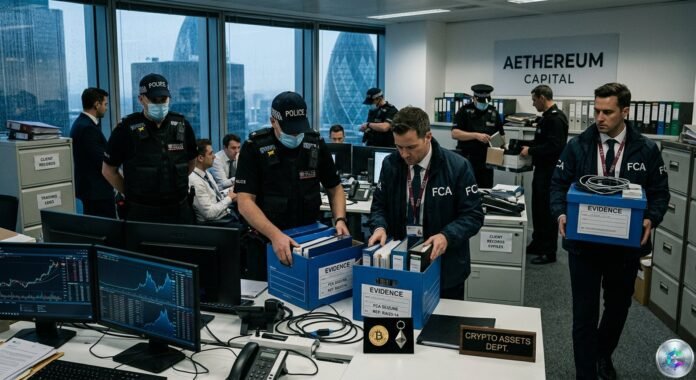
UK FCA Launches First Raids Against Illegal Peer-to-Peer Crypto Trading in London
The UK’s Financial Conduct Authority (FCA) coordinated its first-ever physical enforcement action against illegal peer-to-peer (P2P) cryptocurrency trading in the United Kingdom. Eight London sites were raided on Wednesday, April 22, 2026, in collaboration with His Majesty’s Revenue and Customs (HMRC) and the South West Regional Organised Crime Unit (SWROCU). Cease and desist letters were issued on site, ordering operators to halt illegal activity immediately. Evidence gathered during the inspections is supporting ongoing criminal investigations. This operation marks a significant turning point in the UK’s regulatory policy toward digital assets, with implications that extend far beyond the borders of the United Kingdom.
Context
Since January 2020, the UK has imposed a mandatory registration regime for cryptoasset businesses under anti-money laundering regulations derived from EU AMLD5 directive. Any firm providing cryptocurrency-related services in the UK — whether exchanges, trading platforms, custody or payment services — must be registered with the FCA and pass strict compliance checks related to anti-money laundering and counter-terrorist financing.
However, peer-to-peer brokers — intermediaries who directly match buyers and sellers for cash-to-crypto or bank-to-crypto trades — have largely escaped this regulatory obligation. Unlike centralized exchanges such as Coinbase, Kraken, or Binance UK, which must perform exhaustive Know Your Customer (KYC) checks and continuous monitoring, a P2P operator can run from a small office, an encrypted messaging group on Telegram or Signal, or even in-person meetings at a café. Physical cash changes hands, and cryptocurrency is transferred directly wallet-to-wallet. No customer file is opened, no transaction report is generated, and no supervisor reviews the source of funds.
This situation persisted for years, creating a regulatory blind spot that UK authorities had long identified without ever concretely addressing. The regulator itself had documented the total absence of registered P2P brokers, but no physical enforcement action had been taken until this week. The current political and security context — marked by intense international pressure on illicit financial flows and rising geopolitical tensions — is now changing that dynamic decisively.
The UK government, in its National Risk Assessment of Money Laundering and Terrorist Financing, explicitly stated that cryptoassets are increasingly used to launder the proceeds of crime. This official position explains why this week’s raids mobilized not only the FCA, but also HMRC and an organized crime unit — a combination that signals stakes far exceeding simple financial regulation violations.
The Facts
On Wednesday, April 22, 2026, the FCA mobilized an unprecedented enforcement operation in British crypto regulatory history. Alongside HMRC — the British tax authority — and the SWROCU, the regulator ordered simultaneous raids on eight London addresses. Agents delivered cease and desist letters at each site, informing traders they must halt illegal activity on the spot. Unlike previous actions that consisted of simple warning letters or consumer alerts, this operation involved physical descents with combined FCA, HMRC, and police teams.
Steve Smart, executive director of enforcement and market oversight at the FCA, said: « Unregistered peer-to-peer crypto traders operating in the UK are doing so illegally and pose a financial crime risk. We will use our powers and work with partners to disrupt them. Consumers should protect themselves by only dealing with firms registered with the FCA and by remembering that crypto remains a high risk investment. »
Detective Inspector Ross Flay of the SWROCU added: « By working with our colleagues at the FCA and HMRC, we are able to effectively target and disrupt unregistered peer-to-peer crypto traders operating illegally. As law enforcement, we want to stop these traders providing a route for criminals to move, disguise and spend illegal money. Our goal is to cut the routes that allow criminal networks to access the financial system. »
No peer-to-peer crypto traders are currently registered with the FCA in the UK. This reality was already documented by the regulator in its annual reports, but no physical enforcement action had been taken until now. The FCA had previously taken action against unregistered cryptoasset activity, including prosecuting an individual operating an illegal network of crypto ATMs, and the arrest in June 2024 of two individuals suspected of running an illegal cryptoasset exchange with the Metropolitan Police Service.
The operation also falls within Operation Atlantic, an international coordinated action carried out in March 2026 by the UK’s National Crime Agency, the US Secret Service, and Canadian authorities. That operation identified more than 20,000 victims across three countries and seized over $12 million in suspected criminal proceeds. Investigators also traced more than $45 million in additional stolen crypto linked to fraud networks. This international dimension shows that the British P2P raids are part of a broader coordinated enforcement strategy against crypto financial crime.
Analysis
The very composition of the task force reveals the depth of authority concern and the severity of the suspicions. HMRC involvement typically signals structural tax evasion or large-scale undeclared economic activity. The presence of organized crime units indicates suspected money laundering, proceeds of crime, or cross-border smuggling links. A joint task force of this nature — combining financial regulator, tax authority and organized crime police — suggests the eight raided sites were already flagged in intelligence files, and that warrants were executed in parallel rather than sequentially to prevent targets from being warned.
Slav Demchuk, CEO of AMLBot.com, a company specializing in anti-money laundering compliance solutions for the crypto ecosystem, told Cointelegraph: « These raids mark a shift under the incoming FSMA crypto regime. Unregistered OTC desks are no longer simply an AML registration gap — they are an unauthorized regulated activity, and enforcement will look more like traditional finance. We are moving from an era where regulators sent warning letters to an era where they send enforcement teams. »
He also emphasized that « unregulated OTC brokers are one of the most consistent chokepoints in illicit flows, including Iran-linked evasion corridors where actors cut off from regulated exchanges use informal desks to move USDT and BTC in and out of fiat. These OTC desks are particularly attractive for networks under sanction because they offer an anonymity that regulated platforms can no longer guarantee since the entry into force of travel rule requirements. »
This statement points to a specific geopolitical risk that goes far beyond the British context: P2P corridors potentially serve as a channel to evade international sanctions, a burning topic in the geopolitical context of 2026 where tensions with Iran and other sanctioned countries remain extreme. The involvement of HMRC and organized crime units in the London raids suggests British authorities have reasons to believe that funds linked to criminal activity or sanctioned regimes have passed through these OTC desks.
For the British crypto industry, these raids send a clear signal: the era of warnings is over. P2P brokers who continue to operate without registration now face physical descents accompanied by judicial warrants, not simply warning letters or consumer notices on the FCA website. This evolution reflects a doctrine change within the regulator, shifting from an educational posture to a repressive one.
Market Reactions
The announcement of the raids did not trigger significant price movement in the main cryptocurrencies at the time of publication. Bitcoin was trading around $77,000 on Wednesday, slightly up as the market digested the latest US macroeconomic data and first quarter earnings results. Legally operating centralized platforms in the UK, such as those registered with the FCA, were not affected by the operation.
Trading volumes on major exchanges showed no notable variation attributable to this news. This absence of market reaction is explained by the fact that unregistered P2P platforms represent an infinitesimal fraction of total global crypto market volume. The direct impact on prices is therefore virtually zero — which is no surprise for analysts familiar with market microstructure.
Analysts consulted by Cointelegraph note that the majority of retail users in the British crypto market using regulated services are not impacted by these raids, which exclusively target undeclared cash-to-crypto trading operating outside the regulatory framework. Cryptocurrency holders on registered platforms like Coinbase UK or Kraken UK face no particular risk related to this operation. Individual traders who used unregistered P2P services to acquire cryptocurrencies without going through a regulated platform could, however, receive information requests from HMRC in the coming months.
The regulated OTC desk market in the UK remains tiny compared to the overall crypto market. This operation therefore does not represent a systemic threat to the ecosystem. The indirect impact — a clear signal of strict regulatory enforcement — could, however, durably modify the behavior of P2P operators in other European jurisdictions. Poland and Germany, in particular, are closely watching the British model to replicate their own MiCA-parallel enforcement.
Perspectives
The coming months will be decisive in assessing the real scope of this action. The FCA opened a public consultation in April 2026 on guidance for its upcoming crypto regulatory regime, expected to take effect in 2027. This regime will cover stablecoins, trading platforms, custody, and staking. Companies will be able to submit authorization applications from September 2026, with full compliance required once the framework is implemented. This new framework should close part of the regulatory blind spot that has allowed P2P OTC desks to prosper outside any legal framework.
For UK residents who have used unregistered P2P services, the immediate risk is not a knock on their own door — the raids targeted operators, not retail users. It is rather the possibility that transaction records seized during the raids will feed into HMRC’s tax intelligence files. Anyone who traded with a now-raided operator and did not declare capital gains on their tax returns should expect retrospective scrutiny of their filings for the relevant years. HMRC has three years to amend tax returns in the UK, and investigations related to evidence seized during raids can extend this period.
For the broader crypto economy, the signal is clear: the FCA has moved from warning letters to physical interventions. This evolution shows that the British regulator now considers crypto registration regime violations as criminal offenses, not simply administrative ones. Other European countries watching the UK’s approach — notably Poland, Germany, France, and the Netherlands — could use this playbook as a reference for MiCA-parallel enforcement.
Retail investors should keep one essential point in mind: peer-to-peer cryptocurrency trading in the UK now requires FCA registration. Not registering is no longer a simple administrative gap — it is now a criminal activity that exposes promoters to criminal prosecution and clients to retrospective tax investigations. For users who wish to operate within a legal framework, the only option is to use registered platforms or wait for the new authorization frameworks to become operational from September 2026.
Sources
- FCA leads first crackdown on illegal crypto trading — FCA (official)
- UK FCA Targets Illegal Crypto P2P Trading in Nationwide Raids — Cointelegraph
- UK FCA Runs Its First P2P Crypto Raids Across Eight London Sites — Spendnode
- UK FCA Cracks Down on Illegal Peer-to-Peer Crypto Trading — Bitget
- UK FCA Raids Illegal Crypto Trading Sites in London — Phemex

