

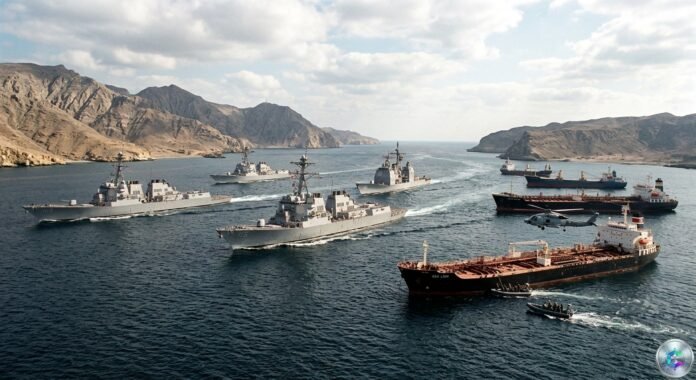
Donald Trump Announces US Naval Blockade on Strait of Hormuz
US President Donald Trump announced on Sunday, April 12, 2026, that the US Navy will impose a naval blockade on the Strait of Hormuz, just hours after the failure of negotiations with Iran in Pakistan. This decision marks a major escalation in the conflict between the two countries that has lasted over six weeks and threatens to disrupt the entire global economy.
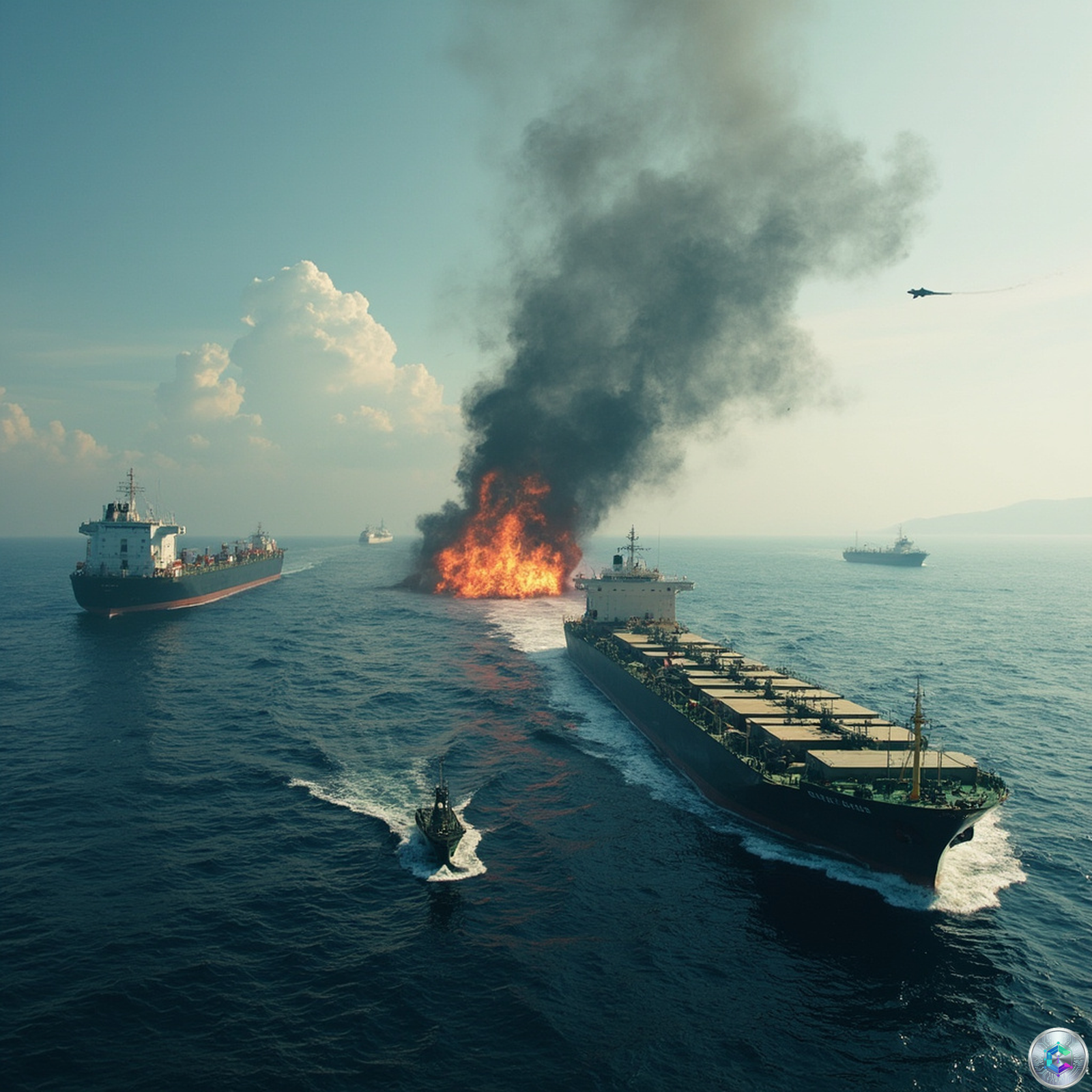
An Immediate and Unprecedented Blockade
In a post published on Truth Social, Trump stated: « Effective immediately, the US Navy, the Finest in the World, will begin the process of BLOCKADING any and all Ships trying to enter, or leave, the Strait of Hormuz. » This announcement comes after the failure of peace talks between US and Iranian delegations in Islamabad, which lasted 21 consecutive hours without reaching an agreement.
The US president also stated that the American goal is to fully open Hormuz, reaching a state where « all » vessels can freely enter or exit the Strait. This statement follows Trump’s announcement on Saturday that the United States had begun the process of clearing underwater mines from the Strait of Hormuz, a complex and dangerous operation that could take several weeks or months.
The precise military terminology used by Trump indicates that the United States is prepared to use force to prevent all maritime traffic through this strategic strait. This approach represents a significant shift from previous operations, which were limited to airstrikes and economic sanctions.
21 Hours of Unfruitful Negotiations
The Islamabad talks represented the most serious attempt at resolving the conflict since the hostilities began. Under Pakistan’s mediation, US and Iranian delegations discussed relentlessly for 21 consecutive hours but failed to find common ground on the following points:
– The Iranian nuclear program: The United States demanded that Iran commit to definitively abandoning any uranium enrichment program, a request that Tehran refused as an infringement on its national sovereignty. Iran maintains that its nuclear program is solely for peaceful civilian purposes.
– Control of the Strait of Hormuz: The United States wants the immediate liberalization of the strait and the removal of all mines laid by Iran. Tehran demands payment guarantees for ships transiting the strait and unconditional passage rights for its own vessels.
– Economic sanctions: The Trump administration demands the maintenance of some sanctions until the complete verification of Iran’s nuclear program dismantling. Iran requests immediate and total lifting of sanctions as a precondition for any agreement.
– Security guarantees: Iran requests written guarantees that the United States will not attack its territory, which Washington refuses to provide, believing it would limit its response capability in case of agreement violation.
Vice President JD Vance, who led the US delegation, stated during his press conference at Karachi airport: « The Iranian negotiators chose not to accept our conditions. It’s bad news for Iran, much worse than for the United States. »
The Strait of Hormuz: A Critical Strategic Point
The blockade announcement comes as Iran still controls the Strait of Hormuz, through which approximately 20% of global oil production and 30% of global refined petroleum trade passes. This narrow waterway, situated between Oman and Iran on the Gulf of Oman, is one of the most important shipping routes in the world.
Each day, approximately 20 million barrels of oil pass through this strategic route, making it one of the most important energy arteries in the world. The width of the strait at its narrowest point is only 54 kilometers, making it an extremely vulnerable passage point for any blockade or disruption.
Trump called Iran’s closure of the Strait « world extortion » and promised that the United States would not tolerate this situation. « Iran is using the Strait of Hormuz as a weapon against global trade, » the American president declared. « We will not allow this extortion to continue. The Strait must be open to all ships, without exception. »
Mines: A Major Obstacle
The mines laid by Iran in the strait represent a major obstacle to navigation. According to estimates from US Central Command (CENTCOM), it would take several weeks, or even months, to completely clear the strait’s waters. This demining operation is extremely complex due to several factors:
– Water depth: Some areas of the strait reach depths of 60 to 100 meters, making demining operations extremely difficult and dangerous.
– Currents: Strong currents in the region can move mines and create new danger zones.
– Mine types: The mines laid by Iran are of different types, some being amphibious and others hydraulic, which complicates their detection and removal.
Major Economic Implications
The Strait of Hormuz is one of the most critical shipping lanes in the world. With approximately 20% of global oil production and 30% of global refined petroleum trade passing through this route, any major disruption can have devastating effects on the global economy.
Analysts predict potential oil price increases of 30 to 50% if the blockade continues for several weeks. Brent futures have already reached $85 per barrel, a level not seen since the beginning of the year, and could continue to rise if the situation worsens.
Oil-importing countries are closely monitoring this situation, particularly China, Japan, South Korea, and India, which heavily depend on oil supplies passing through the Strait of Hormuz. These countries have already begun diversifying their supply sources and building strategic reserves to cope with a potential crisis.
China, the world’s largest oil importer, stated through its Foreign Ministry: « We hope that the parties concerned can resolve their differences through dialogue and avoid any action that could destabilize global energy markets. »
Financial Markets Reaction
Financial markets immediately reacted to the blockade announcement. Crude oil prices increased by more than 5% in Asian markets, reaching their highest level in several months. Brent touched $85 per barrel, while WTI reached $80.
Major international oil companies saw their shares rise significantly. ExxonMobil gained 3.2%, Chevron 2.8%, and Shell 2.5%. Investors anticipate a period of increased volatility in energy markets and higher profits for oil companies.
The main victims of this situation are airline and shipping companies, which face potential increases in their fuel supply costs. Several major airlines have already announced that they may be forced to increase their fares if oil prices continue to rise.
International Community Reaction
The announcement has raised major concerns internationally. The European Union called on both parties to exercise restraint and de-escalation. EU High Representative Josep Borrell stated: « We call on all parties to avoid any action that could hinder global energy trade and worsen the humanitarian situation in the Middle East. »
The United Nations also expressed its concern. The Secretary-General called for dialogue and de-escalation, recalling that the Strait of Hormuz is an international waterway that must remain open to global trade.
Russia, a traditional ally of Iran, condemned the blockade announcement as a « violation of international law. » The Russian Foreign Ministry stated that US actions risked further destabilizing the region and could have unforeseeable consequences for world peace.
Possible Scenarios for the Coming Weeks
As the blockade takes effect immediately, several scenarios are conceivable for the coming days and weeks:
– Scenario 1 – Negotiations resumed: Iran agrees to resume negotiations under new mediation (Oman, Iraq) and the blockade is lifted after an agreement. In this case, oil prices could quickly return to their previous level. This scenario represents approximately 25% probability according to analysts.
– Scenario 2 – Military incident: Iran attempts to defy the blockade and provokes a military incident with the US Navy. This scenario could lead to an escalation of the conflict and a sharp increase in oil prices, or even ground intervention. This scenario represents the highest risk.
– Scenario 3 – Prolonged blockade: The blockade continues for several weeks and oil prices continue to rise to historic levels. Global economies are impacted by this energy crisis, with potential recessions in developed countries. Emerging markets particularly feel the effects of this crisis.
– Scenario 4 – International solution: The international community intervenes massively (Saudi Arabia, United Arab Emirates, China) and proposes a compromise solution that satisfies both parties. This scenario represents the best possible outcome for global stability, but seems unlikely in the current context.
Iran refused American conditions during the latest negotiations, and increasing military pressure could lead to unpredictable consequences. The Iranian regime seems determined to continue its nuclear program and defend what it considers its sovereign rights over the Strait of Hormuz.
Impact on the Crypto Ecosystem
In this context of geopolitical uncertainty, cryptocurrencies could play a role as a safe haven, as observed during previous geopolitical crises. Bitcoin and other digital assets increasingly attract investors during periods of uncertainty, although correlation with traditional markets remains limited.
Stablecoins, often used as a means of exchange in the crypto ecosystem, could also be impacted by this crisis if global trade disruptions worsen. Crypto users must remain vigilant and adapt their investment strategies according to the evolution of the situation.
The prices of major cryptocurrencies showed a slight upward trend in the hours following the blockade announcement, suggesting that some investors consider digital assets as protection against potential inflation caused by the oil crisis. Bitcoin gained 2.3% and Ethereum 1.8% in the 24 hours following the announcement.
This trend could intensify if the energy crisis worsens and investors seek alternatives to traditional assets to protect their wealth.
Conclusion: Towards a New Era of Tensions
The announcement of the US naval blockade on the Strait of Hormuz represents a major escalation in the conflict between the United States and Iran. This decision will have considerable repercussions on the global economy, energy markets, and potentially on the cryptocurrency ecosystem.
The coming days will be crucial in determining the evolution of this situation. Investors and market observers will closely follow developments, while oil-importing countries will strive to diversify their supply sources to reduce their dependence on the Strait of Hormuz.
This crisis highlights the importance of energy diversification and the need to develop alternatives to fossil fuels. In the long term, the transition to renewable energy could reduce economies’ vulnerability to oil crises like this one.
As the world faces this new geopolitical crisis, consequences will be felt in all sectors of the economy, from transportation to manufacturing to financial services. Caution is advised for investors, who must take this new geopolitical reality into account in their investment strategies.
This article is for informational and educational purposes only. It does not constitute investment advice. Cryptocurrencies and digital assets are volatile: conduct your own research before making any financial decisions.

