

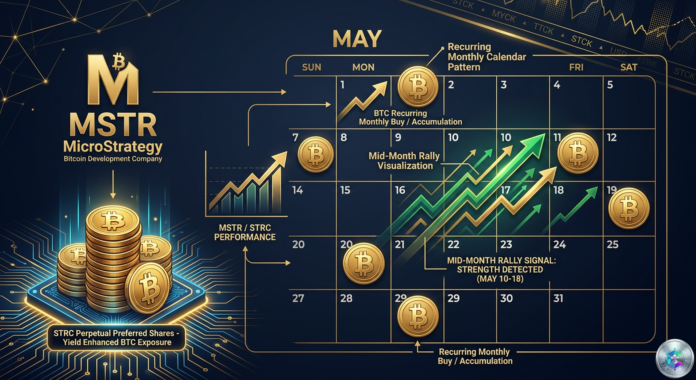
Strategy’s STRC Mechanism May Be Fueling Recurring Mid-Month Bitcoin Rallies
Research firm K33 asserts that Strategy’s recurring STRC (Strategic Bitcoin Refinancing Corpus) issuances troublingly coincide with historical Bitcoin price rallies occurring mid-month. This structured acquisition mechanism raises serious questions about the sustainability of the bullish trend and the underlying systemic risks in what has become one of the most unusual financial experiments in the history of digital assets.
Context
Strategy, under the charismatic leadership of Michael Saylor, has deployed since 2020 a strategy that has become iconic in the digital assets universe: massively accumulating Bitcoin by issuing dedicated financial instruments, primarily convertible bonds and perpetual preferred shares. This approach, described as bold by some and risky by others, has enabled the company to progressively build the largest Bitcoin reserve held by any publicly traded entity in the world.
One of the most significant side effects of this approach, the STRC, has proven to be a growing financial lever for financing new BTC acquisitions. This complex instrument, structured to trade close to a par value of $100 with an attractive yield, has allowed Strategy to mobilize considerable capital from investors seeking superior returns in a low interest rate environment.
In 2025, Strategy issued more than $8 billion in STRC to purchase Bitcoin, making the company the world’s largest public BTC holder with approximately $65 billion in digital assets. This unprecedented accumulation has profoundly influenced the Bitcoin market, creating price dynamics increasingly correlated with issuance calendars. K33 analysts observed that this correlation strengthened over the months, becoming a identifiable structural factor in Bitcoin price movements.
The Facts
According to the comprehensive analysis published by K33 Research, Bitcoin has shown since early 2026 a marked trend: significant rallies occurring systematically between the 10th and 18th of each calendar month. This periodicity precisely matches Strategy’s STRC issuance windows, creating a predictable pattern that market participants can no longer ignore. Historical data shows this configuration has repeated at least five consecutive times since the beginning of the year, with varying amplitudes but troubling consistency.
The mechanism works as follows: Strategy issues STRC (perpetual preferred shares with an 11.5% dividend), then uses the proceeds from this issuance to purchase Bitcoin on the market. This policy creates an apparent virtuous circle, at least during BTC uptrends. The company purchased approximately $7.2 billion in Bitcoin over the past eight weeks, bringing its total reserves to over 250,000 BTC, equivalent to a considerable capitalization at current prices.
STRC is structured to trade close to its $100 par value, with an annualized yield of 11.5%, a level particularly attractive compared to the less than 7% offered by traditional junk bonds. This yield differential has allowed Strategy to gather substantial capital from institutional investors and wealth managers seeking superior returns in an environment where traditional savings products offer increasingly limited yields.
To further stabilize the STRC price and reduce volatility, Strategy proposed in early April 2026 to shift from monthly dividend payments to bi-monthly distributions. Michael Saylor officially stated that this change aims to stabilize the instrument price, dampen the cyclicality inherent to this type of structure, drive liquidity, and accelerate demand growth. The proposed timeline calls for the first bi-monthly dividend on July 15, 2026, subject to shareholder approval at the vote closing on June 8.
Meanwhile, Strategy maintained its STRC dividend at 11.5% for May, marking the third consecutive month at this historical level. April’s volume-weighted average price (VWAP) stood at $99.76, close enough to par to mathematically justify maintaining the unchanged dividend rate, thus preserving existing investor confidence.
How STRC Works in Detail
To fully understand STRC’s impact on the Bitcoin market, it is worth analyzing in depth the financial mechanics of this unique instrument. STRC, standing for Strategic Bitcoin Refinancing Corpus, is a perpetual preferred share issued by Strategy and specifically designed to attract capital destined for additional Bitcoin acquisition. Unlike traditional convertible bonds that mature and require repayment, STRC has no maturity date, eliminating refinancing risk for the company.
The operation relies on an apparently well-oiled virtuous cycle: Strategy issues new STRC shares on the market, investors buy these shares in exchange for an attractive 11.5% annual yield, then Strategy uses the proceeds from these issuances to purchase additional Bitcoin. This new Bitcoin indirectly guarantees the value of STRC, creating a positive feedback loop that has enabled the company to build a considerable war chest in Bitcoin.
The dividend structure deserves particular attention. The 11.5% yield is calculated on the $100 par price per share, not the market price. This means that if STRC trades below par, the real yield for the investor increases, making the instrument even more attractive. Conversely, if the price rises above par, the effective yield decreases. This automatic pricing mechanism helps maintain the price close to its par value, a clear objective of Michael Saylor’s strategy.
Since the initial STRC listing in July 2025 with a 9% dividend, Strategy progressively increased the yield to attract more investors and maintain demand for its issuances. This progressive yield increase to 11.5% reflects the company’s determination to keep its Bitcoin acquisition lever operational even in difficult market conditions.
Analysis
K33’s methodical analysis highlights a major structural risk: the system’s dependence on investor sentiment and Strategy’s financial health. If the Bitcoin price were to drop significantly, the company’s ability to honor its STRC dividends would be immediately compromised, triggering a massive sell-off of the instrument and potentially requiring a forced pause in BTC purchases. This negative causation chain could create a destructive spiral effect for the Bitcoin price.
Matt Hougan, Chief Investment Officer at Bitwise, agrees while considerably nuanced his statement: if obligations approach 50% of Bitcoin reserves, investor questions will become more pressing and Strategy’s room for maneuver will reduce significantly, he stated in a recent note. Currently, Strategy’s total obligations represent approximately 33% of its Bitcoin holdings, leaving a margin before reaching this critical threshold that markets are closely monitoring.
The main concern identified by K33 lies in the inherently cyclical nature of the mechanism. STRC issuances generate predictable Bitcoin demand, which creates anticipations among algorithmic and discretionary traders buying BTC ahead of issuance windows. This self-reinforcing dynamic considerably amplifies price movements and transforms a corporate strategy into a systemic market factor whose influence largely exceeds Strategy’s simple balance sheet.
Peter Schiff, a renowned American Bitcoin critic for years, was particularly scathing in his critique of the STRC structure. He described the overall instrument structure as misleading to the point of constituting potential fraud and officially warned that if dividends are ever reduced or the share price falls significantly, investors could engage in lawsuits against the company. This warning, although coming from a direct competitor of Saylor in the digital assets debate, deserves consideration in any comprehensive risk analysis.
Risks for Investors
Beyond general macroeconomic considerations, investors buying STRC expose themselves to specific risks that should be carefully evaluated. The first and most obvious risk is the correlation between Bitcoin price and Strategy’s financial health. Indeed, if BTC were to drop significantly, the company’s Bitcoin reserves would see their value decrease, which would reduce the effective coverage of STRC and could trigger a negative spiral.
The second major risk concerns the instrument’s own liquidity. STRC is a relatively new instrument and daily trading volume remains modest compared to large listed stocks. In case of market tensions, investors could experience difficulties selling their positions without incurring significant liquidity premiums, which could amplify losses during periods of increased volatility.
Finally, regulatory risk must be considered. The applicable legal framework for perpetual preferred shares issued by companies holding digital assets remains in evolution in many jurisdictions. Unfavorable regulatory change could impact the STRC structure or Strategy’s ability to continue its Bitcoin acquisition model, creating additional uncertainty for investors.
Market Reactions
The overall market responded positively to news published by Strategy in recent weeks. The MSTR share price closed April at $165, a 33% gain compared to the previous month — its first positive month after nine consecutive months of cumulative decline. This performance reflects renewed investor confidence in the company’s ability to continue creating value through its Bitcoin acquisition model, even in a context of increased volatility in digital markets.
Bitcoin price surged 12% in April, posting its best monthly performance since April 2025. BTC currently trades around $80,000, up 20% from its lows recorded last February. This vigorous recovery was supported by several converging factors: sustained inflows into spot Bitcoin ETFs, marked renewed interest from long-term holders, and the amplifying effect of Strategy’s structured purchases that continue to influence market sentiment.
Additionally, STRC currently trades around $99.21, gradually recovering its par value after a prolonged period below par since April 15. This significant rise comes as geopolitical tensions ease in several world regions, particularly after Iran’s full reopening of the Strait of Hormuz, which helped improve overall market sentiment and reduce the perceived risk premium on digital assets.
Outlook
In the short and medium term, the STRC mechanism appears sustainable if current conditions persist. According to estimates shared by Bitwise, Strategy still has significant room to issue an additional $10 to $15 billion in STRC at current Bitcoin prices before reaching debt levels that could concern observers and rating agencies. This financial visibility explains why the market remains optimistic about the company’s ability to continue its historic Bitcoin accumulation.
However, several risk factors warrant careful and continuous monitoring by investors. First, a significant and rapid drop in Bitcoin price would mechanically reduce the value of underlying collateral for STRC, potentially triggering a vicious cycle of mass sales and forced buybacks. Second, dependence on investor sentiment means that any major macroeconomic shock or any unforeseen geopolitical event could destabilize the mechanism and accelerate a price correction.
Finally, the decisive shareholder vote on the transition to bi-monthly dividends represents a potential turning point for the structure’s future. If approved, this modification could durably reduce STRC volatility and smooth Bitcoin purchases over time, offering a more stable foundation for the accumulation mechanism. Conversely, if approval reveals tensions among investors, the structure could undergo significant pressures and the mechanism could lose part of its current predictability.
Conclusion
The STRC mechanism represents an unprecedented financial innovation in the digital assets ecosystem. By allowing Strategy to create a Bitcoin acquisition lever while offering investors an attractive yield, this structure has transformed the company into a systemic player in the BTC market. Data collected by K33 suggests that this mechanism creates predictable price patterns that now influence the entire market, a phenomenon that savvy investors must integrate into their strategy.
Admittedly, significant risks exist and criticisms, particularly from Peter Schiff, deserve consideration in any balanced analysis. However, as long as Bitcoin price remains stable or rising, and Strategy has room to continue its issuances, the mechanism appears viable. The key lies in careful monitoring of the debt-Bitcoin ratio and the company’s ability to maintain investor confidence in an instrument whose underlying asset remains notoriously volatile.
Sources
- Bitwise CIO says Strategy’s STRC could keep fueling Bitcoin’s latest rally — Crypto Briefing
- Strategy keeps STRC dividend at 11.5% as stock logs first monthly gain in nine — CoinDesk
- Strategy Proposes Semi-Monthly Dividends for STRC to Stabilize Price and Demand — TradingView / Coinpedia
- Strategy’s STRC-fueled Bitcoin buying spree highlights sentiment-driven structural risks — K33 / The Block

