

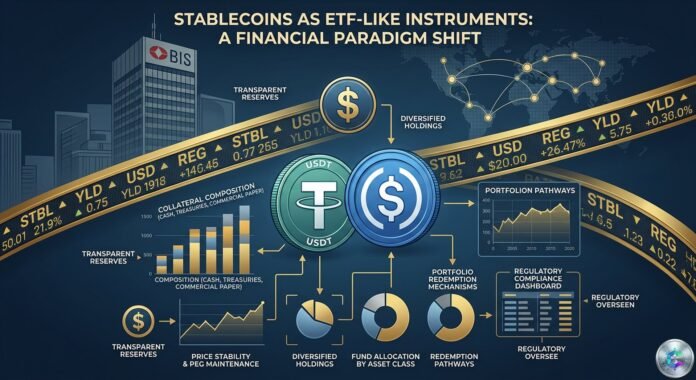
Stablecoins Resemble ETFs More Than Money, BIS Report Confirms
The Bank for International Settlements published a definitive report in May 2026 establishing that dollar-pegged stablecoins such as Tether’s USDT and Circle’s USDC function more like exchange-traded funds than money in the strict economic sense. The Basel-based institution is urging the international community to coordinate regulation of this 300 billion dollar market before regulatory fragmentation fuels major systemic risks for global financial stability.
Context
Stablecoins have experienced exponential growth since the Securities and Exchange Commission approved the first spot Bitcoin exchange-traded funds in January 2024. The market now represents nearly 300 billion dollars in aggregate capitalization, with transaction volumes exceeding 4.5 trillion dollars in the first quarter of 2026 alone, a fourfold increase over an eighteen-month period.
This unprecedented expansion has transformed stablecoins into de facto payment infrastructure for millions of users worldwide. Their adoption has expanded from crypto trading on decentralized exchanges to cross-border retail payments, remittances from migrant workers and commercial settlements between businesses of all sizes.
This widespread diffusion has naturally pushed monetary and regulatory authorities to examine with renewed scrutiny their legal nature, reserve model and potential impact on financial stability. Goldman Sachs, in a research note published in early 2026, identified regulatory reform as the primary catalyst for the next wave of institutional adoption, with crypto infrastructure companies best positioned to benefit from this growth with reduced exposure to traditional trading cycles.
In parallel, regulatory frameworks have tightened considerably. In the United States, the GENIUS Act passed in late 2025 requires stablecoin issuers to maintain reserves composed exclusively of top-tier, instantly accessible assets with real-time proof-of-reserve verification through tamper-proof mechanisms. In Europe, the Markets in Crypto-Assets Regulation has established an equally strict framework, harmonized across the twenty-seven European Union member states.
The Facts
The BIS Papers No 170 report, authored by economists Iñaki Aldasoro, Jon Frost and Hiro Ito from the BIS Monetary and Economic Department, analyses stablecoins through the prism of the three traditional functions of money: means of payment, store of value and unit of account. Its main conclusion is unambiguous: dollar-pegged tokens currently satisfy none of these three functions in a fully optimal manner.
« Current issuers like Tether and Circle exhibit features resembling securities rather than money due to redemption frictions inherent in their creation and redemption mechanisms, » said Pablo Hernández de Cos, BIS General Manager, at a Bank of Japan seminar in Tokyo on April 20, 2026. He specifically cited creation fees charged by issuers, variable redemption conditions across platforms, and documented cases where secondary market prices deviated significantly from the theoretical one-dollar parity.
The report also emphasizes that regulatory fragmentation risks between jurisdictions could exacerbate market tensions, particularly in emerging economies facing partial dollarization phenomena. Without international coordination, regulatory arbitrage practices could allow less rigorous issuers to capture market share at the expense of systemic stability.
The structural parallel with ETFs deserves further elaboration. Like an exchange-traded fund, a stablecoin is created against a collateral deposit denominated in underlying assets, can be traded on decentralized or centralized secondary markets, and its market value fluctuates marginally around its nominal value. This structural analogy implies important implications for regulatory classification, market risk exposure and monetary policy transmission.
In Europe, the progressive implementation of MiCA regulation has imposed stablecoin issuers with transparency and reserve composition requirements comparable to the U.S. framework. Compliant stablecoins now hold top-tier assets, primarily short-term government bonds issued by G7 governments, with compressed yields ranging between 3 and 5 percent annually. Algorithmic stablecoins, on the other hand, face significant restrictions or outright bans in major jurisdictions, triggering a progressive migration of volumes toward fiat-backed reserve models.
Analysis
The parallel with ETFs highlighted by the BIS is not a mere rhetorical analogy. It reflects a deep structural reality: modern stablecoins inherit the financial mechanisms of exchange-traded funds while operating within a regulatory framework still largely under construction. This functional hybridization explains why monetary authorities are concerned about their potential impact on monetary policy transmission and financial system stability.
The former IMF Chief Economist formulated a detailed warning about the systemic risks arising from this configuration. His analysis insists on the danger of simultaneous easing of stablecoin and commercial banking regulation. In such a scenario, interconnections between the two sectors could create unprecedented shock transmission channels, allowing turbulence occurring in the crypto ecosystem to propagate toward the traditional banking system with amplified effects.
The BIS goes further by proposing concrete structural solutions. The institution estimates that access to deposit insurance or central bank lending facilities would « significantly mitigate » stablecoin run risks in the event of a confidence loss. This suggestion aligns with ongoing discussions in the U.S. Congress regarding the Digital Asset Market Clarity Act, where a compromise on the question of stablecoin yield could unlock a decisive legislative markup for the sector.
On the international monetary policy front, regulatory fragmentation risks creating regulatory havens where less controlled issuers could accumulate systemic positions before national regulators detect emerging risks. This regulatory arbitrage dynamic has already been observed in other segments of decentralized finance, and authorities fear it could reproduce itself at the scale of stablecoins if global coordination does not emerge swiftly.
Market Reactions
Market participant reactions have been mixed but overall constructive. On the established issuers side, Tether and Circle have published detailed reserve reports exceeding the minimum requirements set by new regulations. Tether notably reinforced its real-time verification mechanisms, while Circle obtained several independent certifications confirming the full coverage of its emissions by compliant reserves.
Among traditional financial actors, adoption has continued to accelerate. Mastercard announced the acquisition of BVNK, a crypto infrastructure platform, for 1.8 billion dollars to integrate stablecoin technology at the heart of its global payment network. This transaction signals the intent of traditional payment giants to position themselves in the emerging stablecoin instant settlement niche between financial institutions.
MoneyGram extended its stablecoin balance product to El Salvador, a country that had already legalized bitcoin as a means of payment in 2021. Tether launched a certified multi-blockchain self-custodial wallet, allowing users to hold and transfer USDT across a dozen different networks without going through centralized exchange services. Meanwhile, stablecoin velocity doubled from 2.6x to 6x, indicating a progressive shift in usage toward medium-of-exchange functions rather than store-of-value functions.
In Asia, stablecoins dominate payments with nearly two thirds of global volume, driven by massive adoption in developing economies of Southeast Asia and by remittance flows from Gulf markets. Consumer-to-business transactions surged 128 percent year-on-year to reach 284.6 million units in 2025, demonstrating the growing integration of these instruments in retail commerce.
Perspectives
The BIS and the Financial Stability Board have solemnly called for global coordination before divergent national regulatory frameworks irreversibly fragment the market. Without mutual recognition between regulatory regimes and without information-sharing agreements between national authorities, the stablecoin market will remain siloed, limiting its potential for financial inclusion in developing economies and keeping transaction costs at higher levels than necessary.
Medium-term scenarios fall between two distinct trajectories. The optimistic trajectory assumes the conclusion of an international framework agreement inspired by European MiCA and the U.S. GENIUS Act, with cross-border recognition of reserve standards and supervision mechanisms. This convergence would enable the progressive integration of stablecoins into traditional payment systems, with tangible benefits in terms of reduced transfer costs for individuals and businesses.
The pessimistic trajectory would see contradictory regulations proliferating, creating incentives for international arbitrage and triggering runs on the least capitalized or least transparent issuers. Such a scenario could temporarily restore confidence in the most regulated assets while provoking an adoption retreat in the most strictly controlled markets.
For investors and businesses, the primary risk factor has now shifted toward regulatory compliance rather than peg deviation. Unregulated tokens face growing exit liquidity problems on centralized exchanges, while fully compliant issuers gain institutional credibility and access to traditional financial infrastructure. The end of the opportunity window for non-compliant actors now appears to be in sight.
Sources
- BIS says stablecoins act more like ETFs than money, warns of fragmentation without global rules — The Block
- Global stablecoin rulemaking slows prompting BIS to urge cooperation to avoid fragmentation risks — CoinDesk
- Stablecoin Regulation Shifts to Infrastructure as BIS Warns of Fragmentation — AInvest
- The impact of stablecoins on the international monetary and financial system — BIS
- BIS says stablecoins fail the test of money — PaymentExpert
- Goldman Sachs sees regulation driving next wave of institutional crypto adoption — CoinDesk

