

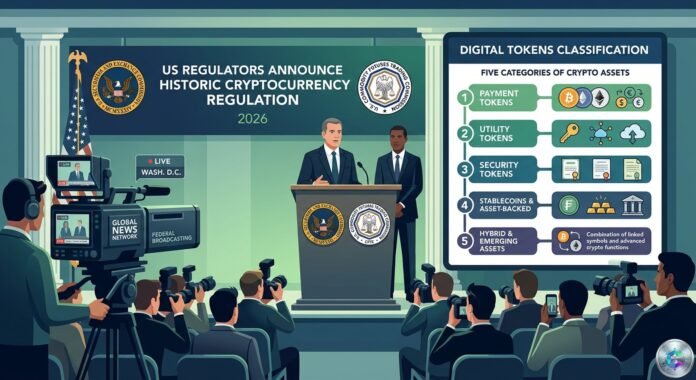
The SEC and CFTC publish a historic joint interpretation: five token categories recognized, long-awaited regulatory clarity finally arrives for the American crypto industry.
March 17, 2026, marks a decisive turning point for the entire crypto ecosystem in the United States. The Securities and Exchange Commission (SEC), in coordination with the Commodity Futures Trading Commission (CFTC), released an official interpretation clarifying how federal securities laws apply to crypto assets. This announcement ends more than a decade of regulatory uncertainty that has weighed on the development of the digital sector in the United States.
This publication arrives in a context where the American crypto legislative framework has significantly strengthened over the past two years. The Financial Accounting Standards Board (FASB) had already paved the way with ASU 2023-08, allowing companies to account for certain crypto assets at fair value. Congress subsequently passed the GENIUS Act, establishing a federal framework for payment stablecoins. The IRS modernized crypto tax reporting with the introduction of Form 1099-DA.
But the interpretation published by the SEC represents arguably the most significant advancement ever made in regulatory clarity for digital tokens. For the first time, a federal agency formally and explicitly distinguishes five categories of tokens, acknowledging that the vast majority of crypto assets do not constitute securities under federal law.
Five categories to finally bring clarity
The SEC interpretation establishes a precise taxonomy of digital tokens, divided into five distinct groups. This classification is not trivial: it directly determines which regulator has jurisdiction over which type of token, and above all, which rules apply.
The first category concerns digital commodities. Bitcoin and Ethereum, the two largest cryptocurrencies by market capitalization, clearly fall into this category. The SEC explicitly confirms that these assets are not securities. They fall under CFTC jurisdiction rather than SEC jurisdiction, a position many industry actors had been demanding for years.
The second category groups digital collectibles, commonly known as NFTs. These tokens, which represent ownership of a unique digital or physical asset, are generally not considered securities as long as they are not sold with the expectation of financial profit dependent on the efforts of others. Their regulatory treatment resembles that of traditional art or collectibles.
The third category covers digital tools. These are tokens that provide access to services or functionalities within a protocol, without any promise of financial return. Pure utility tokens, which allow for example paying transaction fees or accessing decentralized services, finally have their place in this framework.
The fourth category concerns payment stablecoins, already largely covered by the GENIUS Act. These tokens, designed to maintain a stable value and facilitate payments, are subject to specific regulation requiring full reserves in high-quality liquid assets and monthly independent attestations. The SEC interpretation confirms this shared jurisdiction with the CFTC.
The fifth and final category designates digital securities. Some tokens remain subject to federal securities laws, particularly those marketed with the reasonable expectation of profit derived from the efforts of a third party. The SEC specifies, however, that securities status is not permanent: a digital asset can lose this status if it ceases to be marketed in an investment context.
This last point is particularly important for the ecosystem. The new interpretation explicitly recognizes that an investment contract can come to an end. A token that evolves and substantially changes its structure can cease to be a security, opening the way for regulatory de-escalation trajectories for established projects.
A joint framework to avoid double standards
The joint publication with the CFTC is not a detail. It guarantees a harmonized approach between the two federal regulators sharing jurisdiction over digital assets. The CFTC confirmed that its interpretation of the Commodity Exchange Act would be consistent with that of the SEC, thus avoiding the headache of contradictory dual interpretations.
This coordination addresses a frequent criticism of the industry: the former regulatory approach, characterized by individual enforcement actions, had created a situation where different federal actors seemed to pull in opposite directions. The common SEC-CFTC position establishes a single reference framework.
SEC Chairman Paul S. Atkins emphasized that this interpretation « will provide market participants with a clear understanding of how the Commission treats crypto assets under federal securities laws. » He also stated that « most crypto assets are not securities, » an explicit acknowledgment of what the industry had been asserting for years.
For his part, CFTC Chairman Michael S. Selig stated that « for far too long, American builders, innovators, and entrepreneurs have awaited clear guidance on the status of crypto assets. » This statement marks a significant shift in tone compared to the previous era.
Airdrops, staking, and wrapping: SEC removes ambiguities
Beyond the general classification, the SEC interpretation addresses several operational questions that created considerable legal uncertainty for sector companies.
Regarding airdrops, a common practice in the crypto ecosystem where tokens are distributed free or at a discount to promote adoption, the SEC confirms that receiving an airdrop does not automatically constitute a securities transaction. Intent and the context of distribution are determining factors, but the SEC recognizes that airdrops can serve legitimate marketing and adoption objectives without constituting securities offerings.
Protocol mining and protocol staking, mechanisms by which users participate in securing a blockchain network in exchange for rewards, are also clarified. The SEC indicates that these activities do not inherently constitute investment contracts, as long as the user directly participates in the protocol’s functionalities rather than investing in a common enterprise with the expectation of passive profits.
The wrapping of non-securities assets, a practice involving locking a token to issue an equivalent token on another blockchain (for example transforming Bitcoin into Wrapped Bitcoin on Ethereum), is also clarified. The technical wrapping operation does not automatically transform a non-security asset into a security.
These clarifications address years of uncertainty where every new DeFi practice had to be analyzed under the prism of potentially applicable securities regulation. The new interpretive framework eliminates the need for case-by-case analysis for mechanisms now considered non-securities activities.
Safe harbor: the next expected step
The interpretation published in March 2026 is only the first step in a broader process. The SEC announced its intention to publish in the coming weeks a formal safe harbor proposal for public comment.
This safe harbor framework is particularly awaited by the industry. It should offer crypto companies a precise path for launching token offerings in compliance with securities laws, while preserving investor protection. The proposal would include an « innovation exemption » aimed at supporting new business models in the crypto sector.
This mechanism functionally resembles existing exemptions in the traditional securities regulatory framework, adapted to blockchain technology specifics. It would notably allow early-stage projects to raise capital without immediately risking prosecution for unregistered securities offerings.
The industry will closely monitor the details of this proposal, particularly the duration of the safe harbor period, eligibility conditions, and disclosure requirements. Initial sector reactions have been largely positive, even if questions remain about the coordination between safe harbor and the various agencies’ jurisdictions.
Implications for market participants
The impact of this new regulatory era will be felt across several market segments.
For token issuers, the finally achieved legal certainty could trigger a wave of new token offerings that had been waiting for clearer framework. ICOs and IDOs had significantly declined in the face of regulatory risks; they could experience a resurgence.
For exchanges, the clear identification of token categories will allow better structuring of trading offers and clarifying compliance obligations. Tokens classified as digital commodities or digital tools can be treated with regulatory requirements adapted to their nature.
For stablecoins, the GENIUS Act and the joint interpretation establish a particularly robust framework. Regulated stablecoin issuers will benefit from a significant competitive advantage over those operating outside the framework, while institutional users will finally have the certainty needed to integrate stablecoins into their operations.
For financial advisors and asset managers, the explicit recognition that Bitcoin and Ethereum are not securities lifts a major obstacle to including these assets in regulated products. Spot Bitcoin ETFs had already opened the door; the SEC interpretation consolidates this trend.
An imperfect but decisive framework
Despite the significance of this advancement, the interpretation leaves several questions open.
The boundary between different categories sometimes remains vague, particularly for tokens that could sit at the intersection of multiple classifications. Tokens that begin as digital tools but develop securities characteristics over time will raise practical application questions.
DeFi (decentralized finance) assets are not fully addressed by this framework. While certain specific activities are clarified, the entire DeFi sector still operates in significant gray territory. Decentralized protocols whose development has been abandoned by their initial creators will need additional clarifications.
On the accounting side, ASU 2023-08 only covers fungible crypto assets whose value derives solely from their existence on a distributed ledger. Stablecoins, self-issued tokens, and NFTs are excluded, leaving unresolved accounting questions for these segments.
The question of tokens that change categories over time is also not fully addressed. A digital asset classified today as a digital tool could evolve toward a configuration that makes it a security, without a clear transition mechanism currently defined.
Will 2026 be the year of all challenges?
With this regulatory framework now in place, 2026 promises to be the year of implementation rather than creating new rules. Companies and practitioners will need to navigate between different interpretations, adapt their internal processes, and develop necessary compliance capabilities.
The monthly attestations required for stablecoins under the GENIUS Act will begin producing their first reports. The first 1099-DA filings for crypto asset income will be submitted. Compliance audits will become a reality for many sector companies.
Courts will also play a role in refining this framework. Ongoing cases involving allegations of unregistered securities will be decided in light of the new interpretation, which will test its real scope. Court decisions will help clarify remaining gray areas.
The American crypto industry thus enters a new phase, characterized by legal certainty rather than regulatory uncertainty. While challenges remain at the application and day-to-day interpretation level, the direction taken by federal regulators is clear. The digital ecosystem as a whole will need to adapt, innovate, and demonstrate its ability to operate within a structured framework.
This interpretation marks the end of an era of regulatory isolation for the American crypto industry. It opens the door to wider integration of digital assets into the traditional financial system, provided that sector participants demonstrate their ability to meet the investor protection and financial stability standards that authorities now expect.
In parallel, the tax reporting framework introduced in previous years will face its first real test. The new Form 1099-DA regime requires brokers to report digital asset sales and exchanges, beginning with the 2025 tax year. This third-party reporting regime is designed to strengthen compliance, but it comes with notable limitations that both taxpayers and service providers will need to carefully navigate.
The basis tracking challenge
One of the most complex aspects of the new tax framework involves cost basis determination. Taxpayers must now calculate gains and losses on a wallet-by-wallet basis rather than using the pooled basis under the universal method. They must also apply specific lot identification rules when disposing of assets.
This requirement becomes particularly challenging in the crypto context because digital assets frequently move across different platforms and wallets. Reconstructing historical basis information is difficult, and brokers themselves may lack complete acquisition data needed to produce compliant forms. The regulatory framework acknowledges that brokers will not report basis information for 2025 and may only do so in later years when they have comprehensive acquisition data available.
Furthermore, the broker reporting rules explicitly exclude several common DeFi activities. Wrapping tokens, liquidity pool transactions, staking, and lending operations do not fall within the broker reporting framework. Activity conducted through non-custodial wallets is likewise outside the scope of the requirements. These exclusions mean that much economically significant DeFi income will never appear on a 1099-DA, placing the burden of accurate reporting squarely on individual taxpayers.
The de minimis thresholds add another layer of complexity. Qualifying stablecoin transactions under $10,000 and specified NFTs under $600 fall outside the reporting requirements, potentially creating inconsistencies in how similar activities are treated across different taxpayer situations.
DeFi: the regulatory frontier remains open
While traditional crypto asset classifications have been significantly clarified, the DeFi sector continues to operate with substantial regulatory ambiguity. The SEC interpretation specifically addressed certain mechanisms like airdrops and staking when conducted directly with protocols, but the broader universe of decentralized finance applications remains largely uncharted territory.
Smart contracts that automatically execute financial transactions, decentralized exchanges that match buyers and sellers without intermediaries, and lending protocols that connect lenders directly to borrowers all present novel questions that existing regulatory categories struggle to fully address. The question of who bears responsibility for compliance in a truly decentralized system, where no single entity controls the protocol, remains fundamentally unresolved.
This gap is particularly significant because DeFi activity represents an increasingly substantial portion of overall crypto market activity. Total value locked in DeFi protocols has grown substantially, yet the participants in these protocols often have no clear regulatory counterparties to interact with for compliance purposes.
The coming months will reveal how regulators choose to address these persistent gaps. Options range from hands-off approaches that rely on technological innovation to self-regulate, to more interventionist strategies targeting specific protocols or activities that clearly cross established legal boundaries.
For market participants, the practical implication is clear: while the traditional crypto asset space has achieved a significant measure of regulatory clarity, anyone operating in or considering entering the DeFi space should proceed with eyes open about the ongoing uncertainty in this area.
Looking ahead: implementation and adaptation
As the crypto regulatory framework takes concrete shape, the focus shifts from legislative design to operational reality. Businesses throughout the ecosystem are now facing the practical challenge of building compliance infrastructures that can handle the requirements of multiple overlapping regulatory frameworks.
Legal teams are being tasked with reviewing existing token structures against the new classification system, identifying potential rebalancing needs, and advising clients on transition strategies. Technical teams must ensure that systems can generate and retain the data needed for attestations, audits, and reporting requirements. Finance teams must adapt accounting practices to accommodate both the opportunities and the complexities introduced by fair value accounting for crypto assets.
The transition will not be seamless. Early implementation challenges are inevitable as market participants learn to operate within the new rules. But the direction of travel is now clear: regulatory integration rather than regulatory exclusion is the future for the American crypto industry.
This shift carries implications beyond compliance departments and legal counsel. Investors evaluating crypto projects will increasingly weigh regulatory positioning alongside technical merit and market opportunity. Projects that demonstrate proactive engagement with regulatory requirements may find themselves advantaged relative to those that continue to operate in ambiguity.
The market structure emerging from this regulatory evolution may look substantially different from what existed in the preceding decade. Integration with traditional finance, institutional participation, and mainstream adoption all become more plausible when regulatory frameworks are clear and consistently applied. The challenges of implementation should not obscure the significance of having frameworks in place at all.
The year ahead will test whether this promise of regulatory clarity translates into practical outcomes for market participants and the broader digital asset ecosystem.

