

Massive Bitcoin ETF Flows Haven’t Driven Price Higher: Here’s Why
Bitcoin ETFs attract billions of dollars, but BTC price remains strangely stable. Explanation of a phenomenon that baffles investors.
The cryptocurrency market is going through a rather disconcerting period. While spot Bitcoin exchange-traded funds (ETFs) are recording record inflows, the BTC price stubbornly refuses to follow. This paradox has left many investors puzzled, wondering why so much fresh money isn’t moving the markets.
The answer lies in the complex mechanisms that govern ETF operations, particularly the role of Authorized Participants (APs) in the share creation and redemption process.
$1.4 Billion Inflows in Five Days
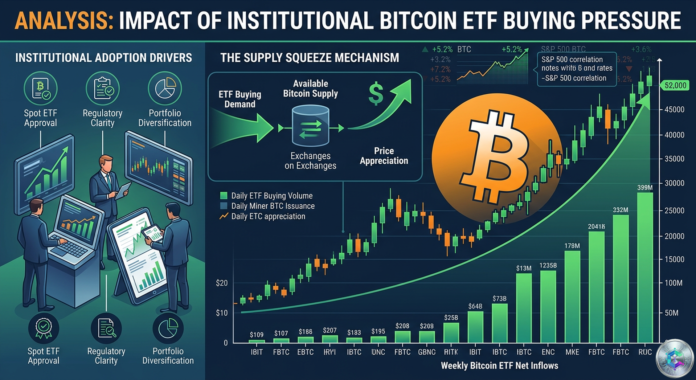
According to data compiled by CoinDesk, U.S. spot Bitcoin ETFs saw no less than $1.4 billion flow in over the first five days of March 2026. This represents the largest capital movement into these products since their historic launch in January 2024.
Yet, despite this massive injection of liquidity, Bitcoin’s price has only risen marginally, still oscillating around the $70,000 psychological level. This disconnection between financial flows and price movement has intrigued market analysts.
« The result is that the ETF grows, but the actual BTC price doesn’t rise because there has been no buying in the spot market, » Bitfinex exchange analysts explained in a note to CoinDesk. « This can give the impression that the BTC price is ‘stuck’ or suppressed. »
Understanding the ETF Mechanism: Why Flows Are Delayed
To understand this phenomenon, we must first grasp how spot Bitcoin ETFs work. An ETF is a pooled investment vehicle that holds assets – in this case, Bitcoin – and issues shares tradable on stock exchanges like ordinary equities.
Each share represents a claim on the fund’s underlying holdings. Shares are created and redeemed by Authorized Participants, specialized financial institutions such as large banks, market makers, or broker-dealers.
The Role of Authorized Participants
When an investor buys an ETF share, several steps are set in motion. First, demand pushes the ETF price above its net asset value (NAV). This premium then incentivizes APs to create new shares.
But here’s the crucial detail: often, APs sell shares they don’t yet own – a process known as « short selling. » In traditional markets, short-selling rules require most investors to first borrow shares, but regulators allow APs to short ETF shares almost immediately.
It’s only several hours later, or until the next business day depending on whether creations are done in cash or in-kind, that APs buy the corresponding Bitcoin to cover their position.
The Illusion of Immediate Demand
This mechanism creates a lag between ETF inflows and actual Bitcoin purchases in the spot market. Bitfinex analysts emphasize that ETF flows risk being over-interpreted as immediate spot demand.
« ETF structures often create a lag between inflows and actual Bitcoin purchases, » they explained. « As a result, ETF demand can rise even while actual BTC buying in the spot market is delayed. »
When these BTC purchases finally take place, they are often offset by other selling pressure elsewhere in the market. This helps mitigate the bullish impact on price and keep Bitcoin trading in a tighter range.
« Generally, this doesn’t have a significant market impact, but in periods of severe market dislocation, the gap between ETF demand and real BTC spot buying, or vice-versa, can create a short period of market mispricing, » the analysts added.
Bitcoin’s Journey in March 2026
March 2026 has been marked by high volatility for Bitcoin, which has repeatedly tested the $70,000 psychological level. On March 20, U.S. spot Bitcoin ETFs recorded $708.7 million in net outflows – the largest single-day exit in two months.
Analysts suggest this isn’t a sign of structural weakness, but rather a tactical « flight to cash » by institutions as the 10-year Treasury yield climbed back toward 4.2%.
This rotation to liquidity comes amid a tense macroeconomic environment, with geopolitical tensions in the Middle East and surging energy prices weighing on risk assets.
Ethereum Finds Breath Thanks to Staking ETFs
While Bitcoin was grappling with massive outflows, Ethereum found a new growth catalyst. On March 12, 2026, BlackRock launched the iShares Staked Ethereum Trust ETF (ETHB), an innovative product that allows institutional investors to capture ETH’s staking yield – up to 3% – plus price exposure.
This « real yield » approach found a receptive audience in a macro environment where the Federal Reserve maintains high interest rates. The real yield of staked ETH has become an attractive alternative to flat price exposure.
Since ETHB’s launch, ETH has gained over 20%, widely outperforming the S&P 500 by reclaiming the $2,300 level. This momentum has contributed to driving record weekly inflows of $160.8 million into ETH ETFs.
What This Means for Investors
This analysis of the Bitcoin ETF mechanism reveals an important reality for investors: ETF flows are not a perfect indicator of actual spot market demand. The structure of these products creates a filtering effect that can temporarily decouple supply and demand.
However, this isn’t a fundamental problem. Massive inflows show that institutional appetite for Bitcoin remains solid. The recent five-day inflow streak represents the longest sustained buying period since the August-September 2025 window.
Since their launch, the 12 spot Bitcoin funds have recorded more than $56 billion in cumulative inflows, demonstrating sustained major investor interest in the first cryptocurrency.
Market Outlook
The market may be entering a base-building phase. While the $70,000 level is currently being tested for BTC, continued institutional interest in yield-bearing products like BlackRock’s ETHB suggests that long-term allocators are still finding value in the ecosystem.
For Bitcoin to reclaim its momentum above $75,000, it will likely need stabilization in energy prices and a retreat in the U.S. dollar. Until then, investors must understand that ETF flows are a lagging indicator of actual market dynamics, not an immediate signal.
Key takeaways:
- Bitcoin ETFs attracted $1.4 billion in five days in early March 2026
- The AP mechanism creates a lag between ETF inflows and spot BTC purchases
- The $708.7 million outflows on March 20 represent the largest in two months
- Ethereum outperforms thanks to staking ETFs offering « real yield »
- ETF flows remain an indicator of long-term institutional interest
Sources: CoinDesk, Bitfinex, Crypto.com, BeInCrypto

