

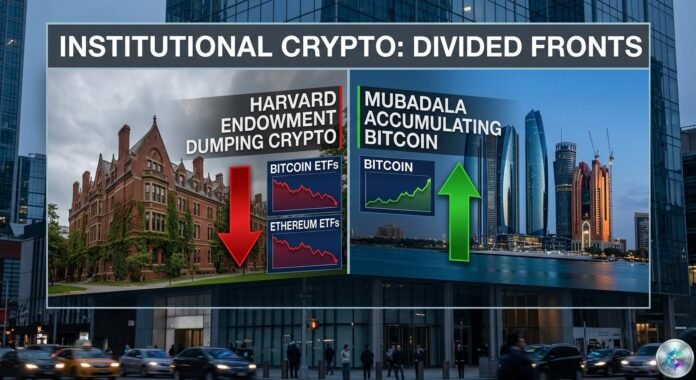
Harvard liquidates Ethereum ETF as Abu Dhabi doubles down on Bitcoin positions
Two opposing strategies emerged from the latest 13F filing cycle released this week. Harvard Management Company, one of the world’s largest university endowments with $56.9 billion in assets under management, fully liquidated its iShares Ethereum Trust (ETHA) position in Q1 2026 while simultaneously cutting its Bitcoin exposure by 43%. In parallel, Abu Dhabi’s sovereign wealth fund Mubadala continued its systematic accumulation of U.S.-listed Bitcoin products, pushing its position to over $565 million and confirming a profound institutional divergence in risk appetite and investment duration in the cryptocurrency market.
Context
Form 13F filings, mandatory for any investor holding more than $100 million in U.S. equity assets, provide a quarterly snapshot of institutional portfolios. For cryptocurrency-based exchange-traded funds listed on American stock exchanges, these documents represent the only public window for tracking how large wealth management institutions allocate within this emerging segment. Q1 2026 filings, published in mid-May, reflect positions held as of March 31, 2026 and are now being thoroughly analyzed by all market participants.
The U.S. listed crypto ETF market has experienced explosive growth since the SEC’s historic approval of spot Bitcoin products in January 2024. BlackRock, Fidelity and other major asset managers have watched their products attract billions of dollars in net inflows. By May 2026, total assets under management of U.S. spot Bitcoin ETFs exceeded $66 billion, making this segment one of the most dynamic in the exchange-traded fund industry and a significant driver of institutional crypto adoption.
Prolonged crypto market volatility since the start of 2026, with Bitcoin trading in a $78,000 to $80,000 range throughout May, appears to have catalyzed divergent strategic choices between traditional American institutions and Gulf sovereign investors. This divergence illustrates two radically different investment philosophies facing a new-generation asset class that sits at the intersection of digital gold, diversification tool, and speculative instrument.
The Facts
Harvard Management Company (HMC) completed in Q1 2026 a drawdown movement initiated in late 2025. The Cambridge, Massachusetts university exited its entire stake in BlackRock’s iShares Ethereum Trust (ETHA), even though it had entered just the previous quarter with an approximate $87 million position. This rapid entry and equally rapid exit illustrates the experimental nature of crypto allocation for an institution whose traditional investment horizon is measured in decades rather than quarters.
In parallel, Harvard’s position in iShares Bitcoin Trust (IBIT) was cut by 43%, falling from 5.35 million shares to approximately 3.04 million shares. This reduction means the endowment sold nearly half of its listed Bitcoin shares in a single quarter, during a period when the market was undergoing extended consolidation after the spectacular run-up in 2024.
In absolute dollar terms, Harvard’s declared crypto exposure fell from $353 million to approximately $117 million, a 67% reduction in a single quarter. HMC’s total assets under management stand at $56.9 billion, meaning the remaining IBIT stake now represents approximately 0.2% of the overall portfolio. Harvard’s crypto allocation, which had peaked at nearly $530 million in Q3 2025 (when IBIT had become the largest equity position in the portfolio), has been divided by more than four in just six months.
| Indicator | Q4 2025 | Q1 2026 | Change |
| IBIT Shares | 5,353,612 | 3,044,612 | -43% |
| IBIT Value | ~$266M | ~$117M | -56% |
| ETHA Shares | ~3.87M | 0 | -100% |
| ETHA Value | ~$87M | $0 | -100% |
| Total Crypto ETF | ~$353M | ~$117M | -67% |
| HMC Total AUM | $56.9B | $56.9B | 0% |
| Portfolio Share (%) | ~0.9% | ~0.2% | -0.7 pt |
At the same time, Abu Dhabi’s Mubadala fund disclosed 14.72 million shares in IBIT, valued at $565.6 million as of March 31, 2026. That represents a 16% increase from the 12.70 million shares held at the end of Q4 2025. The fund therefore purchased approximately 2 million additional shares during the quarter, representing systematic accumulation even during a market consolidation period. The institution manages a global portfolio exceeding $330 billion in assets, and its IBIT position represents only an infinitesimal fraction of its total assets, but the political signal of this allocation is considerable within the institutional investor community.
With its subsidiary Abu Dhabi Investment Council (ADIC), the combined IBIT position of the two Abu Dhabi vehicles crossed the symbolic $1 billion threshold by the end of 2025, marking a historic milestone for Gulf Cooperation Council sovereign participation in regulated Bitcoin products. The firm Goldman Sachs for its part declared approximately $2.36 billion in crypto exposure through IBIT and other vehicles in the same 13F filing cycle, confirming the scale of institutional engagement from traditional financial powerhouses.
Bitwise asset management launched in October 2025 the first U.S.-listed staking Solana ETF, providing direct exposure to yields generated by token delegation on the Solana network. Dartmouth College disclosed approximately $3.3 million in this product and some $3.5 million in Grayscale’s Ethereum Staking ETF, illustrating that some university endowments are still exploring the possibilities offered by structured products based on DeFi protocols.
Analysis
The contrast between Harvard and Mubadala is striking and illustrates a deep institutional divergence in how different categories of investors assess risk and optimal duration of exposure to cryptocurrencies. Gulf sovereign funds, guided by virtually unlimited investment horizons and a strategy of diversifying oil-currency reserves, view Bitcoin primarily as a form of digital gold. They systematically accumulate during periods of price weakness, without concern for quarterly fluctuations that are invisible on a twenty- or thirty-year investment horizon.
American university endowments, for their part, present a structurally shorter risk profile. They must preserve the value of their portfolios to fund annual operating expenses of their respective institutions, which constrains them to more reactive volatility management. Harvard’s historical approach to alternative assets consists of testing, gauging, and then rebalancing based on market conditions and treasury imperatives.
Harvard’s massive entry into IBIT in Q3 2025, to the point of making it the largest equity position in the portfolio with nearly $530 million, was already atypical for an institution of this type. This allocation had been widely commented on in American financial circles, with some analysts seeing it as evidence of strong long-term conviction and others arguing it represented a fashion-driven move inspired by the enthusiasm generated by Bitcoin ETF approvals.
An analyst at the Center for Financial Studies in Frankfurt explained: « Gulf sovereign funds have a virtually unlimited investment horizon. They can afford to wait for a complete market cycle, several years, without this impacting their operational functioning. University endowments, on the other hand, must preserve value for annual operating expenses. Their appetite for volatile assets adapts to market conditions and their perception of risk. Mubadala has characterized its Bitcoin allocation as a long-term diversification strategy, explicitly comparing the digital asset to gold in its official communications. Universities, on the other hand, have a more operational horizon. »
Harvard’s decision to completely exit the Ethereum ETF while maintaining a Bitcoin position deserves particular analysis. It could reflect a marked preference for Bitcoin as a digital reserve asset, deemed more suitable for an alternative treasury role than Ethereum, whose economic model depends more closely on DeFi protocol activity and decentralized applications running on its network.
Market Reactions
Deferred flow data from U.S.-listed Bitcoin products reflects short-term market sentiment and shows a mixed picture. On May 13, 2026, U.S. spot Bitcoin ETFs recorded approximately $635 million in daily net outflows, their worst single day in months. IBIT alone accounted for $285 million of those outflows, reflecting a short-term investor preference for taking profits rather than new allocations.
Ethereum ETFs experienced a parallel $36 million in outflows the same day, extending a multi-week streak of defl ows for the ether segment. This divergence in flows between Bitcoin and Ethereum products contrasts with the trajectory of flows on Bitcoin products, which had experienced sustained inflows during most of Q1 2026.
Despite these short-term outflows, BlackRock’s IBIT maintains a streak of six consecutive weeks of net inflows as of May 13, with total assets under management at $66.1 billion. The product remains the dominant vehicle in the U.S. spot Bitcoin ETF market, with a market share exceeding 50% of the segment’s net assets.
On the structured crypto-based products market, Goldman Sachs filed in April 2026 an application with the SEC to create a « Bitcoin Premium ETF, » a derivative product designed to generate regular yields by selling options on Bitcoin ETFs. This initiative illustrates how major investment banks are transforming cryptocurrencies into traditional financial products, accelerating their institutionalization and making them accessible to a broader range of institutional investors through familiar vehicles.
Outlook
For Harvard, the question of timing for the next market entry point arises now. With $117 million still held in IBIT, the endowment has preserved significant presence in the Bitcoin ETF market, but its relative exposure has declined very rapidly from the $530 million peak recorded in Q3 2025. The timing of a potential reallocation in the coming quarters will depend on several factors, including the evolution of the U.S. federal regulatory framework for cryptocurrencies, the direction of real interest rates, and whether Bitcoin can break through the psychological $100,000 resistance level.
For Gulf sovereign funds, structural accumulation appears set to continue in the coming months and years. Mubadala characterized its Bitcoin allocation as a « long-term diversification strategy, » explicitly comparing the digital asset to gold in its official communications. The firm expects both assets to play structural roles in its portfolio as the global economy digitalizes and demand for alternative reserve assets to sovereign government bonds continues to grow among sophisticated institutional investors.
The current divergence among institutional actors could persist or intensify in the coming quarters. Some analysts predict the emergence of a differentiated institutional consensus: Bitcoin as a digital reserve asset (on the model of gold in exchange reserves), Ethereum as a DeFi infrastructure supported by structured ETF products. Others, more cautious, argue that Harvard’s decision to fully liquidate its ETH position suggests this differentiation has not yet been validated by the market.
The most significant evolution to monitor remains the continued institutionalization of the market. With Goldman Sachs entering the Bitcoin ETF derivatives segment, with the growing participation of sovereign funds, and with the multiplication of regulated products accessible to institutional investors, the cryptocurrency market is completing its transformation from speculative asset to institutionally accepted alternative asset class.
Sources
- Harvard Cuts Bitcoin ETF Stake 43%, Exits Ethereum ETF — Our Crypto Talk
- Mubadala raises its Bitcoin ETF stake 16% to $566 million — CryptoNews
- Harvard Management Company Exits Ethereum ETF, Abu Dhabi Sovereign Fund Continues to Increase Bitcoin Holdings — ABAB News
- Dartmouth adds Solana ETF as endowment crypto exposure reaches $14M — MEXC
- Harvard Endowment Slashes Bitcoin Investment, Buys $86.8M Worth of Ethereum ETF Shares — The Daily Hodl
- Goldman Sachs files for Bitcoin Income ETF — CoinDesk

