

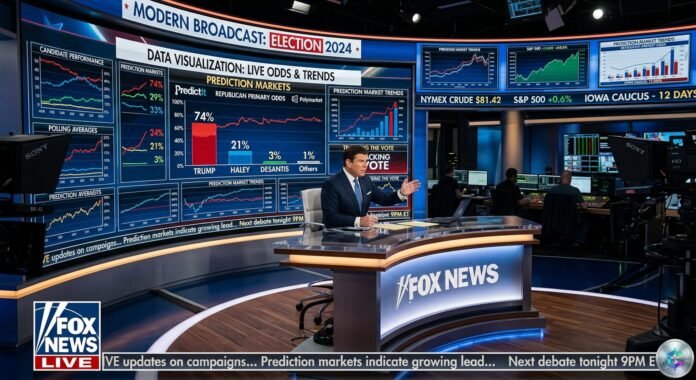
Fox Integrates Prediction Market Data from Kalshi into News Broadcasts
Fox Corporation, the American media giant, announced the integration of prediction market data from Kalshi into its news broadcasts and information programs. This decision marks a major step in using prediction markets as a journalistic tool.
Kalshi, the prediction market platform regulated by the CFTC, allows investors to trade on the outcomes of economic, political, and even sporting events. By integrating this data into its programs, Fox offers viewers a new perspective on market expectations.
A First in the Media Industry
This is the first time a major American television network has integrated prediction market data so extensively into its editorial content. Traditionally, news networks rely on polls, expert analysis, and traditional economic data to inform their viewers.
Fox’s approach represents a paradigm shift. Unlike polls, where people can say anything without consequence, prediction markets require participants to put their money where their mouth is. This economic constraint creates powerful incentives for accuracy.
How Prediction Markets Work
Prediction markets allow participants to buy or sell contracts on the outcome of future events. If a participant thinks an event will occur, they buy contracts that increase in value if the event happens.
For example, on Kalshi, one can trade on questions like: Will US GDP exceed 2% this quarter? Will the Fed cut rates? Will a certain team win its match? These contracts are quoted in cents, from 0 to 100, representing the probability perceived by the market.
The beauty of these markets is their ability to aggregate information. Unlike polls where people can say anything, prediction markets require participants to put skin in the game. This economic constraint creates powerful incentives for precision.
Fox’s Journalistic Advantage
By integrating Kalshi data, Fox has a significant competitive advantage. Viewers can see in real time how the market evaluates the probabilities of various events, rather than relying solely on analyst projections.
This transparency offers a more dynamic view of collective opinion. Whereas a poll is a snapshot at one point in time, prediction markets are a continuously updating film that adjusts to new information.
Kalshi data already shows interesting trends. For example, markets have often been more accurate than traditional polls at predicting electoral outcomes. This superior performance explains the growing media interest in this data.
Implications for the Media Industry
Fox’s initiative could trigger an arms race in the media industry. Other networks might seek to integrate similar data to remain competitive. Prediction markets offer unique content that can retain viewers.
For advertisers, this data also represents an opportunity. Understanding how consumers perceive the future can help create more relevant campaigns. Market-based advertising could become a new norm.
However, this integration also raises questions about media ethics. Journalists must clearly explain to viewers that prediction market data is not certain prediction but probability assessments based on trader behavior.
Challenges and Limitations
Despite the benefits, there are challenges. Prediction markets can be volatile and influenced by factors unrelated to the events themselves. A tweet from an influential figure or unexpected news can move prices dramatically.
Additionally, not all events are suitable for prediction markets. Some topics may be too complex or difficult to quantify. Media must carefully select which indicators to present.
The regulation of prediction markets also remains a concern. The CFTC has authorized these markets but maintains close oversight. Any regulatory change could affect data availability.
Future Outlook
Fox’s integration may represent the beginning of a new era for financial journalism. Prediction markets offer a unique window into market collective intelligence, and media that know how to exploit them will have an advantage.
For viewers, this means access to more dynamic and potentially more accurate information about market expectations. But it remains essential to understand the nature of this data and its limitations.
Fox’s experience will be closely followed by the entire industry. If it succeeds, we can expect prediction market data to become a staple of the American media landscape.
This article is for informational and educational purposes only. It does not constitute investment advice. Prediction markets are complex financial instruments: conduct your own research before making any financial decisions.

