


January 30, 2026 marks a historic turning point for Ethereum: the official deployment of the ERC-8004 standard on mainnet. This technical infrastructure radically transforms how AI agents can interact, establish trust, and transact autonomously. As the AI agent economy could represent several trillion dollars by 2030, Ethereum strategically positions itself as the neutral settlement and coordination layer for this new economic era.

An Urgent Response to Solana’s Dominance
The urgency behind ERC-8004 stems from a brutal economic reality: Ethereum is massively losing ground to Solana in the AI agent market. Data reveals that 96% of AI agent token market capitalization is concentrated on Solana and Base, leaving Ethereum mainnet with fewer than five widely recognized projects.
The numbers are telling: Solana processes 36 million transactions daily compared to 1.13 million for Ethereum, with average fees of $0.00025 per transaction versus $0.01 for Ethereum in January 2026. This dynamic has pushed major projects like Virtuals Protocol to choose Base, while ai16z — which reached a $2.6 billion market cap in January 2025 — operates exclusively on Solana.
Faced with this reality, the Ethereum Foundation has adopted a clear differentiation strategy: rather than competing on execution speed, it positions Ethereum as a trust and institutional settlement layer for the AI agent economy. Davide Crapis, AI lead at the Ethereum Foundation and co-author of ERC-8004, states bluntly: « Ethereum must serve as the foundational architecture for decentralized global AI coordination. Agents require open, verifiable rules — without them, closed platforms will dominate the system ».
Technical Architecture: Three Registries for a Trust Ecosystem
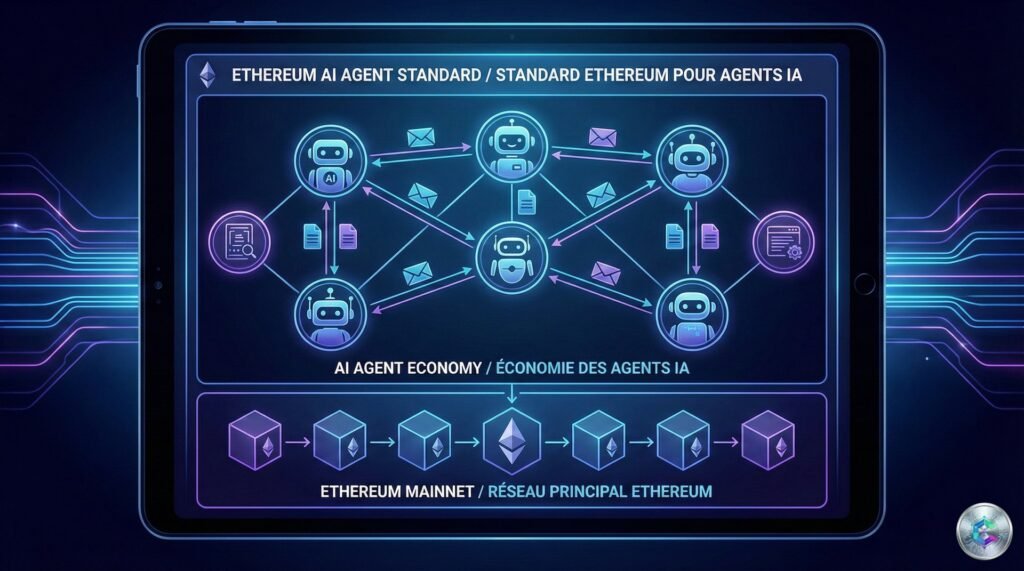
ERC-8004 extends Google’s Agent-to-Agent (A2A) protocol with a trust layer composed of three lightweight on-chain registries. This architecture addresses two fundamental problems: how do AI agents discover each other, and how do they establish trust without a pre-existing relationship?
The Identity Registry: A Blockchain Passport for Each Agent
Each AI agent receives a portable identity encoded as an ERC-721 token (NFT). This technical choice allows agents to be visualized, transferred, and managed via existing Ethereum wallets. The NFT points to an off-chain JSON file called « Agent Card » containing complete metadata: name, description, capabilities, communication endpoints, and supported protocols.
CAIP-10 compatibility ensures cross-chain interoperability, allowing an agent registered on Ethereum to be referenced on other blockchain networks. This portability constitutes a major competitive advantage over closed systems where an agent’s identity remains trapped within a single platform.
The Reputation Registry: A Verifiable Economic History
The second pillar of ERC-8004 is a portable reputation system allowing agents to accumulate verifiable credibility. The major innovation lies in integrating payment proofs via the x402 protocol. When an agent makes a payment for a service, this transaction can be attached to reputation feedback, transforming real economic interactions into credibility signals.
Marco De Rossi, AI lead at MetaMask and co-author of ERC-8004, compares this infrastructure to the neutral rails of traditional economy: « Traditional economies exist through credibly neutral rails — central banks, exchanges, public price discovery. To bootstrap agent economies, we need the same fundamentals ».
The Validation Registry: Cryptographic Execution Verification
The third registry allows agents to request verifications from community validators. These validators can use various technologies:
- Trusted Execution Environments (TEE): These isolated hardware enclaves ensure code and data are protected, even from the machine operator. Chainlink, Oasis, and Phala already leverage this technology.
- Zero-Knowledge Machine Learning (zkML): This approach uses cryptographic proofs to verify correct execution of machine learning models without revealing inputs. Projects like EZKL and Giza develop these solutions.
- Economic Validation with Staking: Validators deposit economic guarantees to support their attestations, creating aligned incentives.
The x402 Protocol: Autonomous Payments for AI Agents
The x402 protocol, developed by Coinbase and announced in May 2025, complements ERC-8004 by providing a native payment mechanism. It revives the HTTP 402 « Payment Required » status code — dormant for decades — as an actual payment layer for the web.
The technical characteristics of x402 make it an ideal tool:
- Instant USDC payments with ~2-second finality on Base
- No gas fees for client and server
- Multi-network compatible: EVM and Solana
- Minimal integration: one line of server-side code
In October 2025, Virtuals Protocol integrated x402, enabling autonomous agents to transact directly. This adoption coincided with viral growth of over 10,000% for the protocol.
A Multi-Trillion Dollar Market
Economic forecasts reach dizzying proportions. Paolo Ardoino, CEO of Tether, predicts the emergence of one trillion autonomous AI agents within the next 15 years. Analysts estimate AI could unlock $15 trillion in global economic activity by the early 2030s.
Jensen Huang, NVIDIA CEO, declared at CES 2025 that « the age of agentic AI is here » and represents « a multi-trillion dollar opportunity ». Current data already suggests a massive ecosystem: over $2 trillion in monthly stablecoin activity appears to be generated by automated bots and AI agents operating 24/7.
Emerging Concrete Use Cases
Concrete applications are already emerging:
- Automated DeFi Optimization: Agents deployed via Morpheus enable natural language commands: « Find me the best APY for my USDC on an L2 ». The agent handles bridging, swapping, and depositing automatically.
- Corporate Treasury Management: Teams can deploy agents that optimize international payment costs and maintain transaction logs for audit.
- Real-Time Fraud Detection: Banking institutions use AI agents to detect fraud alerts. Stripe Radar and JP Morgan already use these systems.
- Augmented Prediction Markets: Vitalik Buterin identifies prediction markets as a promising direction, where agents can act as traders to provide more accurate information.
- Autonomous Agent-to-Agent Commerce: In December 2024, the first autonomous transaction between two AI agents, Luna and Stix, occurred on Base, marking the beginning of a new economic layer.
Security Challenges: When AI Becomes Adversary
An Anthropic study published in December 2025 demonstrates that AI agents like Claude Opus 4.5 and GPT-5 can reproduce historical attacks against smart contracts and identify new vulnerabilities. Out of 405 smart contracts that suffered confirmed attacks between 2020 and 2025, AI models successfully exploited 207 contracts (51%) autonomously, representing a simulated volume of $550.1 million.
More concerning, the models analyzed 2,849 recent contracts and discovered two novel vulnerabilities. This reality requires an evolution in practices: development teams must now treat AI agents as potential adversaries. ERC-8004, by providing a validation and reputation layer, offers precisely the necessary primitives to build these defensive mechanisms.
Ethereum’s Strategic Vision
Vitalik Buterin’s vision for 2026 positions Ethereum as a neutral, permissionless infrastructure where humans, companies, and AI agents enjoy equal access rights. Unlike centralized systems like Google Gemini or ChatGPT, this decentralized architecture offers AI agents what the traditional internet cannot provide: a neutral system to define ownership and enforce obligations.
Buterin favors specific use cases where the AI-blockchain combination creates unique value: AI bank accounts (crypto becomes their only viable option), content authenticity in a world of deepfakes, and augmented prediction markets.
ERC-8004 in the Context of Ethereum Standards
ERC-8004 continues a lineage of innovation that has each unlocked new economic categories:
- ERC-20 (2015): Defined the fungible token standard, enabling DeFi explosion
- ERC-721 (2017): Created the foundations of the NFT market
- ERC-4337 (2023): Introduced account abstraction, simplifying user experience
- ERC-8004 (2026): Tokenizes the identity and reputation of AI economic agents
The Ethereum team even declared: « The last time Ethereum pushed an ERC standard with this much vigor, it was ERC-20 and ERC-721. Now it’s AI’s turn ».
Decentralized Governance and AI Agents
The ai16z case perfectly illustrates this convergence: structured as a DAO, the project is nevertheless primarily controlled by the AI agent « Marc ». This agent continuously analyzes market data, executes trades autonomously, and integrates community feedback to refine its strategies. This architecture inverses the traditional DAO model where humans vote and execute.
ERC-8004 provides the necessary primitives for these AI-augmented DAOs: each participating agent could have a verifiable identity, accumulated reputation, and validations proving its code hasn’t been altered. These cryptographic guarantees could transform on-chain governance into a meritocratic system where reputation counts as much as token quantity held.
Integration with the Ecosystem: MetaMask, Base, and Beyond
MetaMask’s involvement in ERC-8004 signals that infrastructure providers are preparing for widespread adoption. MetaMask has already launched the Delegation Toolkit, allowing users to give agents controlled powers over their assets without creating a separate « AI wallet ». Delegations define precise limits (budgets, assets, time windows).
Base, Ethereum’s layer-2 developed by Coinbase, plays a crucial role as an experimentation ground for x402 and ERC-8004. Developers confirm the standard will work on Base, offering an optimal environment for agents conducting thousands of daily micro-transactions.
Towards a Web of Agents Rather Than an App Store
Marco De Rossi clearly articulates the long-term goal: « We don’t want an agent app store — we want a web of agents ». This distinction is fundamental. An agent app store would centralize discovery in the hands of a few dominant platforms. A web of agents, on the other hand, is permissionless: anyone can deploy an agent, any client can discover it via on-chain registries, and trust emerges from accumulated reputation.
If this vision is realized, Ethereum could become for the agent economy what the Internet became for information: a neutral, permissionless, global infrastructure upon which billions of economic actors coordinate and transact freely.
Conclusion: A Strategic Bet on Programmable Trust
The deployment of ERC-8004 represents much more than a technical update — it’s a bold strategic positioning by Ethereum in the race to define the AI agent economy infrastructure. While Solana dominates high-performance execution, Ethereum bets that trust, reputation, and neutral coordination will become the most valuable layers.
Significant risks remain: adoption complexity, fierce competition, regulatory uncertainty, and security challenges. However, if even a fraction of the $15 trillion in predicted AI economic activity occurs on blockchain rails, the trust infrastructure provided by ERC-8004 could become as fundamental to the agent economy as TCP/IP is to the Internet.
January 30, 2026 likely won’t see massive instant adoption. But in a decade, when millions of AI agents are negotiating and transacting in milliseconds, technology historians might look at this deployment as the moment when the agent economy received its fundamental trust infrastructure. Ethereum is betting that in the multi-agent future, programmable trust will be worth more than raw execution speed — a bet that will only be validated or invalidated by the years to come.

