

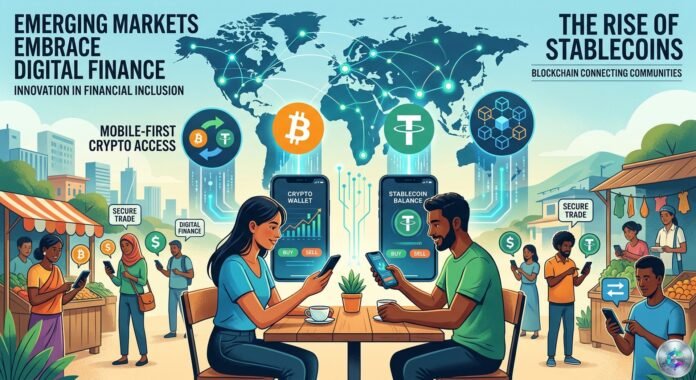
Emerging Markets Are Turning Crypto Exchanges Into Full-Fledged Banking Alternatives
Cryptocurrency platforms have become the primary gateway to financial services for hundreds of millions of people in developing countries. According to Binance Research’s « Finance Without Frontiers » report published in May 2026, 77% of Binance’s users now come from emerging markets, up from just 49% in 2020. This dramatic demographic shift is irreversibly redefining the role of crypto exchanges in the global financial system. This is not a marginal phenomenon: it involves entire nations where traditional finance has historically failed to provide basic services to its populations.
A Massive Financial Divide
Binance’s report exposes a reality that traditional financial institutions have long ignored. The figures are staggering: 4.7 billion adults lack access to credit or loans, 3.6 billion people in low- and middle-income countries do not have digital payments or bank cards, and 1.4 billion savers in these same regions earn no interest on their deposits. These numbers represent half of the world’s adult population.
At the same time, 900 million unbanked adults own a mobile phone and 530 million own a smartphone. This apparent contradiction, between the absence of banking services and high mobile penetration, is exactly what crypto platforms have exploited. A smartphone becomes the gateway to dollar-denominated savings, instant transfers, and limited investments, all without requiring a traditional bank account.
Traditional banks never built adequate infrastructure to serve these populations. Opening branches in rural Nigeria or remote Indonesia was prohibitively expensive. Maintaining compliance infrastructure for small-balance accounts exceeded the financial capacity of conventional institutions. Operational costs that eroded margins on small accounts made the traditional banking model fundamentally unsuited for these markets. The result: hundreds of millions of people turned to crypto platforms as a natural banking substitute.
Stablecoins at the Core of Emerging-Market Savings
The most striking phenomenon involves the massive use of stablecoins as savings instruments. Among Binance users from emerging markets with balances of at least $10, 36% hold at least half their portfolio in stablecoins. This is not speculation: it is protection against domestic inflation and currency depreciation. Globally, this rate of stablecoin usage for savings reaches 28%, up from just 4% in 2020. The evolution over five years is vertiginous.
Altogether, 73% of all stablecoin savers on Binance are based in emerging markets. This figure perfectly illustrates how populations in regions with unstable domestic currencies have found in stablecoins a way to protect their purchasing power. When the Lebanese pound loses 90% of its value in a few months or the Nigerian naira experiences regular depreciation, holding dollars as USDT on Binance becomes the only viable option to preserve savings.
Stablecoin transfers cost approximately $0.0001 per transaction on high-performance networks like Solana or Tron, compared to a minimum of $20 for a traditional cross-border SWIFT transfer. This 200,000-fold cost difference explains the massive adoption for international remittances. A migrant worker in Nigeria sending $200 per month to family via SWIFT pays $20 in fees, or 10% of the amount. Via stablecoins, the same transfer costs $0.02. This saving is enormous for low-income families.
The volume of remittances to emerging markets represents hundreds of billions of dollars each year. Stablecoins are becoming the preferred method for these flows, with costs reduced by 95% compared to traditional channels. In Brazil, stablecoins already account for 90% of the country’s total crypto volume, according to tax authority data. This is not a Brazilian phenomenon: in Nigeria, Kenya, the Philippines, and India, stablecoins are used daily by millions of people to receive funds from abroad.
Multi-Purpose Usage Beyond Simple Trading
Users in emerging markets are not limited to speculation or transfers. They use Binance as a full-fledged multi-purpose financial tool: dollar-denominated savings, cross-border payments, credit access, investments, and exchange services. This multi-product adoption is measurable: 83% of Binance users actively using two or more products on the platform are based in emerging markets.
This versatility also translates into growing use of more sophisticated financial products. Tokenized pre-IPO instruments allow users in countries outside major stock market jurisdictions to access initial public offerings from startups like SpaceX, Anthropic, or OpenAI, with average appreciation of 88% on secondary markets according to Venturals data. This type of opportunity was historically reserved for institutional investors in wealthy countries.
Additionally, artificial intelligence agents now represent a growing share of on-chain activity. Since 2025, more than 17,000 AI agents have been deployed, and 19% of on-chain activity is now automated or agentic. 76% of stablecoin transfer volume consists of bot transactions, according to Artemis data. This automation of financial flows illustrates a modernization of services that goes far beyond simple human usage.
The Limits of Financial Inclusion Through Crypto
While crypto platforms effectively fill the gap left by traditional banks, this situation is not without concerns from international regulators. Moody’s and the International Monetary Fund have both warned about financial resilience risks and monetary sovereignty issues linked to widespread stablecoin adoption in emerging markets. When hundreds of millions of people hold their savings in USDT rather than in local currency, central banks lose part of their capacity to conduct monetary policy.
The central problem also lies in the fact that these platforms often operate in jurisdictions with regulatory frameworks still being developed. When the legal framework is not adapted, recourse in case of disputes or loss of funds is limited. Users in emerging markets who do not have access to deposit insurance or regulatory protections comparable to those in developed countries are particularly exposed.
Binance has faced persistent scrutiny over its practices, particularly concerning illicit fund flows and market manipulation. The company recently implemented guidelines to ensure integrity in market-making partnerships for projects listed on its platform. These measures show that the company acknowledges the need to comply with international financial standards, but the challenges remain immense.
Binance’s expansion strategy in Asia, Africa, and Latin America deliberately targets markets where traditional finance has failed, but also markets where regulatory frameworks remain unwritten, sometimes in response to crypto-specific controversies. This strategy creates considerable opportunities for financial inclusion, but it also raises questions about consumer protection and global financial stability.
Prospects and Regulatory Challenges for 2026 and Beyond
Binance’s success illustrates a financial reality that traditional institutions can no longer ignore. Financial inclusion through blockchain and stablecoins works: it grants entire populations access to modern financial services without going through conventional channels. Entire cities in Nigeria, the Philippines, and Brazil now operate with stablecoins as basic financial infrastructure.
However, this rapid growth comes with significant risks. Regulators will need to find a delicate balance between protecting users and preserving the innovation that enabled this inclusion. Blocking stablecoins would deprive hundreds of millions of people of access to basic financial services. Not regulating them exposes these same populations to uncontrolled risks.
Stablecoins are no longer a niche phenomenon: they now represent essential financial infrastructure for hundreds of millions of people in emerging markets. Binance’s report shows that this transformation is not reversible. Populations that have discovered the advantages of instant and low-cost stablecoin transfers will not return to traditional financial systems even if these improve.
The regulatory question is now concrete: how to design a framework that preserves the benefits of financial inclusion while mitigating systemic risks? Answers will vary by jurisdiction, but the movement is underway. Stablecoins have become a permanent element of the global financial landscape, and regulators must now account for them in their reflections on the future of the international monetary system.
The Stablecoin Market in Full Expansion
Beyond transfers and savings, the market for stablecoin-denominated financial products is expanding. Stablecoin lending protocols allow users in emerging markets to access credit without going through local banks, often with more competitive rates than those offered by traditional institutions. DeFi protocols like Aave or Compound facilitate these borrowings in a decentralized manner, without a banking intermediary.
Stablecoin emissions have reached massive volumes in 2026. Tether has surpassed $150 billion in USDT in circulation, and Circle has exceeded $60 billion in USDC. This growth reflects both the real demand from emerging market users and the growing confidence of institutional players in these instruments. Governments themselves are exploring bank-issued stablecoins, with projects underway in about twenty countries.
Stablecoins have also opened the door to new financial products for underbanked populations. Decentralized insurance protocols now allow users to subscribe to coverage against risks specific to emerging markets, such as exchange rate risk or energy instability. Stablecoin savings accounts with annual yields of 5 to 15% attract millions of users who cannot find comparable offerings at their local banks.
Sources
- Emerging-market users are treating crypto exchanges like banking apps, Binance says — CoinDesk
- Binance Reports 77% of Users in Emerging Markets Treat Exchanges Like Banking Apps — Crypto Briefing
- Binance Reports 77% of Its Users Now Based in Emerging Markets — CoinMarketCap Academy
- Finance Without Frontiers — Binance Research
- Binance Reports 77% Emerging Market User Share as 1.4 Billion Adults Remain Unbanked Globally — MEXC

