


Core Scientific, a former Bitcoin mining heavyweight, has signed a 2.5-gigawatt AI hosting mega-deal with AMD. According to a Bernstein note published on July 30, 2026, the arrangement could generate roughly $14 billion in revenue over 15 years and reshapes the economic model of pivoting crypto miners.
🔑 Key Takeaways
- 530 MW initially contracted, with optional expansion up to 2.5 GW by the end of the decade
- ~$900M average annual revenue, implying a $1.8M per MW rate
- Adjusted operating margin estimated at nearly 96% across the combined deal
- 30 million AMD warrants struck at $23.47 per share
- Bernstein reiterates Outperform with a $32 price target
A mega-deal built around 530 megawatts
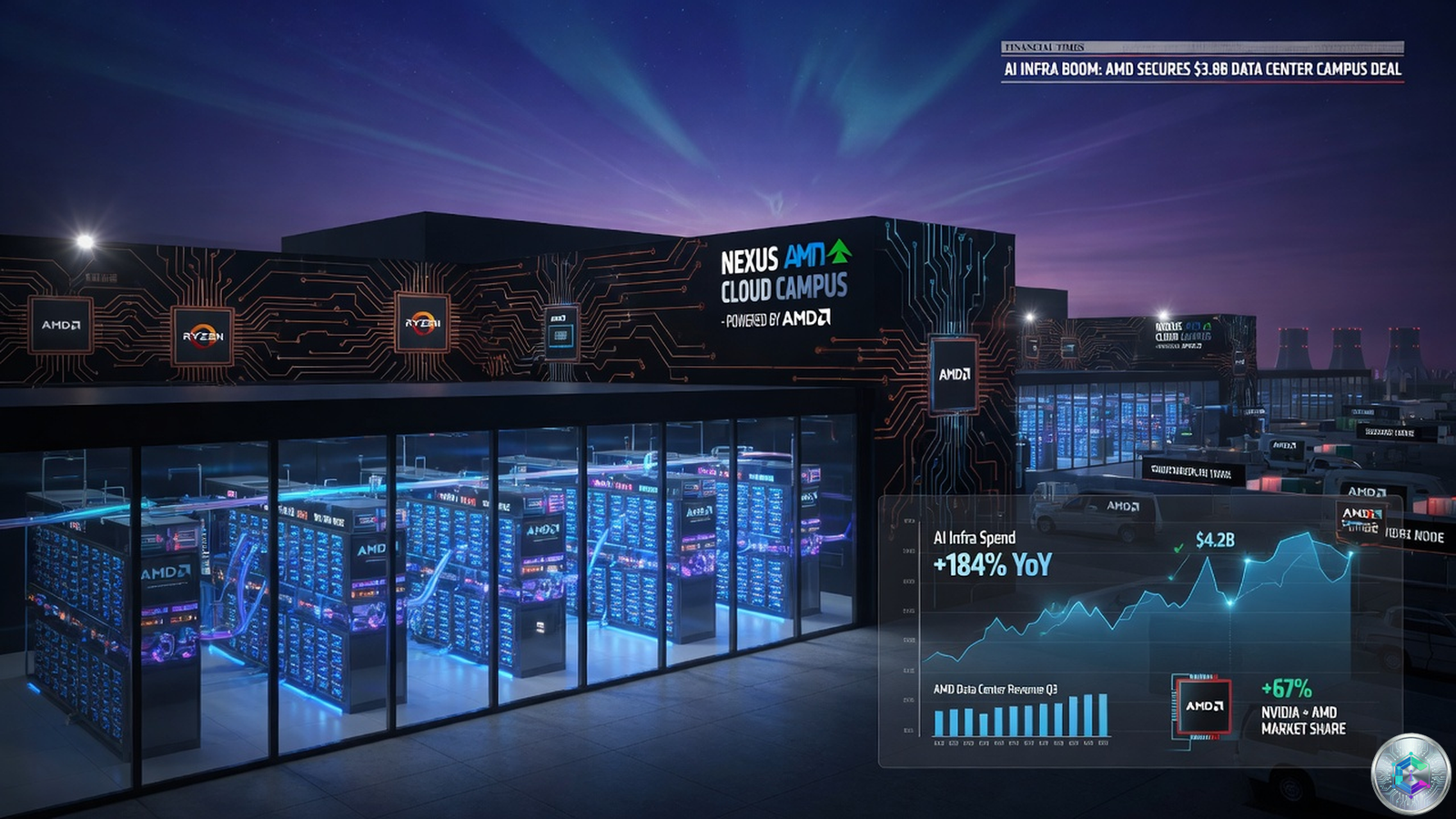
Announced on July 28, 2026, the partnership covers an initial 500+ MW of U.S. infrastructure coming online from 2027, with an option to expand to 2.5 GW. The 530 MW effectively contracted splits into two distinct tranches, each with its own risk and return profile.
A first 377 MW block is leased directly to AMD under a triple-net structure (operating expenses, insurance and taxes borne by the tenant). A second 152 MW block is leased to an undisclosed neocloud provider (a specialized operator offering on-demand GPU compute) backed by an AMD credit guarantee. Core Scientific keeps a high-quality intermediary but relies on the chipmaker’s signature to secure payment.
Competitive pricing, unmatched margins
Bernstein puts Annualized Run Rate revenue at approximately $900 million, implying an average rate of $1.8 million per megawatt. That level sits 5% to 25% below recent colocation contracts (third-party hosting of compute equipment) signed by other crypto miners, whose rates range from $1.9M to $2.4M per MW.
“Direct leases with investment-grade tenants are superior to earlier structures that relied on a credit guarantee from a partner like Google, as they reduce financing costs and counterparty risk over 15- to 20-year tenors.”
Gautam Chhugani, Chairman, Bernstein
The triple-net structure on the 377 MW leased to AMD produces margins close to 100%. Combined, the adjusted operating margin reaches nearly 96% — an exceptional level for a physical infrastructure business. Capex is estimated at $11M to $12M per MW, or roughly $6 billion for the whole project, of which slightly more than $1 billion has already been deployed. Core Scientific plans to fund the balance through project-level debt.
Chipmakers step in as credit guarantors
AMD receives warrants on 30 million Core Scientific shares at the current $23.47 price. Those warrants only vest if the partnership hits its full 2.5 GW potential — a mechanism that aligns incentives between the two parties. Bernstein characterizes these arrangements as “less aggressive” than some critics fear, given that compute demand outstrips the limited supply of powered shells and land.
| Operator | Counterparty | Capacity | Status |
|---|---|---|---|
| Core Scientific | AMD | 530 MW → 2.5 GW | Direct + sub-lease |
| Hut 8 | Nvidia (per FT) | 704 MW | Single tenant |
| Core Scientific | CoreWeave | 437 MW delivered / 590 MW | Ahead of schedule |
| Riot Platforms | AMD | 200 MW | Separate lease |
Core Scientific now has roughly 1.1 GW of compute load secured through its AMD and CoreWeave agreements, with an additional ~2 GW of expansion potential under the AMD deal. The CoreWeave contract is running ahead of plan: 437 MW were delivered by mid-July 2026, versus a 590 MW target slated for early 2027.
A contract pipeline reshaping the mining sector
Core Scientific operates eleven sites across seven U.S. states: Alabama (1), Georgia (2), Kentucky (1), North Carolina (1), North Dakota (1), Oklahoma (1) and Texas (4). The bulk of revenue now comes from high-density colocation, with the rest split between proprietary cryptoasset mining and miner hosting. Remaining mining facilities are being progressively converted to AI colocation.
The move illustrates a broader trend Bernstein has flagged: chipmakers are acting as guarantors behind long-dated leases, enabling former Bitcoin miners to finance AI capacity. Miners bring grid connections and powered shells, while chipmakers lend their credit profile to anchor creditworthy tenants. Other landmark deals have been signed recently, including Hut 8’s 704 MW with a single tenant the Financial Times identified as Nvidia.
Conclusion
The Core Scientific-AMD partnership validates an equation that, until recently, was theoretical: a former Bitcoin miner can monetize its power and land footprint at near-software margins, while retaining a crypto strategic foothold. For sector players, the priority is now to lock in investment-grade tenants before the expansion window closes. Near term, attention will shift to the conversion of the 1.1 GW already secured and to the trajectory of the $900M Annualized Run Rate, expected at full ramp.
Longer term, the key unknowns are the evolution of GPU demand for AMD versus Nvidia, and Core Scientific’s ability to fund the $6 billion capex through the bond market. A failure to raise that financing, or an AI-market reversal, would quickly separate Bernstein’s $32 target from the current $23.47 share price.
Sources
- The Block — Bernstein says Core Scientific’s AMD partnership could generate $14B over 15 years
- Yahoo Finance — Why AMD, Core Scientific’s $14B Deal Matters
- HPCwire — Core Scientific and AMD Announce Infrastructure Partnership
- Core Scientific Investor Relations — Press release
- Seeking Alpha — AMD partners with Core Scientific for 500 MW AI infrastructure deal
This article is for informational and educational purposes only. It does not constitute investment advice. Do your own research (DYOR) before making any decision.

