

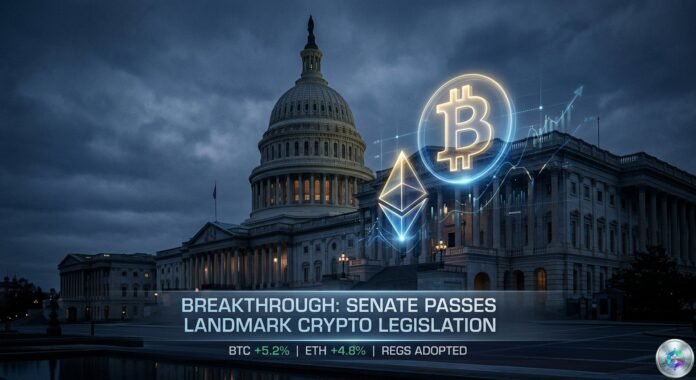
Coinbase Reaches Deal on Clarity Act Stablecoin Yield, Clearing Path to Senate Markup
A deal has been reached on one of the most contested provisions of the Clarity Act, industry advocates announced on May 1, 2026. Coinbase chief legal officer Paul Grewal confirmed that negotiations over stablecoin yield had concluded, removing the primary obstacle that had blocked the landmark crypto market structure bill for months. The battle between traditional banks and the crypto industry over rewards paid to stablecoin holders now appears resolved, opening the prospect of a historic vote at the Senate Banking Committee as early as mid-May.
Background
The Clarity Act is the flagship U.S. crypto market structure bill, designed to establish a clear regulatory framework for digital assets. Since its initial introduction, the legislation has accumulated delays in the Senate Banking Committee, with a markup originally scheduled for January 2026 and repeatedly postponed. This legislative slowdown has frustrated both the crypto industry, which had been awaiting a federal framework for years, and institutional investors waiting for regulatory clarity before deploying capital in the token markets.
The central reason for these repeated postponements lies in the deep disagreement between American banks and crypto platforms over stablecoin yield — the interest or rewards paid to stablecoin holders. This technical dispute masked a larger confrontation between two economic models: traditional banks, which view yield-bearing stablecoins as a threat to their credit monopoly, and DeFi platforms and token issuers, which see yield as an essential component of their value proposition.
Commercial banks, represented by the industry’s leading associations including the American Bankers Association, pressured Senator Thom Tillis, the bill’s lead Republican negotiator, to outright prohibit the payment of yield on passive stablecoin holdings. Their core argument was that if stablecoins offered competitive returns with traditional savings accounts, households might withdraw deposits from banks and transfer them to digital tokens, triggering a liquidity crisis for the banking system. Studies commissioned by the banking sector cited alarming figures, warning of potential deposit flight totaling hundreds of billions of dollars.
On the other side, Coinbase, Kraken, Circle, and the broader crypto industry fiercely defended stablecoin holders’ right to earn rewards on their holdings. Platforms argued that the proposed restrictions had no solid empirical basis. Paul Grewal repeatedly told the Senate that real-world data showed no significant migration of deposits to yield-bearing crypto products, and that bank studies relied on unrealistic assumptions about mass conversion of checking accounts into reward-bearing tokens.
The Facts
On May 1, 2026, Coinbase chief legal officer Paul Grewal appeared on Fox Business’s Mornings with Maria and stated without equivocation: « I think we are very close to a deal. Negotiators are working in good faith and I believe we will make progress very soon. » This interview marked the most explicit public signal from Coinbase on the state of negotiations since the company reviewed the March 23 draft text and communicated detailed concerns to Senate staff regarding DeFi clauses and developer restrictions.
Senator Thom Tillis then confirmed this major development in a press statement on Capitol Hill. « The banking industry’s objections regarding stablecoin yield have been resolved, » he said, adding that he would ask Senate Banking Committee chair Senator Tim Scott to schedule a markup as soon as legislators return from the congressional recess. The statement marked a notable reversal for a senator who, just days earlier, had raised fresh concerns about the bill’s impact on software developers under a 1960-era criminal statute, all within a context of heightened scrutiny of digital asset activities.
Senator Cynthia Lummis, the Democratic co-sponsor of the bill from Wyoming, spoke at the Bitcoin 2026 conference in Las Vegas on April 29. She stated that the Clarity Act markup should take place by mid-May, with potential final passage by June if everything proceeds as planned. « We have made enormous progress over the past months. Tillis’s press conference confirms that we are approaching the finish line, » she told the audience, which organizers said drew 40,000 participants.
SEC Chair Paul Atkins confirmed at the same event that he shared the outlook for advancement in May. In a dedicated regulatory panel, he stated that the current Clarity Act proposals were « on the right track » and that the federal agency was prepared to coordinate with the new legislative framework upon the bill’s passage. This convergence between the SEC, the Senate, and the crypto industry creates a rare political momentum on digital asset issues.
The final compromise preserves the prohibition on yield tied to passive stablecoin holdings — that is, simply holding tokens in a wallet without using them. In contrast, it allows reduced but genuine rewards for users who actively engage with platforms: recurring payments, loyalty program participation, regular interaction with decentralized applications. As Faryar Shirzad, Coinbase’s chief policy officer, summarized on X: « In the end, banks secured more restrictions on passive rewards, but we protected what really matters: the ability of Americans to earn rewards based on their actual use of crypto platforms and networks. »
Analysis
The report from the White House Council of Economic Advisers (CEA), published on April 8, 2026, provided decisive ammunition for yield advocates. Titled « Effects of Stablecoin Yield Prohibition on Bank Lending, » the 47-page document demonstrated that a stablecoin yield prohibition would have only a marginal impact on American bank lending. According to the CEA’s econometric model’s baseline estimates, even under extreme assumptions — a twenty percent increase in stablecoin holdings and full transfer to non-lending products — community bank lending would increase by only $129 billion, or 6.7 percent.
The report further noted that studies advanced by the banking lobby rested on theoretical assumptions never observed in practice. To date, there is no empirical evidence of significant migration of bank deposits to yield-bearing stablecoins in jurisdictions where such products are available. « In short, a yield prohibition would do very little to protect bank lending, while forgoing the consumer benefits of competitive returns on stablecoin holdings, » the report concluded with unusual firmness for an executive document.
This report marked a decisive turning point in the negotiations. Banks, stripped of their economic argument, could no longer justify a total yield ban against an administration and Senate increasingly convinced by the crypto industry’s reasoning. Senator Tillis, who had hesitated for months to take sides, ultimately concluded that the compromise was acceptable to all parties.
Meanwhile, the OCC (Office of the Comptroller of the Currency) continues its own parallel regulatory action. In February 2026, the agency published a notice of proposed rulemaking to implement GENIUS Act provisions, signed in July 2025, concerning payment stablecoin issuers. This proposal takes a broad view of the yield prohibition, applying to OCC-supervised institutions and their affiliates. If the GENIUS Act and the Clarity Act advance in tandem, their respective provisions will need to be harmonized to avoid legal contradictions that could paralyze the market.
Market Reactions
The announcement of an imminent deal on stablecoin yield triggered a positive reaction in American digital asset markets. Coinbase shares (COIN, Nasdaq) rose 8 percent in the hours following Paul Grewal’s statements, reflecting traders’ optimism about major regulatory clarity. The stablecoin market, which now represents more than $200 billion in capitalization, anticipates increased transaction volumes and accelerated institutional adoption.
Ripple CEO Brad Garlinghouse was the most bullish at a sector conference in Las Vegas. He stated he expected Clarity Act passage by the end of May, while acknowledging he had already announced three similar timelines that were not met. « I remain confident. The political environment has never been this favorable and negotiations are truly advanced this time, » he told attendees.
The American Bankers Association did not wish to publicly comment on the reached compromise. Sources close to the matter, speaking on condition of anonymity, indicated that the restrictions obtained on passive rewards were being viewed as a partial victory. The banking sector nevertheless remains vigilant about implementation details and the OCC’s future rules, which could, in its view, create loopholes in yield oversight.
Major DeFi players greeted the agreement with considerably more enthusiasm. Uniswap, Aave, and Compound, which together represent more than $50 billion in locked value, emphasized that the compromise preserved access to decentralized financial services for millions of American users. Several nonetheless expressed puzzlement at the maintained restrictions on DeFi developers, which they argued could hinder American innovation in a sector dominated by established protocols based outside the United States.
Outlook
With the primary obstacle removed, the path to a Senate Banking Committee markup now appears clear. The mid-May window, with a precise date still to be confirmed by committee chair Tim Scott, represents the next major inflection point. If the committee acts on the bill in May, a Senate floor vote could follow in June, leading to final passage before the midterm election cycle intensifies and inevitably slows congressional activity.
Several conditions must nonetheless be met for this scenario to materialize. Senator Tillis emphasized the need for « good faith » from all parties to advance the text in the coming days. The fate of provisions concerning executive branch crypto holdings — an ethics clause targeting the President’s and his associates’ digital assets — could create additional friction at markup time. Protections for DeFi developers, including provisions of the Blockchain Regulatory Certainty Act and Section 1960 protections in the U.S. Code, also remain uncertain.
For investors and market participants, the most likely scenario remains progressive adoption of the regulatory framework over the coming months. Direct implications touch trading volumes at regulated platforms like Coinbase and Kraken, conditions for listing digital tokens on secondary markets, and institutional actors’ ability to deploy large-scale crypto products. Asset managers including BlackRock, Fidelity, and Franklin Templeton, all of which launched Bitcoin-linked products this year, are closely monitoring the regulatory framework’s evolution in preparation for new launches.
The prospect of clear federal stablecoin legislation, combined with the already enacted GENIUS Act, would fundamentally transform the legal environment in which major U.S. crypto sector participants operate. For the first time since the beginning of the 2020 regulatory crisis, American industry would have a coherent and predictable framework for payment tokens, exchange platforms, and custodial services. This newfound clarity could attract considerable capital flows from Europe and Asia, where stricter regulations have prompted several players to relocate.
Sources
- Coinbase Says Deal Reached on Clarity Act, Stablecoin Yield Clearing Path to Long-Stalled Senate Markup — The Block
- CLARITY Act : Coinbase’s Top Lawyer Says a Stablecoin Yield Deal Is Very Close — FinTech Weekly
- Coinbase deal unlocks Senate crypto push as stablecoin yield standoff breaks — Cryptonews.net
- Clarity Act Breakthrough : Senator Tillis Backs Markup and Says Stablecoin Disputes Are Resolved — Coinpedia
- Coinbase CLO Says CLARITY Act Stablecoin Yield Deal Is Very Close — CoinMarketCap Academy
- Effects of Stablecoin Yield Prohibition on Bank Lending — White House CEA
- Stablecoin Yield Saga Continues : OCC, Congress, and the White House Weigh In — JDSupra
- Clarity Act Markup Slips to May as Tillis Seeks More Time, But OCC Advances Stablecoin Rules — Yahoo Finance

