

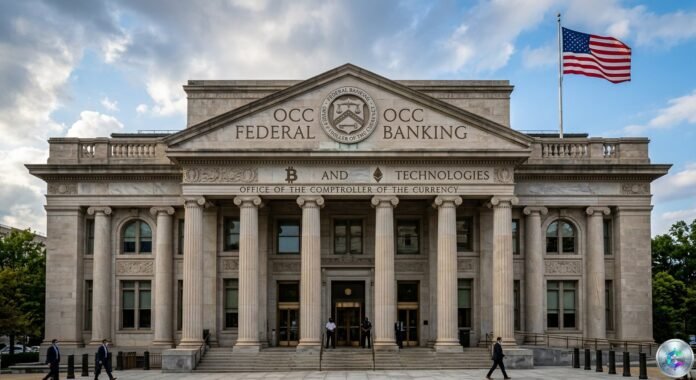
Coinbase moves closer to federal bank status with OCC conditional approval
On April 2, 2026, Coinbase received conditional approval from the Office of the Comptroller of the Currency (OCC) to establish Coinbase National Trust Company, an uninsured New York-based structure. This historic decision marks a major step in the American platform’s quest for clear federal regulatory framework. It moves closer to becoming a qualified digital guardian for institutional assets under direct federal supervision.
This major news comes in a context where the US cryptocurrency market is desperately seeking regulatory reference points after years of uncertainty, regulatory conflicts, and risky navigation between different supervisory authorities.
Application context
Coinbase had submitted its national charter application in October 2025, six months before this conditional approval. This processing timeline is similar to those for Circle, Ripple and other major sector players during the December 2025 charter wave.
The Office of the Comptroller of the Currency is one of the primary US banking regulatory agencies. This independent agency within the US Treasury Department oversees national banks and federal savings associations. It plays a crucial role in granting bank charters and regulating financial institutions operating at the national level.
The national trust charter approval process is particularly rigorous. It requires demonstrating robust technical capabilities, adapted compliance systems, and sufficient financial resources to operate safely.
A historic approval
The OCC approval represents much more than an administrative green light. It means the US regulator now explicitly recognizes Coinbase’s role in the national financial infrastructure. This recognition marks a turning point in the relationship between regulatory authorities and cryptocurrency industry players.
Brian Armstrong, CEO of Coinbase, called this decision a fundamental step for cryptocurrency adoption in the United States. This approval demonstrates that traditional financial institutions are beginning to accept digital assets as a legitimate asset class.
This decision could have major implications for the entire US cryptocurrency industry. It provides a clearer regulatory framework for institutional players looking to position themselves in this growing market.
What is a national trust charter?
A national trust charter allows an institution to act as a qualified custodian for financial assets. Unlike a traditional bank charter, this structure does not allow receiving traditional bank deposits or issuing loans.
However, it authorizes holding funds and assets on behalf of institutional clients, managing clearing accounts, and providing fiduciary services. For Coinbase, this charter represents the ability to offer qualified custody services compliant with federal standards.
This structure also provides access to the federal payment system, facilitating dollar transactions for institutional clients. It’s a major competitive advantage in a market where regulatory compliance is becoming increasingly important.
Industry implications
This approval places Coinbase in a unique position versus competitors. The platform can now offer qualified custody services compliant with federal standards, meeting the growing requirements of institutional investors in terms of security and compliance.
Other sector players like Kraken or Binance US are closely watching this regulatory development. This decision could influence their own regulatory strategies and encourage them to pursue similar approaches.
Coinbase’s OCC approval also sends a positive signal to traditional financial markets. It demonstrates that cryptocurrencies can be integrated into the existing financial system while meeting strict regulatory standards.
Impact on institutional investors
For institutional investors, this approval represents a significant advancement. It offers additional guarantees regarding asset security and regulatory compliance, two essential criteria for pension funds, asset managers, and family offices.
The possibility of using government-regulated custody services reduces operational and legal risks associated with holding cryptocurrencies. This could accelerate institutional adoption of digital assets.
Years of regulatory uncertainty have held back many institutional investors. This approval marks a turning point and could trigger a wave of institutional capital inflows into the cryptocurrency market.
Comparative analysis with other players
Circle, the USDC stablecoin issuer, obtained a similar charter in December 2025. This approval had already demonstrated US regulators’ willingness to integrate cryptocurrencies into the traditional financial system.
Ripple is also among the players having advanced discussions with regulatory authorities. The company faces complex legal challenges with the SEC but remains determined to obtain regulatory clarity.
Decentralized exchanges (DEX) and DeFi protocols remain in a regulatory gray zone. These decentralized platforms cannot obtain such charters because they lack a centralized legal structure.
Remaining challenges
Despite this conditional approval, Coinbase must still meet several requirements before obtaining final authorization. The platform will need to demonstrate continued compliance with OCC standards and maintain sufficient capital reserves.
The final approval process could take several months or even years. Coinbase will need to massively invest in its compliance systems and internal control processes.
State regulators also remain involved in Coinbase’s oversight. The platform will need to navigate between federal and state regulations, which can sometimes create operational complexities.
Stock price impact
The OCC approval had a positive impact on Coinbase’s stock price. Investors responded favorably to this news that strengthens the platform’s position in the US market.
COIN stock gained several percent in the hours following the announcement. Analysts note that this approval represents a long-term growth factor for the company.
Coinbase’s revenue prospects will likely improve thanks to this new capacity to serve institutional clients. Qualified custody fees typically generate higher margins than traditional brokerage services.
Future outlook
This decision could accelerate discussions with other jurisdictions and strengthen Coinbase’s position against international competition. The US cryptocurrency market now has a more predictable framework for institutional investments.
The coming months will be crucial in seeing how this conditional approval translates into practice and what services Coinbase can offer under this new status. The platform should progressively roll out new offerings for institutional clients.
This evolution also marks an important step in cryptocurrency market maturity. The growing integration of digital assets into the traditional financial system creates new opportunities for investors and sector players.
Market reaction
The entire cryptocurrency sector reacted positively to this news. Other listed players also benefited from this announcement, demonstrating market interconnection.
Market indicators show increased investor confidence in the regulatory future of US cryptocurrencies. This decision could also positively influence discussions about Bitcoin and Ethereum ETFs.
Trading volumes on major platforms increased in the days following the approval, reflecting investor optimism.
Conclusion
Implications for competition
The OCC approval creates a significant competitive advantage for Coinbase versus other cryptocurrency platforms. Competitors will either need to obtain similar charters or partner with traditional financial institutions.
Platforms that cannot achieve strict regulatory compliance risk losing market share to better-regulated players. This trend could lead to sector consolidation.
Traditional banking institutions could also benefit from this situation. Several banks have already launched cryptocurrency services, and this approval could accelerate their investments in this area.
The SEC’s role in cryptocurrency regulation
The Securities and Exchange Commission (SEC) remains a key player in US cryptocurrency regulation. The OCC approval only covers the custody aspect, with the SEC responsible for securities qualification.
The relationship between Coinbase and the SEC remains complex. The platform is involved in a judicial procedure regarding the classification of certain tokens as unregistered securities.
Despite these challenges, the OCC approval demonstrates that Coinbase can successfully navigate the US regulatory landscape. This success could positively influence discussions with the SEC.
Financial analysis
From a financial perspective, the trust charter approval represents a significant growth opportunity for Coinbase. Institutional custody services generate recurring revenues with higher margins.
Financial analysts have revised upward their earnings estimates for Coinbase following this announcement. The company’s market capitalization has increased significantly.
Price targets for Coinbase stock range between $200 and $300, reflecting positive market outlook.
International comparison
Globally, regulatory approaches vary significantly. The European Union adopted MiCA regulation, creating a unified framework for cryptocurrencies. The UK is also developing a comprehensive regulatory framework.
Asia presents a fragmented landscape with different approaches across jurisdictions. Japan requires strict licenses, while Hong Kong attracts companies with more flexible regulations.
The OCC approval positions the US as a potential leader in cryptocurrency regulation. This decision could inspire other jurisdictions.
Technology and security
The OCC approval imposes strict technology and security requirements. Coinbase must demonstrate the robustness of its cold storage systems and security protocols.
Required security standards include advanced encryption, multi-factor authentication, and regular security audits. These requirements ensure client asset protection.
Coinbase has invested billions of dollars in its security infrastructure in recent years. These investments are paying off with this approval.
Legal aspects
The legal framework for the national trust charter is based on US federal banking laws. The OCC has had authority to grant these charters since the 19th century.
The legal implications of this approval are significant. Coinbase now benefits from a clear regulatory framework defining its rights and obligations.
Coinbase’s clients also benefit from this legal protection. Funds held by Coinbase National Trust Company receive specific protections.
The OCC conditional approval represents a major victory for Coinbase and for the entire cryptocurrency industry. This decision demonstrates that US regulators are willing to accept digital assets as a legitimate component of the financial system.
For investors, this approval offers new perspectives on custody and compliance. It could accelerate institutional adoption of cryptocurrencies and contribute to market stabilization.
The months ahead will be decisive for the future of this initiative. Coinbase will need to demonstrate its ability to operate compliantly and securely under federal supervision.

