

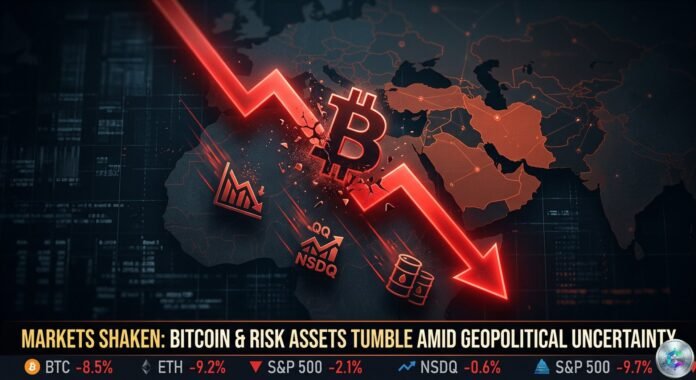
Bitcoin’s market experienced another turbulent week, held hostage by geopolitical tensions in the Middle East. While US President Donald Trump had set an ultimatum for Iran on April 7, 2026, it was ultimately a fragile two-week ceasefire announced on April 8 that triggered relief across financial markets and revived risk appetite. This news marks a turning point in a conflict that has shaken global markets for six weeks and raises fundamental questions about bitcoin’s ability to serve as a safe-haven asset in the digital age.
A Week Under High Tension
The days leading up to the April 7 deadline were marked by extreme volatility across all risk assets. Bitcoin fell 2.5% before paring some of its losses in New York trading, narrowly avoiding a steeper decline. Ether, the world’s second-largest cryptocurrency, retreated more than 3%, illustrating the entire sector’s sensitivity to macroeconomic and geopolitical factors.
This bearish trend came against a backdrop where bitcoin had already been confined to a narrow range since the start of the Middle East conflict at the end of February 2026. Between $60,000 and $75,000: that was the range the digital currency attempted to hold, oscillating with geopolitical news. At one point, bitcoin neared $76,000 before plunging again, illustrating the market’s extreme sensitivity to external factors. For many analysts, this period reminded investors that cryptocurrencies, despite their decentralized nature, are not immune to the geopolitical tremors that shake traditional markets.
Trump’s Ultimatum and Its Impact on Markets
On April 7, Donald Trump threatened to strike Iran’s civilian infrastructure unless the Strait of Hormuz was reopened. This strategic waterway, through which approximately 20% of global oil production transits, had been at the heart of the conflict between the United States and Iran since late February 2026. This war, which killed thousands and triggered the largest disruption ever seen in global oil markets, had already sent shockwaves through international financial markets.
While the American administration had hinted at a possible diplomatic-military breakthrough, Iran had initially rejected ceasefire proposals, pushing markets into a prolonged uncertainty phase. US stocks retreated ahead of this deadline, with cryptocurrencies swept up in this wave of generalized caution. Brent crude has gained approximately 50% since the start of the conflict at the end of February, illustrating the severity of the supply-side shock on energy markets.
As analyzed by Chris Beauchamp, chief market analyst at broker IG: Cryptocurrencies remain in suspended animation, moving sideways for the past month. While equities seem content to ignore the looming energy crisis, at least until they decide to focus on it, and oil prices continue to climb thanks to the ongoing Strait closure, cryptocurrencies seem to be just left to drift. This analysis neatly sums up the paradox of a market searching for direction in an environment marked by geostrategic uncertainty.
The Unexpected Ceasefire of April 8
It was in this tense context that a surprise announcement came on April 8: the United States and Iran agreed to a two-week ceasefire. While the deal calls for the reopening of the Strait of Hormuz under Iranian armed forces supervision, the terms remain vague and analysts warn of structural fragility in this truce. President Trump specified that the agreement was conditional on the complete, immediate, and safe reopening of the strait, while Iranian authorities indicated that safe passage would be possible, subject to coordination with its armed forces and technical limitations. These caveats leave room for Iran to interpret the agreement’s terms according to its own interests.
According to Michael Langham, economist at Aberdeen Investments, this ceasefire should hold in the near term, as economic costs have become unbearable for both parties after six weeks of conflict. Meanwhile, BCA Research notes that energy and commodity markets will remain structurally higher regardless of the ceasefire outcome, as governments have adopted preventive stockpiling strategies in anticipation of renewed conflict. This collective anticipation could keep oil prices at an elevated floor well beyond the actual normalization of commercial flows in the Gulf.
Bitcoin ETFs: Signs of Institutional Recovery
Amid this geopolitical turmoil, a more positive note deserves attention. US-listed bitcoin index funds recorded their first monthly inflow since October 2025. According to SoSoValue data, spot bitcoin ETFs posted $1.32 billion in net inflows in March 2026, ending a streak of four consecutive months of fund redemptions that had severely affected market sentiment.
These massive redemptions began in November 2025, with $3.5 billion in outflows, followed by $1.1 billion in December, $1.6 billion in January, and $206 million in February. A correction that had caused bitcoin to lose up to 50% from its all-time high of $126,000 reached in October 2025. After this long period of decollect, the return of positive flows in March represents an important psychological turning point for the market.
April 7 flows were particularly encouraging: $471.3 million in net inflows, following $22.3 million the previous week. A sharp reversal from nearly $300 million in outflows the prior week. The overall crypto market initially posted a $2.47 trillion market cap at the height of optimism over a possible deal, before retreating to $2.42 trillion after Trump’s statement that Iran’s proposal was not enough to avert strikes.
Bitcoin’s Remarkable Resilience
Despite this still uncertain macroeconomic backdrop, bitcoin has shown relative resilience compared to other risk assets. As Alex Kuptsikevich, chief market analyst at FxPro, notes: If we take a step back, it is easy to see that bitcoin is doing relatively well. It is trading within a fairly narrow range and above the levels seen in early March, unlike stock indices and gold. This relative performance is all the more notable given that gold, traditionally considered the ultimate safe-haven asset, fell more than 10% since the start of the Middle East conflict.
This resilience is partly explained by the fact that the market had already anticipated and priced in much of the geopolitical risk since the start of the February conflict. The initial shock already in prices, negative news has a diminishing marginal impact. Google Trends data shows that searches for bitcoin zero hit an all-time high in February, signaling extreme fear among retail investors at a time when bitcoin was approaching $60,000. This fear peak, often considered a contrary indicator, may have signaled a market bottom close to an exaggerated bearish overshoot.
Rachael Lucas, analyst at BTC Markets, remains cautiously bearish over the medium term: The market is in wait-and-see mode. Bulls lack sufficient conviction to sustain breakouts, and bears cannot force a decisive breakdown. This stagnation in a horizontal range follows the consolidation phenomenon that generally occurs after periods of sharp correction.
Catalysts for a Potential New Bull Cycle
Two major catalysts could shift the market into a new bull cycle in the coming weeks. First determining factor: a durable confirmation of the US-Iran ceasefire that would bring oil below the $100 per barrel mark. Brent has gained approximately 50% since the start of the conflict at the end of February, and a return to more normal levels would represent significant relief for households and businesses worldwide, reducing inflationary pressures and restoring consumer confidence.
Second key element: the potential passage of the US Clarity Act, expected at the end of April, which institutional players expect to serve as a regulatory unlock for the cryptocurrency market in the United States. This legislation, long awaited by the industry, could finally clarify the legal status of digital assets and allow traditional financial institutions to engage more seriously in the market. Regulatory uncertainty has been a major obstacle to institutional adoption for years, and its resolution could unlock considerable capital flows.
Strategists are also watching for a possible test of $73,595 to confirm a definitive bullish breakout, as well as the maintenance of support between $66,500 and $68,306 which, if broken, could trigger a short squeeze liquidating overleveraged bearish positions.
Structural Challenges That Persist
While the April 8 agreement represents immediate relief for markets, strategists remain divided on the parties’ ability to maintain this calm. Uncertainties surrounding Iran’s interpretation of the ceasefire terms, inflationary pressures linked to persistently high oil prices, and central banks’ vigilance against any new supply shock provide reasons to remain cautious.
Another factor to closely monitor is the cost basis situation for ETF investors. According to some estimates, the average cost basis for bitcoin ETF investors remains around $84,000, compared to a current spot price of approximately $68,500. This means most institutional investors remain underwater, which could slow new inflows as long as bitcoin does not sustainably return above this psychological threshold. This underwater institutional situation could prove self-fulfilling if the market manages to resume its upward path.
Signals from the US Federal Reserve, with rates held in the 3.5% to 3.75% range, also represent a tailwind for risk assets. Higher rates make financing more expensive and weigh on institutions’ willingness to take additional risks. However, any normalization of monetary policy could change the dynamics in favor of cryptocurrencies.
A Strong Correlation With Traditional Markets Persists
Far from the popular belief that bitcoin would be an asset uncorrelated from traditional financial markets, recent events remind us that the digital currency remains deeply linked to risk flow dynamics and global macroeconomic health. The past three months have amply demonstrated this: when stocks retreat amid geopolitical tensions, bitcoin follows, proving that its safe-haven function remains to be proven in acute crisis contexts.
However, bitcoin’s resilience relative to gold in recent weeks raises questions. Gold fell more than 10% since the start of the Middle East conflict, while bitcoin, despite its volatility, managed to hold its range. Some strategists see this as a sign of the crypto market’s growing maturity and diversification of flows toward digital assets, while others caution that celebrating prematurely before technical confirmation of a trend reversal would be unwise.
Conclusion
The announcement of the US-Iran ceasefire on April 8, 2026, immediately relieved financial markets, bitcoin included. Growing flows into bitcoin ETFs constitute an encouraging signal for the months ahead. But the political fragility of the Middle East, residual volatility in black gold, and ongoing regulatory uncertainties call for the utmost caution. The crypto market remains in wait-and-see mode: the bullish catalysts are there, but their activation will depend on both parties’ ability to maintain this fragile truce. For long-term investors, the current period represents a window of opportunity before a possible market resurgence.

