


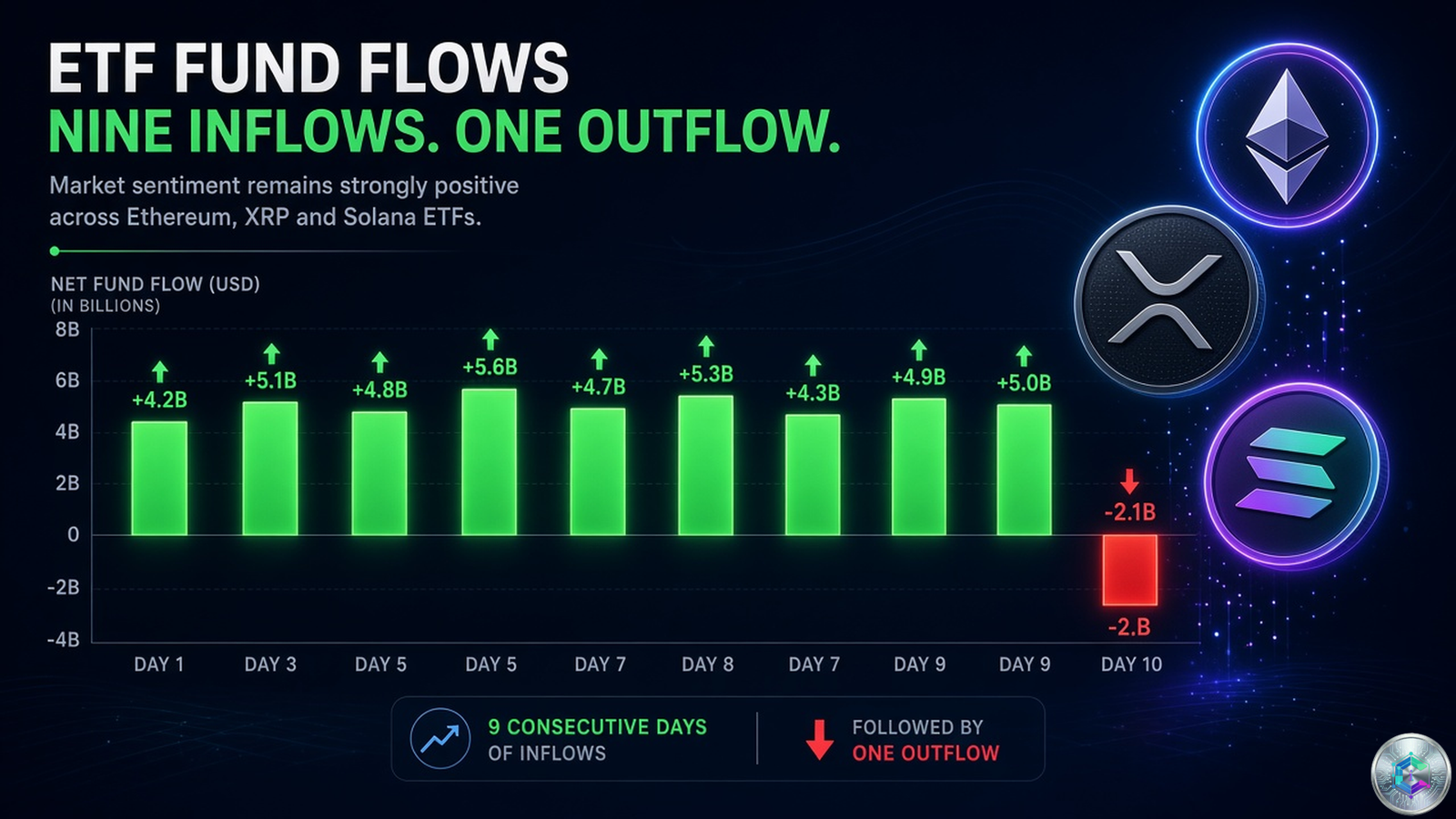
US spot Bitcoin ETFs recorded a net outflow of $202 million on August 28, snapping a nine-day inflow streak that had totaled $3.04 billion, according to data from Farside Investors and SoValua. The one-day reversal contrasts sharply with continued strong appetite for Ether, XRP and Solana ETFs, which absorbed fresh institutional capital on the same session.
🔑 Key Takeaways
- $202M outflow from Bitcoin ETFs on Aug 28, ending a 9-day inflow streak totaling $3.04B
- BTC price dropped 3.2% to around $77,500 on the day, with volume jumping to $39.47B
- Ether ETFs pulled in $102M (10-month high) and extended a 10-day streak above $1.5B
- XRP ETFs: +$26M; Solana ETFs: +$17.3M — capital clearly rotating into altcoins
- Since launch, US Bitcoin ETFs have absorbed $54.6B in cumulative net inflows and manage about $97B in assets
The end of a historic nine-day streak
The nine-session positive run, which began on August 17, represented “the largest continuous buying period by ETFs of the entire current bear market”, according to Ecoinometrics. The research firm added that cumulative flows over the period surpassed any other stretch recorded since the start of the bear cycle.
“Since this breakout began, we have seen nothing but inflows. More importantly, the cumulative buying has now made this the strongest streak of ETF inflows of the entire bear market.”
Ecoinometrics, research note
The August 28 outflow only erases about 6.6% of the total accumulated over those nine days. Across the five sessions closed on August 28, Bitcoin ETFs still posted a positive net flow of $924.5 million, underlining that the underlying buying dynamic remains structurally intact despite the daily wobble.
Breakdown of outflows by issuer
The August 28 pullback was spread across most issuers, with a notable concentration at ARK 21Shares (ARKB), which alone accounted for more than half of the withdrawals. The table below details the net flows by fund on the day.
| Issuer (Ticker) | Aug 28 Net Flow |
|---|---|
| ARK 21Shares (ARKB) | -$114.9M |
| Bitwise (BITB) | -$49.7M |
| BlackRock (IBIT) | -$33.4M |
| VanEck (HODL) | -$13.2M |
| Morgan Stanley Trust | +$9.3M |
| Total Bitcoin ETF | -$202.0M |
The outflow remains small relative to market size: since launch, US Bitcoin ETFs have absorbed roughly $54.6 billion in net flows and now manage around $97 billion in assets under management, confirming their role as a pillar of institutional demand.
Ether, XRP and Solana extend the momentum
While Bitcoin corrected, ETFs tied to alternative assets kept attracting fresh capital. Ether funds pulled in $102 million on August 28, extending their own ten-day inflow streak and bringing the cumulative total to more than $1.5 billion. The August 28 session also marked their highest single-day inflow in ten months, with $225.8M in net flows according to some market estimates.
BlackRock, through its ETHA fund, absorbed $1.02 billion over the past nine days alone, about 72% of total category flows, without registering a single day of net outflow. Fidelity (FETH) recorded its best day of the period at $56.2 million on August 28. Conversely, Grayscale’s ETHE continues to generate structural outflows that weigh on the category’s cumulative net flows.
XRP ETFs generated about $26 million on the same day, extending their nine-day streak to roughly $150 million. Since launch, these funds have posted $1.6 billion in cumulative net flows and manage $1.4 billion in assets. Solana ETFs raised $17.3 million, extending their nine-day run to around $200 million, for cumulative net flows of $1.2 billion since inception and $1.43 billion in assets under management.
Macro backdrop and the “depreciation trade”
The macro tailwind is playing a decisive role in this sector rotation. On August 19, the US Treasury announced it would at least double its long-bond buyback operations starting September 9, compressing long-end yields and weakening the dollar, reviving what traders call the “depreciation trade” — a buyer bias toward hard assets as the greenback loses purchasing power.
The resolutely dovish tone adopted by Kevin Warsh, chair of the Federal Reserve, during his Jackson Hole speech on August 28, pushed the implied odds of a rate cut on futures markets to 56%, supporting investor appetite for risk assets — cryptocurrencies included.
The Ether paradox and the volume question
Despite the massive capital influx, Ethereum displays a striking performance paradox. While Ether ETFs received $1.42 billion over nine days, the price of ether rose only about 5%, from $2,350 to $2,477. By comparison, Bitcoin gained 15% over the same period with $2.8 billion in flows. On August 28, the gap between daily flows of Ether and Bitcoin ETFs narrowed to just $16.5 million, versus a one-to-ten ratio at the start of both streaks.
“Capital has rotated into higher beta blue-chip names such as ZEC, XRP, SOL, and HYPE, which have outperformed.”
Max Shannon, Senior Analyst at Bitwise Europe
Max Shannon also stressed that spot trading volume (cash market) has dropped to the 16th percentile on a year-over-year basis since August 19, raising questions about the sustainability of the rally without renewed volume. On the technical side, ether is currently testing its 200-week moving average for the first time since breaking below that support in late January. About 1.1 million ETH have accumulated around that level — roughly $2.7 billion — which could form a temporary resistance if those holders decide to sell.
Separately, Goldman Sachs announced the acquisition of Neos Investments for up to $2.25 billion, in order to add options-based Bitcoin and Ethereum ETFs to its platform — a signal that major banks now view crypto-ETF distribution as a strategic revenue source.
Conclusion: technical pause or early rotation?
The next sessions will be decisive in determining whether the $202 million outflow on August 28 is merely a technical pause after an exceptionally strong buying period, or the start of a more lasting pullback in institutional Bitcoin demand. A quick return to inflows would reinforce the simple-breather thesis, while persistent withdrawals — combined with continued inflows into Ether, XRP and Solana — would signal a structural capital redistribution toward alternative assets.
Despite the one-day outflow, Bitcoin ETFs remain a pillar of institutional demand, with $97 billion in assets under management and $54.6 billion in cumulative net flows since launch. The market’s ability to absorb flows of this magnitude remains a key indicator of crypto-asset ecosystem health, now buttressed by growing diversification into Ether, XRP and Solana.
Sources
This article is for informational and educational purposes only. It does not constitute investment advice. Do your own research (DYOR) before making any decision.

