

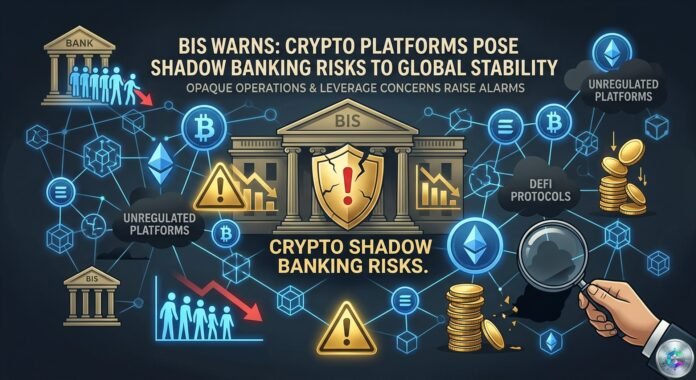
BIS warns crypto platforms operating as shadow banks without safeguards
The Bank for International Settlements (BIS) published a scathing report in April 2026. The Basel-based institution, often called « the central bank of central banks, » warned that major crypto platforms are offering banking services without the protections that traditional financial institutions must provide. This caution comes amid record growth in the cryptocurrency market, which surpassed $4 trillion for the first time in 2025. The combined capitalization of stablecoins exceeded $200 billion, and yield products offered by centralized platforms attracted billions of dollars of public savings. The total absence of safety nets leaves users exposed to risks that traditional banks have been required to mitigate for decades.
Context
Crypto platforms have significantly expanded their offerings over the past five years. Where they once limited themselves to exchanging cryptocurrencies, they now offer annualized yield products, collateralized lending, stablecoin savings accounts with rates sometimes exceeding 8%, and instant payment services. These offerings increasingly resemble those of traditional banks. Yet users benefit from none of the guarantees that accompany classic bank deposits. No deposit insurance mechanism, no minimum capital requirements, no prudential supervision of their maturity transformation activities.
The BIS describes these companies as « multifunction cryptoasset intermediaries » (MCIs). In its report published on April 23, 2026, the institution details how these platforms group functions that would normally be separated across several institutions in traditional finance. A securities broker, an asset custodian, a lender, a fund manager: all of this is combined under a single legal entity with a single balance sheet and a single set of risk management practices. Without uniform prudential safeguards, any default can have serious consequences for clients, and potentially for the entire financial system if links with traditional finance prove deeper than estimated.
The institution identifies three major structural risks that characterize this activity. First risk: maturity transformation. Platforms collect funds on a very short-term basis from users, often with 24 to 48 hours notice for withdrawals, but invest these funds in long-term assets, including tokenized mortgage loans, corporate bonds, or structured products. This practice creates an inherently unstable liquidity mismatch. In periods of tension, mass withdrawals force platforms to sell assets at sacrificial prices to honor requests. Second risk: surrendering control of assets. Users who deposit their funds on these platforms often give up effective control of their assets. They lose not only management of their holdings but sometimes even legal ownership. Client assets are mixed with those of the platform and used for its own trading operations. Third risk: the total absence of safety net. There is no mechanism comparable to the bank deposit insurance system. In case of bankruptcy, clients rank at best as unsecured creditors, at worst as preferred creditors. The sector’s track record is telling: Celsius, Voyager, FTX, BlockFi — all left billions of dollars in losses for users.
The Facts
The BIS report, titled « Crypto Exchanges and the Shadow Banking Risk, » specifies that stablecoin yield products marketed as « savings accounts » are actually unsecured loans to lightly regulated intermediaries. The institution goes straight to the point: « What looks like a high-yield savings product is, in reality, an unsecured loan to a lightly regulated shadow bank. » This wording leaves no doubt about the nature of products sold to ordinary savers. Platforms attract deposits by promising attractive yields, then lend these funds to DeFi market actors, arbitrage funds, and margin traders. Counterparty risk is entirely borne by the saver, who has no visibility into the credit quality of end borrowers.
The largest crypto platforms now operate as multifunction intermediaries in the fullest sense of the term. They combine the roles of broker, custodian, lender, asset manager, and savings product issuer, all under one roof and within a fragmented or even non-existent regulatory framework depending on jurisdiction. This concentration considerably increases systemic risks. The BIS points out that the size of the main players and their growing links with traditional finance mean that a major disruption at one of them could have consequences beyond the crypto sector, potentially affecting bond markets, corporate financing, or even retail payment stability.
The report cites particularly telling historical precedents. The collapse of Celsius Network in July 2022 cost users more than $4 billion in frozen funds. The platform promised yields of up to 18% on certain assets. FTX vanished in November 2022, taking approximately $8 billion in customer assets with it. The report emphasizes that it was not poverty or incompetence that caused these disasters, but « a system built on leverage, opacity, and deposit-like promises without real protection. » The October 2025 flash crash triggered approximately $19 billion in forced liquidations on crypto derivatives in a single day, illustrating the extreme volatility and automatic stop-loss mechanisms that characterize these markets.
Analysis
This BIS report confirms fears voiced for years by critical sector observers. The summary is relentless: crypto platforms attract clients with yields that seem miraculous in a low-rate environment, but behind these promises lurk loans to lightly regulated actors, aggressive trading strategies, and significant leverage. Without a safety net, without mandatory capital reserves, without ongoing supervision, users alone bear all risks. Counterparty risk (the borrower does not repay), liquidity risk (the platform cannot honor withdrawals), market risk (collateral assets lose value), and operational risk (hacking, internal fraud) all fall exclusively on the saver.
Regulators are beginning to tentatively react. The GENIUS Act in the United States, enacted in early 2025, now imposes strict standards on stablecoin issuers. These rules require reinforced Anti-Money Laundering (AML) controls, customer identity verification mechanisms, and high-quality asset reserves to guarantee convertibility. Stablecoin yield products, which promise returns on stablecoin holdings, are receiving particular attention from American regulators. The Securities and Exchange Commission (SEC) has begun qualifying some of these products as « securities » requiring registration. In Europe, the MiCA (Markets in Crypto-Assets) regulation entered progressive application with transparency and accountability requirements for crypto-asset service providers. However, many observers consider these measures insufficient given the sector’s rapid innovation pace and the size of off-balance-sheet exposures that still escape any supervision.
The BIS warns against the risk of authorities reacting too slowly. Its report notes that « customers may regard MCIs as safe places to hold their digital assets, yet in many jurisdictions these platforms operate without the prudential safeguards that typically apply to financial intermediaries engaged in comparable risk transformation. » This caution is directed squarely at central banks and financial supervisors worldwide. The current situation mirrors pre-2008 finance: institutions taking considerable risks without the necessary transparency or capital reserves, with growing links to the traditional financial system that could spread a local shock into a systemic crisis.
Market Reactions
Despite repeated warnings from regulators and international institutions, stablecoin yield products remain extremely popular. Annualized yields offered by some centralized platforms still reach 5 to 9% on products presented as capital-guaranteed. This promise of risk-free return continues to attract billions of dollars in retail savings, often from users who do not fully understand the underlying mechanics. Platforms conduct aggressive marketing and social media campaigns that normalize these products without mentioning counterparty risks. Security audits commissioned from specialized firms and reserve certifications are presented as supreme reliability guarantees, even though several certified platforms have subsequently defaulted.
The stablecoin market itself shows signs of latent tension. Traders anticipate a possible depeg (loss of dollar parity) with an implied probability of approximately 3% according to derivatives. This risk premium suggests that market participants recognize systemic vulnerabilities without knowing exactly when they will materialize. The main stablecoin issuers — Circle (USDC), Tether (USDT) — display their commitment to regulatory compliance and transparency. But critics point out that security measures remain largely symbolic and that published audits do not always cover the full reserves. The BIS report comes at exactly the right time to revive the debate on the need for banking supervision of stablecoins, similar to that applied to traditional bank deposits.
Perspectives
Industry experts agree on the need for a stricter and more uniform regulatory framework. « The industry needs to treat these risks as baseline requirements, not best practices, » says Evgeny Gokhberg, founder of Re7 Capital, an investment fund specializing in digital assets. According to him, security standards should become mandatory rather than recommended, and pre-withdrawal verification, minimum liquidity thresholds per creditor, and zero-trust architectures (where each system component is continuously verified) must become the industry standard before it can claim significant institutional adoption.
Tokenization of real-world assets (RWA) could, however, bring structural solutions to these problems. By anchoring DeFi markets to tangible real-world assets — government bonds, money market funds, commercial receivables — with traditional legal frameworks and proven risk controls, this approach could make decentralized finance more resilient and more compatible with regulatory requirements. « Being open and secure is not incompatible. The goal is to make trust explicit and verifiable rather than implicit and mysterious, » explains Bhaji Illuminati, CEO of Centrifuge Labs, a commercial financing platform on blockchain. This vision remains a medium-term goal, however, and implementation challenges — blockchain fragmentation, limited interoperability, regulatory uncertainty — are still considerable.
In the meantime, institutional adoption continues despite repeated warnings. BlackRock, the world’s largest asset manager with more than $10 trillion in assets under management, launched a tokenized money market fund (BUIDL) on the Ethereum blockchain in 2025, then extended its accessibility via Uniswap. Apollo Global Management, with $900 billion in assets under management, announced a strategic partnership with Morpho Labs to support DeFi lending markets while imposing enhanced security standards on borrowing protocols. These major players continue investing in the ecosystem while publicly advocating for stricter standards and clear regulation. The BIS calls in its report for coordinated international action to prevent risks from spreading across the entire global financial system, a recommendation that finds growing resonance at G20 meetings and the Financial Stability Board.
Sources
- BIS warns cryptocurrency exchanges are becoming shadow banks and why that’s a risk — CoinDesk
- BIS Financial Stability Institute Report — Bank for International Settlements
- BIS warns crypto exchanges acting as « shadow banks, » raising systemic risk concerns — Crypto Briefing
- BIS Report Warns Banking Services From Crypto Firms Carry Risk — PYMNTS
- BIS warns crypto exchanges are banks without rules — Payment Expert
- Elliptic’s 2026 regulatory and policy outlook — Elliptic

