

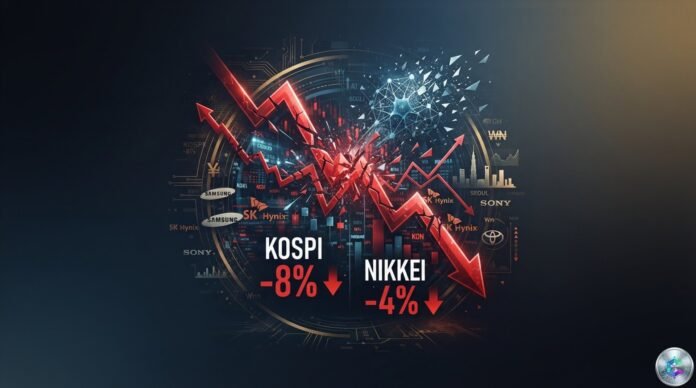
Asian markets sold off sharply on Tuesday, led by semiconductor stocks, after the Wall Street Journal revealed Nvidia is in talks to provide around 250 billion dollars in financing guarantees to OpenAI for a massive AI data center buildout. The KOSPI cratered over 8%, the Nikkei slipped 4%, and traders are bracing for the Federal Reserve’s decision on Wednesday.
🔑 Key Takeaways
- South Korea’s KOSPI plunged more than 8%, tripping an automatic circuit breaker and hitting a three-month low.
- Japan’s Nikkei dropped 4%, after the Philadelphia Semiconductor Index slid 2.2% in the US overnight.
- Nvidia fell 5% in pre-market trading on WSJ reports of a potential 250-billion-dollar financing arrangement with OpenAI.
- SK Hynix -11%, Samsung Electronics -9%, Kioxia -18%, Tokyo Electron -9.8%: the rout rippled across the entire chip supply chain.
- Brent crude at 87.55 dollars extends a near-9% slide; markets now price a 38% probability of a 25-bp Fed hike on Wednesday.
The Nvidia-OpenAI Mega-Deal That Shook Wall Street — and Asia
It started with a Wall Street Journal scoop: Nvidia is reportedly in advanced talks to provide roughly 250 billion dollars in financing guarantees to OpenAI, funding an ambitious buildout of AI data centers. The sheer size of the commitment — and the implicit questions about the economics behind such capex (capital expenditure) — caught traders off guard.
Nvidia shares dropped 5% in after-hours trading, dragging the Philadelphia Semiconductor Index down 2.2%. That weakness set the stage for a punishing Asian session, given that South Korea and Japan host the bulk of global memory production and semiconductor manufacturing equipment.
« There is clearly a growing sense of optimism across mainland Chinese markets about the country’s ability to build a globally competitive AI ecosystem. »
Chris Weston, Head of Research at Pepperstone
Northeast Asia: Semiconductor Stocks Crushed
South Korea bore the brunt of the rout. The KOSPI sank more than 8%, sharp enough to trip an automatic circuit breaker — a mechanism that briefly halts trading when losses exceed a preset threshold. As home to SK Hynix and Samsung Electronics, two pillars of global DRAM and NAND memory, Seoul’s exchange was always going to be the epicenter.
| Company | Exchange | Move |
|---|---|---|
| SK Hynix | KRX (Seoul) | -11% |
| Samsung Electronics | KRX (Seoul) | -9% |
| Kioxia | TSE (Tokyo) | -18% |
| Tokyo Electron | TSE (Tokyo) | -9.8% |
| ASML | AEX (Amsterdam) | -8.5% |
The damage was broad-based: panic spread from memory makers to equipment vendors to lithography specialists. ASML — whose EUV (extreme ultraviolet) lithography machines have no commercial rival — fell 8.5% in Amsterdam following reports that China has begun producing its own DUV (deep ultraviolet) immersion systems domestically.
Oil, the Fed and the Dollar: Three Crosswinds
Lower crude prices, normally a relief for risk assets, did little to calm nerves. Brent extended Monday’s near-9% slide to settle at 87.55 dollars a barrel, after the US-Iran flare-up cooled following Saturday’s abrupt halt to US airstrikes. President Donald Trump said Monday that Washington was engaged in « good negotiations » with Tehran and that a deal was possible. Yet the US 10-year Treasury yield eased only four basis points to 4.64%, a sign that bond markets remain wary.
Fed funds futures now imply roughly a 38% probability that the Federal Reserve will hike its policy rate by 25 basis points on Wednesday. A hawkish surprise, on top of an already fragile tech tape, would be a fresh blow to growth names that have led the cycle higher.
« We expect the Fed this week to want to lean restrictive. The US-Iran conflict, by pushing up crude prices, remains the most important determinant of what happens in the global economy over the coming months — and, by extension, what shapes central bank policy paths. »
Thierry Wizman, FX and Rates Strategist at Macquarie Group
In FX, the dollar stayed bid: the euro slipped below 1.14 to 1.1370, and the Australian dollar hovered just under 70 US cents. The yen traded at 163.78 per dollar, barely above a four-decade low, with markets on alert for possible Japanese intervention — especially if the Bank of Japan holds rates steady this week and triggers another leg lower in JPY.
CXMT and the Chinese Counterattack
Amid the carnage, one event crystallized investor attention: CXMT Corp’s 466% surge on its Shanghai trading debut. The Chinese DRAM specialist briefly commanded a market cap worth tens of billions of dollars before reversing to lose 7% in early trading on Tuesday. The wild ride captured the frenzy around anything tied to Chinese technological sovereignty.
The timing was striking: per The Information, China has begun manufacturing domestic DUV immersion lithography machines, a category long dominated by ASML. If scaled up, this would reshape pricing power across the Western equipment, memory and foundry value chain — and intensify the competitive threat to ASML, Samsung and SK Hynix alike.
Conclusion: A Turning Point for the AI Cycle?
Tuesday’s session may mark an inflection point. Until now, the AI boom has been a near-unidirectional tailwind for equipment vendors and memory makers: Nvidia’s blockbuster earnings and the surge in HBM (high-bandwidth memory) orders for AI GPUs had propelled valuations steadily higher. The disclosure of the Nvidia-OpenAI financing scheme is a sobering reminder that these projects require unprecedented capital commitments — and that the path to monetization remains contested.
Three events now sit at the center of the narrative: the Fed’s rate decision on Wednesday, Nvidia’s upcoming earnings, and the trajectory of China’s domestic semiconductor ecosystem. If Beijing succeeds in mass-producing advanced DUV tools, the competitive squeeze on ASML, Samsung and SK Hynix will intensify. Conversely, a dovish Fed pivot or clearer visibility on data center economics could restore some risk appetite. Until then, volatility remains the only constant.
Sources
- TradingView / Reuters — AI anxiety sparks tech rout, broad selloff in Asian markets
- Euronext — AI anxiety sparks tech rout
- MarketScreener — AI anxiety sparks tech rout
This article is published for informational and educational purposes. It does not constitute investment advice. Do your own research (DYOR) before making any decision.

