

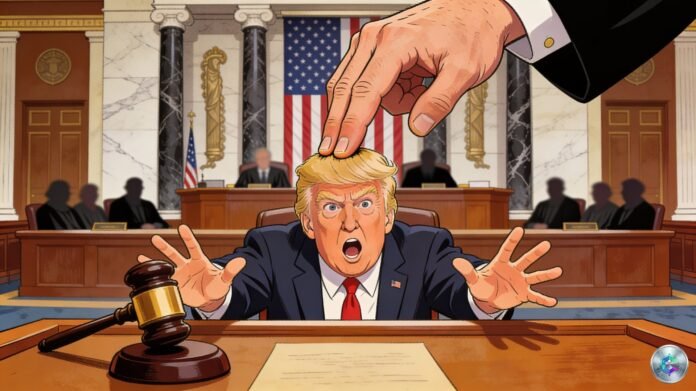
A Historic Ruling That Reshapes U.S. Trade Policy
On Friday, February 20, 2026, the United States Supreme Court issued one of the most consequential rulings in recent trade policy history: in a 6-3 vote, the justices struck down the majority of tariffs imposed by President Donald Trump, finding that he had exceeded his constitutional authority.
At the heart of the dispute: Trump’s use of the International Emergency Economic Powers Act (IEEPA) to impose sweeping tariffs without Congressional approval — a first in the nearly 50-year history of the law.

The Core of the Decision
Chief Justice John G. Roberts Jr. authored the majority opinion, ruling unambiguously that the IEEPA « does not grant the president the power to impose tariffs. » In his opinion, he stated:
« The President claims an extraordinary authority to unilaterally impose tariffs of unlimited amount, duration, and scope. Given the extensive history and constitutional context surrounding this claimed power, he must demonstrate clear Congressional authorization to exercise it. »
— Chief Justice John G. Roberts Jr.
Justices Clarence Thomas, Samuel Alito, and Brett Kavanaugh filed dissenting opinions, arguing for greater deference to the executive branch in foreign affairs and a broader reading of the IEEPA.
A Remarkably Fast Legal Journey
This case moved through the legal system at an unprecedented pace, traversing multiple levels of jurisdiction in under a year:
- May 2025 — The Court of International Trade (CIT) strikes down all IEEPA-based tariffs.
- August 2025 — The Federal Circuit Court of Appeals upholds the ruling 7-4, finding that the IEEPA « does not mention tariffs (or any of its synonyms). »
- September 2025 — The Supreme Court agrees to hear the case on an expedited basis.
- November 2025 — Three hours of oral arguments, during which a majority of justices expressed marked skepticism toward the administration’s position.
- February 20, 2026 — Final ruling: IEEPA tariffs are unconstitutional.
Which Tariffs Are Affected?
The ruling invalidates two major categories of IEEPA-based tariffs:
| Category | Description | Rate |
|---|---|---|
| « Reciprocal » Tariffs | Duties on imports from more than 100 countries | Minimum 10%, up to 145% on China |
| Fentanyl Tariffs | Duties on imports from Canada, China, and Mexico | 25% (Canada raised to 35%) |
Tariffs based on other legal authorities remain in effect: steel and aluminum tariffs (Section 232), copper tariffs, lumber tariffs, and other sector-specific duties imposed under different laws.
$175 Billion on the Line
The financial stakes of this ruling are enormous. IEEPA tariffs had generated approximately $130 billion through mid-December 2025. According to the Penn-Wharton Budget Model, more than $175 billion in tariff revenues are now at risk of being refunded to importers.
The Court of International Trade has already established a refund framework, and CBP’s electronic refund system was upgraded in early February 2026. Trump had previously warned on Truth Social that refunds would be « almost impossible » to manage.
Market Reaction
U.S. stock markets reacted positively to the ruling, with indices rising alongside 10-year Treasury yields. JPMorgan had anticipated this outcome with 64% probability, forecasting an initial S&P 500 gain of 0.75% to 1%, followed by a partial pullback once replacement tariffs were announced.
Trump’s Remaining Options
This ruling does not mark the end of U.S. tariff policy. The president retains several alternative legal levers: Section 232 (national security), already used for steel and aluminum and extendable to other sectors; Section 301, allowing tariffs in response to unfair trade practices; Section 122 of the Trade Act of 1974, permitting tariffs up to 15% for a maximum of 150 days; and negotiating explicit legislative authorization from Congress.
Goldman Sachs anticipated that the administration would use these alternative authorities to maintain « substantially similar » tariffs on major trading partners. However, these routes require longer administrative processes and no longer allow the instant tariff announcements via Truth Social that defined Trump’s trade policy style.
A Major Political Defeat for Trump
This ruling represents the most significant defeat of Trump’s second term before the Supreme Court — all the more striking given that this same Court, with its 6-3 conservative majority, had broadly backed Trump’s executive power assertions in roughly two dozen prior emergency-procedure cases. Minneapolis Fed President Neel Kashkari had warned that the decision could « trigger a surge of uncertainty that may slow economic activity. »
The Supreme Court continues to examine other critical cases from Trump’s second term, including the president’s authority to fire independent federal agency officials and the legality of his plan to end birthright citizenship.
Sources: NPR, CNN, The New York Times, NBC News, CNBC, CBS News, The Hill, Washington Post, Reuters, Bloomberg, SCOTUSblog.

