


The global selloff in government bonds that has shaken markets over recent sessions highlights a structural shift: bond investors are now demanding a higher premium for inflation risk and sovereign debt exposure, a sign of a possible exit from the low-inflation regime observed since 2010.
🔑 Key takeaways
- The yield on the US 10-year Treasury hit 4.81%, its highest level since November 2023.
- Japanese 10-year government bond yields crossed 3.01%, a high not seen in nearly 30 years.
- UK Gilts and German Bunds touched their highest levels since the 2008 financial crisis.
- The probability of a Fed rate hike in September climbed above 66%, up from ~35% before Jackson Hole.
- Brent crude stood at $95.61/barrel and WTI at $91.61, reinforcing inflationary pressure.
Bond yields surge across the curve and across borders
The week of September 2 marked a turning point in global bond markets, with a coordinated selloff that pushed long-term yields toward multi-year and even multi-decade highs. The move reflects a deep repricing of inflation expectations and sovereign risk premia.
According to CNBC, the yield on the US 10-year Treasury climbed to 4.81% on September 2, close to a three-year peak. The 30-year yield returned near its 19-year high. Markets are now pricing in a breach of the symbolic 5% threshold, which could further destabilize equity markets.
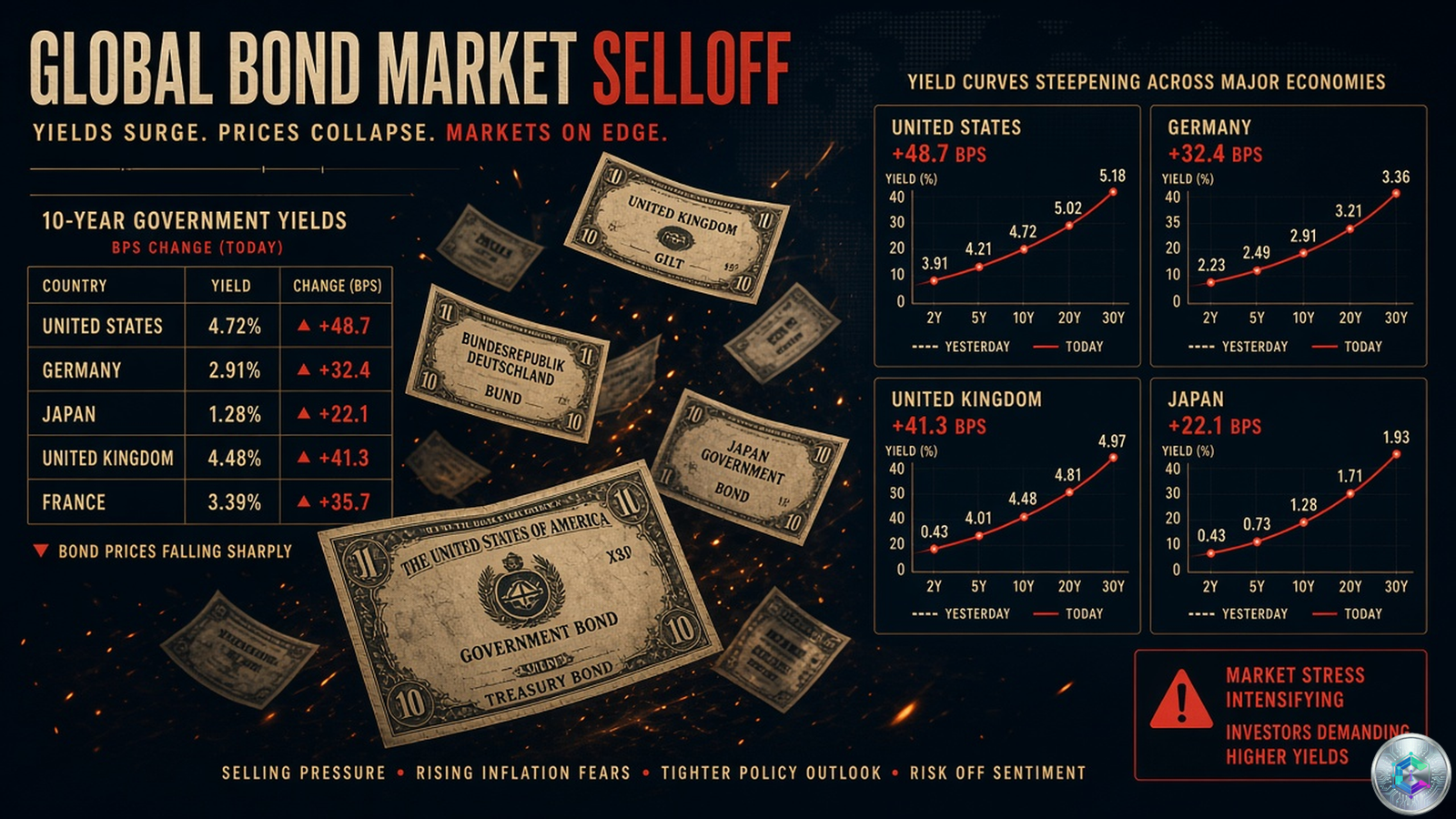
In Japan, 10-year government bond yields crossed the 3.01% threshold for the first time since 1996. In Australia, the 10-year yield climbed to 5.198%, its highest in over 15 years. In the UK, 10-year Gilts touched a post-2008 financial crisis high, while German 10-year Bunds reached levels not seen since 2011, with futures down 0.35%. French OAT futures dropped 0.37%, hitting a historic low.
Structural drivers of the regime change
Beyond short-term market noise, several institutional voices identify a regime change. Emma Moriarty, portfolio manager at CG Asset Management, summarizes the shift: structural features of the global economy are now generating inflationary, rather than disinflationary, impulses.
“Tariffs, and more recently the outbreak of war in the Middle East, have been the sharp edge of this changing order. It is mistaken to view the energy shock as temporary, because the underlying structural change that caused it could prove quite lasting.”
Emma Moriarty, CG Asset Management
Protectionism, industrial reshoring, rising defense spending and the cumulative tariff tensions since 2024 have reshaped the price dynamics. Jon Cunliffe, head of the investment office at JM Finn, stresses that the 2010-2020 era of stable, low inflation is no longer the baseline assumption.
For Cunliffe, the key unknown is whether artificial intelligence will exert a disinflationary pull through a significant productivity uplift. Naka Matsuzawa, chief macro strategist at Nomura Securities in Tokyo, agrees: hyperscalers’ willingness to pay reasonably elevated rates is lifting yields across the board, but the AI-driven productivity jump must translate into higher wages for the economy to absorb higher rates sustainably.
Charu Chanana, chief investment strategist at Saxo, notes that bond investors are demanding an extra premium for inflation risk, fiscal risk and the heavy debt supply hitting the market. “This means the selloff can overshoot expectations, with a 5% yield on the US 10-year Treasury becoming increasingly plausible before yields become attractive enough to lure buyers back,” she told Business Times.
Central banks face a complex trade-off
The current dynamic places major central banks in a tightening bind. Cunliffe draws a clear distinction between the Fed and the Bank of England, which can tolerate temporary overshoots in inflation while monitoring second-round effects on wages and prices, and the ECB and the Bank of Japan, which are on a more definite tightening path.
Market expectations shifted sharply after Kevin Warsh’s Jackson Hole speech on August 29: the probability of a 25 basis-point hike at the September 16 FOMC meeting jumped from about 35% to over 66%, with ING pointing to a 3-to-1 odds ratio. The 2-year Treasury yield, a sensitive gauge of Fed expectations, climbed to 4.41%, its highest since January 2025.
“If the music stopped now, the absolute level of long-term yields for many issuers looks quite reasonable. The problem is that the music keeps on blaring. A lot is happening, and most of the pressure continues to point upward for long rates.”
Padhraic Garvey, ING
Oil prices are amplifying the pressure. Brent, the global benchmark, stood at $95.61/barrel on September 3, up 1%, after gaining nearly 6% the previous day. US West Texas Intermediate crude was at $91.61/barrel. Padhraic Garvey of ING warns: pushed too far, this could become dramatic for long rates.
Bond vigilantes and the fiscal risk
Ed Yardeni, president of Yardeni Research and the originator of the term “bond vigilantes” in the 1980s, captures the dominant fear: vigilantes are being unleashed and pushing yields higher in protest against large public deficits, rising government debt and rapidly mounting interest costs.
Yardeni tempers his view, however. He expects strong demand at the 5% level on the US 10-year, including from Treasury Secretary Scott Bessent, who is willing to issue more Treasury bills to buy back bonds if needed to avoid a selling panic.
Haig Bathgate, managing director of Callanish Capital, warns against an overly reassuring reading. Persistent inflation across the rate structure “is going to be a feature of markets going forward,” he says. He reminds investors that once the inflation genie is out of the bottle, it is very hard to put back in, and it is more sustained than anyone thought. On spiraling fiscal outlays, he warns: at some point, that will come back into play.
“Higher inflation volatility has also tended to raise the correlation between equity and bond markets, reducing the diversification benefits of bonds in balanced portfolios.”
John Stopford, Ninety One
Nick Ferres of Vantage Point Asset Management notes that rate levels are starting to weigh on public and private debt service. If the policy response becomes a form of financial repression, such as yield curve control or quantitative easing, that would likely be extremely bullish for gold. Brian Mangwiro of Barings recommends defensive positioning in short-duration instruments and notes that continued steepening of the US curve is consistent with a weaker dollar, which is typically bullish for emerging markets.
Conclusion: heading into a higher-inflation regime
The early-September global bond rout is not a simple volatility episode: it crystallizes a regime change in which bond investors price in structurally higher inflation, a rising sovereign risk premium and a sovereign debt trajectory that is difficult to sustain without a credible fiscal response.
The base case for the coming quarters depends on three variables: the trajectory of energy prices, the capacity of AI to deliver a disinflationary productivity shock, and the fiscal credibility of major sovereign issuers. As long as pressure remains tilted upward, the 5% threshold on the US 10-year and beyond remains a key inflection point to monitor across all asset classes.
Sources
- CNBC — Global bond selloff raises inflation fears
- Yahoo Finance — Global bond rout
- Business Times — Global bond rout deepens
- Reuters — Inflation fears mount
- Moomoo News — Inflation fears driving bond rout
- Bloomberg — How inflation fears drove a bond rout
This article is for informational and educational purposes only. It does not constitute investment advice. Do your own research (DYOR) before making any decision.

