


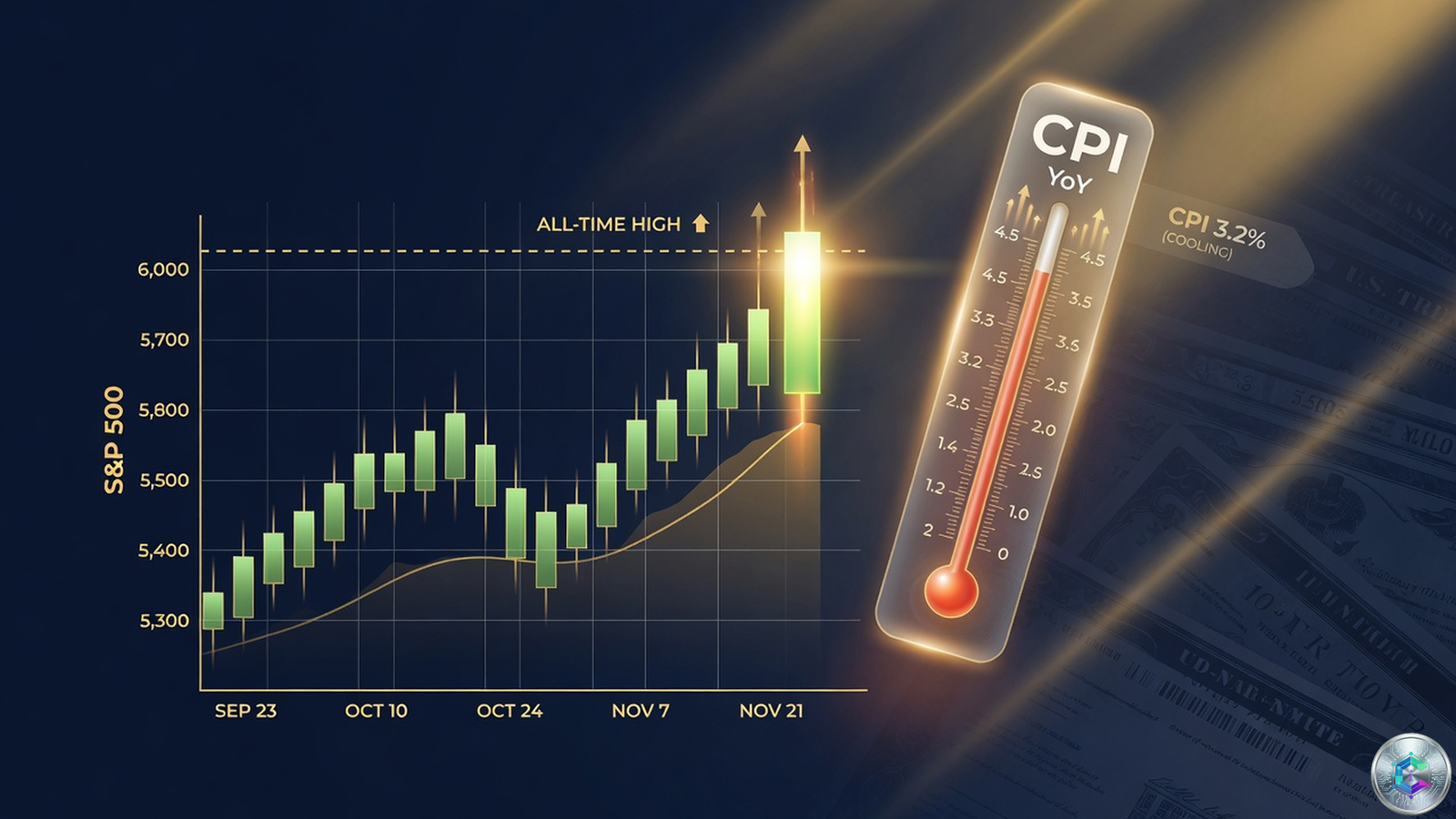
The S&P 500 closed at a fresh all-time high this week, powered by a sharp rebound in technology stocks and semiconductors. But the rally now hinges on a single number: the July consumer price index report, due Wednesday.
🔑 Key takeaways
- The S&P 500 climbed 5.75% over four straight sessions, its strongest four-day run since April 2025.
- July CPI is forecast at +3.4% year-over-year, with core CPI at +2.5%.
- Markets now price a roughly 44% probability of a September Fed hike, down from 60% on Thursday.
- The US economy shed 23,000 jobs in July, an unexpected contraction.
- The 10-year Treasury yield ended the week near 4.67%, with US crude back below $80 a barrel.
A tech rebound that erased two months in the desert
Between August 3 and 7, the S&P 500 logged its strongest four-session advance since April 2025, gaining 5.75%. The surge lifted the US benchmark to a new all-time closing high after two months without a fresh record, wiping out the July consolidation in one move.
Tech names — and semiconductors in particular — did the heavy lifting. These segments, which had been under pressure between two record peaks, found a massive bid on expectations of heavy AI data center capex. The S&P 500’s year-to-date gain now exceeds 12%, according to Reuters, and 13% according to AOL — the two sources showing a slight divergence on the figure.
Inflation: the bull market’s moment of truth
The July consumer price index release, due Wednesday, is now the single most important data point of the week. Economists surveyed by Reuters expect headline CPI at +3.4% year-over-year, and core CPI — which strips out volatile food and energy components — at +2.5%. As a reminder, inflation has stayed above the Fed’s 2% annual target for several years.
“The market is suffering from inflation anxiety. We’ll see next week if inflation data offers the market some relief.”
Matthew Miskin, co-chief investment strategist at Manulife John Hancock Investments
For Dominic Pappalardo, chief multi-asset strategist at Morningstar Wealth, the recent disinflation trend is enough to keep the Fed on hold for now — but a hot print would change the picture quickly.
“The fact that CPI has come down in recent months may be enough to prevent the Fed from raising rates this year. If CPI rebounds above forecasts on Wednesday, I’d expect stocks to give up gains on that news.”
Dominic Pappalardo, chief multi-asset strategist at Morningstar Wealth
A divided Fed and rapidly shifting rate odds
At its most recent meeting, the Federal Reserve held policy rates steady. But three of the twelve policymakers dissented in favor of a hike, exposing internal cracks over the rate path. That dissent is what makes the market so reactive to any inflation signal: the probability of a tightening move has rarely been this elevated in recent months.
The sharpest reversal came from the labor market. Friday’s jobs report showed an unexpected loss of 23,000 positions in July — the first net decline in a long while. In response, the implied probability of a September rate hike, derived from fed funds futures, collapsed from roughly 60% on Thursday to 44% on Friday.
| Indicator | Level / Change | Source / Date |
|---|---|---|
| S&P 500 (weekly close) | All-time high | Reuters, Aug 7 |
| 4-session gain | +5.75% | Reuters |
| S&P 500 YTD performance | +12% (Reuters) / +13% (AOL) | Aug 2026 |
| CPI forecast (YoY) | +3.4% | Reuters poll |
| Core CPI forecast (YoY) | +2.5% | Reuters poll |
| July payrolls | -23,000 | Aug 2026 |
| Sept Fed hike probability | ~44% (down from 60%) | Fed funds futures |
| 10-year Treasury yield | 4.67% (Reuters) / 4.64% (AOL) | Late Jul / Aug |
| US crude oil | < $80/barrel | Week of Aug 7 |
| Philadelphia SE Semiconductor YTD | +70% in 2026 | Reuters |
Treasury yields and oil: two risks to watch
Rising Treasury yields are weighing on the equity rally. In late July, the 10-year yield touched its highest level since January 2025 before easing to 4.67% per Reuters, or 4.64% per AOL. Higher yields raise borrowing costs for households and companies, while making bonds more attractive relative to stocks.
Easing US-Iran tensions pushed US crude back below $80 a barrel, taking some inflation pressure off the table. But, as Matthew Miskin notes, the oil tape remains a key swing factor.
“Any volatility in oil prices is something the market is watching closely. If oil prices continue rising, that increases inflation, and thus the probability that the Fed has to raise rates.”
Matthew Miskin, Manulife John Hancock Investments
Thursday’s producer price index report will add another read on the inflation backdrop, while Friday’s retail sales data will offer a window into consumer spending — a key gauge of the economy’s broader health.
Semiconductors: the AI rally between pause and restart
The Philadelphia SE Semiconductor index is up a striking 70% year-to-date, but it remains more than 17% below its late-June peak — a sign of persistent volatility. Earnings from Applied Materials, Cisco and CoreWeave next week will be treated as live tests of the AI thesis.
“We need to see broader technical recovery across a number of SOX components to really be convinced the worst is behind us. Earnings have generally been encouraging, but there’s still work to do before we can say we’re out of the woods.”
Matt Orton, chief market strategist at Raymond James Investment Management
Orton also points out that much of July’s pullback came from positions that had become too concentrated and expectations that had turned too euphoric — dynamics now partly absorbed. Corporate earnings are also beating elevated expectations for a second straight quarter, providing a floor under equities. “We’ve had solid earnings, particularly from some big companies that needed to post good numbers,” he said.
Conclusion: a rally at the mercy of one number
The week ahead concentrates every key issue facing US equities. A CPI print in line with, or below, expectations would reinforce the soft-landing narrative and give the S&P 500 fresh fuel to push toward new records. A hot surprise would revive fears of a September hike, expose stretched tech valuations, and push Treasury yields higher. In either scenario, semiconductor volatility will remain the cleanest leading indicator of the AI narrative’s health and, by extension, the broader rally’s durability.
Sources
- Reuters – Wall St week ahead: Inflation data to test record-setting US stocks
- AOL – Inflation data to test record-setting US stocks
- Financial Times – US markets coverage
- Yahoo Finance – Stock market today
- SEPE – Wall St week ahead
This article is published for informational and educational purposes only. It does not constitute investment advice. Do your own research (DYOR) before making any decision.

