

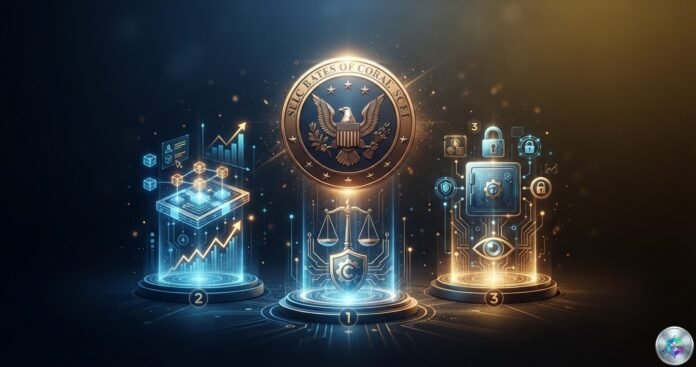
The U.S. Securities and Exchange Commission published on July 7, 2026 a regulatory agenda that places digital assets at the top of its priorities for the second half of the year. The program is built around three rule changes targeting the trading, issuance, and custody of crypto assets, in line with the pro-crypto policy of the Trump administration and the mandate of Chair Paul Atkins.
🔑 Key Takeaways
- Three crypto rule proposals expected by October 2026, covering trading, issuance, and custody.
- An SEC-CFTC memorandum signed March 11, 2026 coordinates joint oversight of digital assets.
- A joint March 17, 2026 interpretation classifies crypto into five categories, including stablecoins and meme tokens.
- A new category of crypto interfaces may operate without broker-dealer registration.
- Democratic lawmakers denounce an enforcement vacuum affecting Binance, Coinbase, Ripple, and Kraken.
The Three Regulatory Pillars Unveiled by the SEC
The H2 2026 regulatory program, released as part of the Office of Information and Regulatory Affairs’ unified agenda, structures the SEC’s action around three technical pillars. The first targets the Division of Trading and Markets, which will recommend amendments to the 1934 Exchange Act rules to integrate crypto asset trading on alternative trading systems (ATS) and national securities exchanges. The second concerns the Division of Corporation Finance, which will draft proposals on the offer and sale of crypto assets, with possible exemptions and safe harbors for issuers. The third addresses the financial responsibility, recordkeeping, and reporting rules applicable to broker-dealers holding crypto assets.
“The proposed rules may provide greater certainty to the market, facilitate capital formation, and accommodate innovation within crypto asset markets while ensuring that investors are adequately protected and receive the information they need to make informed investment decisions.”
SEC, 2026 rule proposal
Paul Atkins justified these initiatives by stating they are intended to “help clarify the regulatory framework for crypto assets and provide greater certainty to the market.” The agenda explicitly aligns with the objectives of the Trump administration’s digital asset policy, which includes clarifying tokenized securities and raising capital through digital assets.

Enhanced Coordination with the CFTC
The SEC’s crypto agenda does not advance in isolation. On March 11, 2026, the SEC and the Commodity Futures Trading Commission (CFTC) signed a landmark memorandum of understanding governing their cooperation across six key areas: developing a “fit-for-purpose regulatory framework” for digital assets, coordinating examinations, economic analyses, and joint enforcement actions. The text champions a “minimum effective dose” of regulation and respect for individual liberty.
On March 17, 2026, both agencies published a joint interpretation classifying crypto assets into five categories:
| Category | Description | Regulatory Treatment |
|---|---|---|
| Digital commodities | Crypto assets not covered by securities laws | Primary CFTC oversight |
| Digital collectibles | Meme tokens, artistic NFTs | Generally not deemed securities |
| Digital tools | Native protocol utilities | Case-by-case analysis |
| Stablecoins | Covered stablecoins per prior staff statement | Not securities offerings |
| Digital securities | Tokens meeting the Howey test | Full application of securities laws |
This classification represents a major doctrinal shift: covered stablecoins are explicitly carved out of the securities perimeter, while meme tokens are treated as collectibles whose value depends on supply and demand rather than the essential efforts of a third party. CFTC Chair Michael S. Selig endorsed this reading, stating that “the CFTC has joined the interpretation to provide guidance that the CFTC and its staff will administer the Commodity Exchange Act consistently with the SEC’s interpretation.”
Tokenization, Crypto Interfaces, and Broker Exemptions
Several technical initiatives complete this picture. On January 28, 2026, the Divisions of Corporation Finance, Investment Management, and Trading and Markets released a baseline taxonomy for tokenized securities, extending the “token taxonomy” introduced by Atkins in a November 2025 speech. The reaffirmed principle is unambiguous: “securities, regardless of their representation, remain securities” and “economic reality trumps labels.”
On December 11, 2025, the Division of Trading and Markets granted a no-action letter to the Depository Trust Company (DTC) to launch a three-year tokenization pilot program scheduled for H2 2026. On December 17, 2025, it clarified the application of the “possession” requirements of Rule 15c3-3 to fully paid and excess-margin crypto asset securities.
Finally, on April 13, 2026, the staff issued a statement on broker-dealer registration requirements for interfaces facilitating access to crypto securities. Under defined conditions, a covered interface provider may operate without registration, and unregistered broker-dealers may receive transaction-based compensation — an unprecedented mechanism since the 2014 M&A broker no-action letter.
Political Tensions and Publication Timeline
The agenda unfolds in a polarized political climate. Congress is debating a crypto asset market structure bill that could shift a significant share of the sector’s oversight from the SEC to the CFTC. In March 2026, Atkins indicated the SEC would advance with an institutional “bridge” while respecting the legislation if adopted by Congress.
| Milestone | Target Date | Subject |
|---|---|---|
| Crypto asset and market proposals | July 2026 | Issuance, trading, and transfer agent rules |
| Custody rule amendments | October 2026 | Digital asset custody for broker-dealers |
| DTC tokenization pilot | H2 2026 | Three-year program on tokenized securities |
Three Democratic members of the House of Representatives sent a critical letter to Atkins in January 2026: “The SEC’s decision to leave those who have violated securities laws without consequences, combined with Chair Atkins’ recent statements that ‘most crypto tokens are not securities,’ despite federal district court findings that at least some tokens are securities, has created a void whereby securities law violations by crypto firms go unenforced and U.S. investors are not protected.” The lawmakers cited Binance, Coinbase, Ripple Labs, and Kraken, whose enforcement actions were subsequently dropped.
Conclusion: A Framework Under Construction and Political Pressure
The SEC’s 2026 agenda marks a decisive step in structuring the U.S. regulatory framework for crypto assets. Coordination with the CFTC, the five-category classification, and targeted exemptions for interfaces are shaping a more readable environment for institutional players. Two scenarios now loom: either Congress adopts the market structure bill and reshuffles the SEC-CFTC division of labor, or the July and October 2026 proposals take effect and lock in an innovation-friendly regime vulnerable to criticism over investor protection. Actual publication dates remain subject to regulatory processes and may slip beyond initial estimates.
Sources
- Cointelegraph — SEC Crypto Rule Changes Are High on its 2026 Agenda
- Latham & Watkins — US Crypto Policy Tracker
- Ropes & Gray — SEC Announces 2026 Regulatory Agenda
- TradingView — SEC 2026 Agenda Coverage
- Office of Information and Regulatory Affairs — Unified Agenda
- Seward & Kissel — SEC Spring 2026 Regulatory Agenda
This article is published for informational and educational purposes only. It does not constitute investment advice. Do your own research (DYOR) before making any decisions.

