

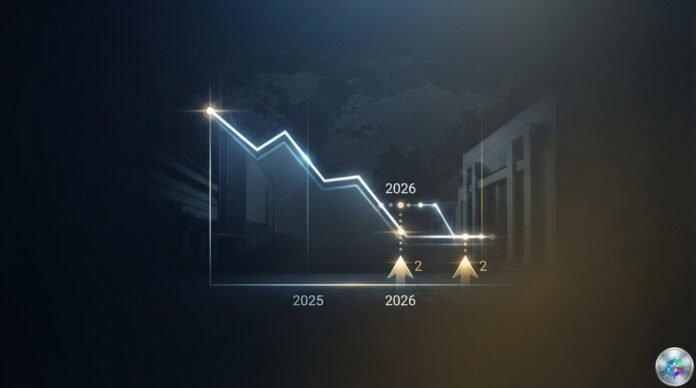
Bank of America (BofA) is sticking to its forecast of two Federal Reserve interest rate cuts in 2026, despite a recent downward revision to its macroeconomic outlook. Economist Aditya Bhave leans on the imminent arrival of Kevin Warsh as Fed chair and on a gradual cooling of inflation to justify a monetary easing scenario.
🔑 Key takeaways
- BofA still expects two Fed rate cuts in 2026 (September and October), despite PCE inflation running at a 4.1 % annualized pace.
- The latest FOMC meeting ended with a 9-3 vote, with three members pushing for a rate hike.
- Headline CPI fell to 3.5 % in June from 4.2 % in May, while core inflation posted its first monthly decline since May 2020.
- The CME FedWatch tool now prices a 60.1 % probability of a September hike, down from 78.8 % before Warsh’s press conference.
- Kevin Warsh, the new chair appointed by Trump, is expected to take office by September and steer the committee toward easing.
BofA’s bet on monetary easing
Aditya Bhave, economist at Bank of America Global Research, defended the firm’s two-cuts call for 2026 in a recent note to clients. The schedule points to a first move in September followed by a second in October, designed to bring policy rates back into a more accommodative range. While BofA acknowledged that its latest revisions now pencil in slightly weaker growth and higher inflation, it considers those adjustments insufficient to derail the rate path.
“We still expect cuts this year given the Fed’s willingness to look through supply-driven inflation, the limited signs of wage pressure, and the political pressure,” Bhave wrote.
Three pillars of the dovish case
Three key factors underpin BofA’s forecast. First, the central bank has historically been willing to look through supply-side shocks such as the recent oil price spike triggered by US-Iran tensions. Second, hourly wages have risen just 3.5 % year over year, a level most economists do not consider inflationary. Third, the political pressure exerted by the Trump administration to loosen monetary policy remains a major driver. According to BofA, by September the new Fed chair Kevin Warsh will be in office and will have gathered enough evidence of an inflation cooldown to rally support for monetary easing.
This stance contrasts with an earlier BofA analysis published on May 9, 2026, in which economists said they no longer expected a rate cut this year and instead pushed easing to the second half of 2027, citing persistent inflation and a resilient labor market. The current scenario thus marks a return to the firm’s initial call of two cuts in September and October.
| Indicator | Reading | Trend |
|---|---|---|
| Fed funds range | 3.50 % – 3.75 % | Unchanged |
| CPI YoY (June) | 3.5 % | Falling |
| Core inflation | 2.6 % | Falling |
| Hourly wages (YoY) | 3.5 % | Stable |
| PCE annualized, 3M | 4.1 % | Rising |
A deeply divided FOMC
The minutes of the March FOMC meeting confirm a growing wait-and-see stance within the institution. According to BofA, a “couple” of officials who still anticipated eventual rate cuts pushed back their timeline, while “some” even flagged the possibility of signaling hikes. Conversely, “many participants” still believed it would be appropriate to lower rates “in time.” At the most recent meeting reported by Charles Schwab, rates were held steady in the 3.50 % to 3.75 % range with a 9-3 vote. Dissenters Beth Hammack, Neel Kashkari, and Lorie Logan pushed for a hike to contain price pressures.
“The committee remains resolute. You have heard it before, but we will maintain price stability.”
Kevin Warsh, Fed Chair
At his press conference, Kevin Warsh described a “good family dispute” while stressing the committee’s unity on its shared commitment to price stability. The new chair defended his decision to scrap forward guidance, noting that nominal and real yields have risen along the curve over recent weeks. He attributed the move to markets paying more attention to data than to Fed signals: “Market participants are learning to play the ball, not the referee,” he said.
The economic indicators under scrutiny
Inflation: a gradual cooldown
Recent inflation data gave the Fed some breathing room. The headline Consumer Price Index (CPI) rose 3.5 % year over year in June, sharply lower than the 4.2 % reading in May, driven mainly by falling oil prices. Core inflation, which strips out food and energy, eased to 2.6 % from 2.9 % the previous month, posting its first monthly decline since May 2020. By contrast, the Personal Consumption Expenditures (PCE) price index — the Fed’s preferred inflation gauge — accelerated to an annualized 4.1 % pace over the past three months, a reminder that underlying pressures remain.
Consumption and the labor market
Real consumer spending rose just 0.1 % month over month in February, slowing to an annualized 0.8 % pace over the previous three months. This demand softness weighs on the Fed’s balancing act between inflation and growth. The labor market remained on a solid footing after stabilizing in recent months: employers added just 57,000 jobs in June, but jobless claims hit a multi-decade low, confirming persistent tightness in the labor market.
The market reprices its probabilities
Right after Kevin Warsh’s press conference, the CME FedWatch tool cut the implied probability of a September rate hike to 60.1 %, down from 78.8 % earlier that Wednesday morning. Earlier in the month, after the escalation of US-Iran hostilities, the tool had shown a 35.8 % probability of a hike, up from 10.7 % on July 15, reflecting the surge in oil prices. The Fed’s June economic “dot plot,” however, still tilts toward tightening: 9 members project at least one rate hike in 2026, 8 others expect rates unchanged, and only one dot still points to a cut this year.
Conclusion
BofA’s call remains a contrarian bet against the consensus. While the arrival of Kevin Warsh and a gradual cooldown in inflation provide a favorable backdrop for monetary easing, internal FOMC divisions, energy price pressures, and labor market resilience complicate the timeline. In the near term, two scenarios dominate: either the Fed validates BofA’s call with two cuts in September and October, or it holds rates steady through year-end while waiting for clearer disinflation.
The next CPI and PCE reports, along with the evolution of geopolitical tensions in the Middle East, will be decisive in shaping US monetary policy over the coming months. BofA’s call can only hold if inflation keeps cooling and Kevin Warsh succeeds in rallying a majority on a committee that is now visibly split.
Sources
- Investing.com — BofA explains why Fed is likely to deliver rate cuts this year
- Bloomberg — Bank of America Sees Two Fed Rate Cuts This Year vs None Before
- Forex Factory — Fed Unlikely to Cut Interest Rates Until Second Half of 2027
- Yahoo Finance — BofA explains why Fed is likely to deliver rate cuts
- Bankrate — How the Federal Reserve impacts your money
- Charles Schwab — FOMC Meeting
This article is published for informational and educational purposes only. It does not constitute investment advice. Do your own research (DYOR) before making any decision.

