

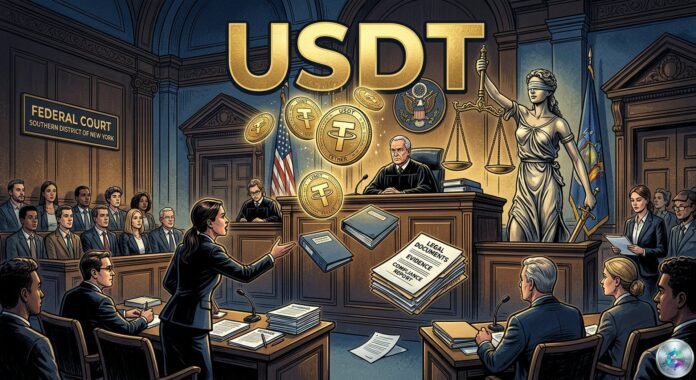
Lawyer Seeks Court Order for Tether to Transfer $344 Million in Frozen USDT to Terrorism Victims
On May 15, 2026, a major legal battle opens in New York surrounding digital assets. Attorney Charles Gerstein, representing American victims of terrorist acts who obtained judgments against Iran but never received compensation, is asking a federal judge to compel Tether to release more than $344 million in USDT frozen since April 2026. This marks the first time such an enforcement mechanism through digital assets has been invoked before an American court. This case could set an unprecedented precedent in the enforcement of antiterrorism judgments via cryptocurrency rails.
Background: The April 2026 Record Freeze
On April 23, 2026, Tether announced it had frozen $344 million in USDT on the Tron blockchain, spread across two addresses identified by American authorities as belonging to Iran’s Islamic Revolutionary Guard Corps (IRGC). This action, carried out in coordination with the Office of Foreign Assets Control of the U.S. Treasury and several federal agencies, constitutes the largest individual freeze in the history of cryptocurrency. This massive freeze operation was made public as geopolitical tensions between the United States and Iran reached a new threshold.
The $344 million figure far eclipses the previous record of $182 million frozen in January 2026. Treasury Secretary Scott Bessent stated at the time: « We will follow the money that Tehran is desperately attempting to move outside of the country and target all financial lifelines tied to the regime. » The operation was dubbed « Economic Fury, » reflecting the Trump administration’s intent to financially pressure the Iranian regime.
Tether, which issues the world’s largest stablecoin by market capitalization, now cooperates with more than 340 law enforcement agencies in 65 countries. In total, the company declares having frozen more than $4.4 billion in assets linked to criminal activities, including $2.1 billion in direct coordination with American authorities. These figures illustrate the scale of Tether’s role in the digital assets compliance ecosystem.
The two frozen addresses had been flagged by OFAC as being used to circumvent international sanctions. The funds were allegedly directly linked to the Islamic Revolutionary Guard Corps’ destabilization activities in the Middle East region. This precise identification of the wallets enabled Tether to act quickly, under pressure from American authorities who shared financial intelligence information.
Charles Gerstein’s Legal Strategy
Charles Gerstein is no stranger to digital asset litigation. In March 2026, he had already convinced a federal court to surrender frozen cryptocurrencies in a case involving the Arbitrum protocol, marking a turning point in the use of digital assets for enforcing civil judgments. Building on this precedent, the attorney is now targeting Tether and its USDT war chest, hoping to replicate the approach that worked with Arbitrum.
The central thesis of his argument rests on bold legal reasoning: since Tether has already demonstrated its ability to freeze tokens by complying with OFAC directives, nothing technically prevents it from « reissuing » an equivalent amount to wallets controlled by the victims’ lawyers. The proposed mechanism is straightforward: the original USDT remains frozen on-chain while new tokens are created and transferred to the plaintiffs’ counsel, thereby satisfying the judgments without affecting the sanctioned wallets.
This approach would exploit a legal vacuum: antiterrorism judgments rendered by American courts against Iran have never been enforced through conventional financial circuits. The volatility of Iranian assets and international sanctions prevented any transfer through traditional banking channels. With this case, Gerstein opens a new enforcement channel via stablecoin issuers, which possess the necessary technical infrastructure to freeze and potentially reissue tokens.
The victims represented by Gerstein hold judgments rendered by American courts against Iran for terrorist acts committed in previous decades. These judgments, totaling several hundred million dollars in damages, have never been enforced due to Iran’s special status under international law and the sanctions affecting the country. The proceeding against Tether therefore represents an attempt to circumvent these traditional obstacles.
Legal Challenges and Potential Objections
The opposing side, represented by Tether’s defenders, is expected to raise several significant objections. The first concerns the legal nature of USDT: as a token on the blockchain, USDT constitutes a digital asset whose ownership is permanently recorded on the distributed ledger. An order to « reissue » would amount to creating value ex nihilo, which could be considered an overreach by a federal court that cannot compel a private entity to create money.
Furthermore, critics point out that such a precedent would grant stablecoin issuers considerable power: the unilateral ability to determine the ultimate ownership of certain assets. This concentration of power runs counter to the decentralized philosophy at the heart of the blockchain ecosystem, where private ownership and the inviolability of wallets are considered fundamental principles. Tether has not publicly commented on this proceeding to date.
An additional dimension may emerge from ongoing investigations. According to Snir Levi, founder of the crypto compliance investigations platform Nominis, the transactional behaviors of the frozen wallets do not fully match the patterns expected from the IRGC. Some data suggests links to Chinese exchange platforms, specifically connections with HTX, formerly Huobi. This discovery could complicate the plaintiffs’ position if confirmed, as it questions the official thesis on the actual beneficial ownership of the frozen funds.
Finally, questions arise regarding the court’s jurisdiction to order a private entity like Tether to perform such an operation. Even though American courts have broad power in enforcing civil judgments, compelling a stablecoin issuer to create new tokens raises unprecedented legal questions that have never been decided by an American court.
Stablecoin Regulation: A Sector Under Heavy Surveillance
This case unfolds against a backdrop of tightening global regulation around stablecoins. The U.S. Congress is currently examining several bills, including the GENIUS Act, specifically designed to regulate issuers like Tether. The prospect that stablecoins could serve as instruments for tax evasion or terrorism financing motivates these legislative initiatives, which aim to impose stricter transparency requirements on fiat-backed token issuers.
Since early 2026, Tether has carried out several major freeze operations. Between April and May 2026 alone, more than $500 million in USDT has been blocked, including $38.4 million seized after blockchain investigator ZachXBT traced funds from several collapsed platforms including DSJ Exchange and BG Wealth Sharing, two Ponzi schemes that defrauded thousands of investors. These successive freeze operations demonstrate Tether’s willingness to cooperate with authorities.
The T3 Financial Crime Unit, a joint initiative of Tether, Tron, and blockchain analytics company TRM Labs, stated it has contributed to freezing more than $450 million in suspected illicit assets since its creation in 2024. The unit claims its ability to freeze funds in less than 24 hours in emergency cases, making it a valuable tool for financial crime enforcement agencies. This close cooperation between the private sector and authorities illustrates the evolving compliance model in the crypto ecosystem.
In May 2026 specifically, New York prosecutors expressed reservations about the GENIUS Act’s fraud provisions, warning that certain clauses could weaken existing protections against market manipulation. These critiques show that the regulatory debate around stablecoins remains deep, and that legislators must navigate between competing interests.
Market Reactions and Industry Implications
Despite the scale of the case, USDT has not experienced significant market drift. The capitalization of the world’s leading stablecoin remains stable, suggesting acceptance of Tether’s role as a compliance actor rather than a threat to its users. This attitude reflects a market evolution that now integrates interactions between stablecoin issuers and regulatory authorities as part of the ecosystem’s normal operation.
If the Gerstein case succeeds, it would create a precedent capable of radically transforming judicial enforcement practices in the digital domain. Specialized law firms are already beginning to review similar cases, anticipating a surge of comparable proceedings targeting other cryptocurrency platforms that have frozen funds as part of their compliance operations.
The outcome of this proceeding could also influence the legislative debate in Washington. Opponents of the current regulatory framework would see proof that industry self-regulation is insufficient and that stricter legislative intervention is necessary. Conversely, industry defenders would emphasize that cooperation between Tether and authorities has delivered concrete results in combating terrorism financing.
For USDT holders worldwide, this case reminds that tokens issued by Tether are not entirely free from regulatory risk. Even if ordinary users’ funds are not targeted, the prospect that courts could order measures concerning the issuer’s assets raises questions about the true nature of the relationship between Tether and its users.
Outlook
The trial before the Manhattan Federal Court promises to be long and complex, with months or even years of proceedings ahead. Whatever the outcome, the decision will make history in the legal annals of digital assets. It could establish the principle that American courts can compel stablecoin issuers to enforce compliance judgments, even in the absence of explicit legislative framework expressly providing for this possibility.
For the stablecoin industry as a whole, this case underscores the mounting pressures facing issuers. Between the need to cooperate with authorities and the promise of decentralization underlying their economic model, these companies navigate an increasingly narrow space. How Tether and its competitors respond to these requirements will shape the regulatory future of the entire sector for years to come.
In the longer term, this proceeding could also accelerate the emergence of international regulatory frameworks concerning stablecoins. Global financial regulatory bodies are watching this case closely, as it could serve as a precedent for similar cases involving other jurisdictions and other fiat-backed token issuers.
Sources
- Lawyer behind Arbitrum crypto seizure fight now targets Tether for $344 million — CoinDesk
- Tether Freezes $344 Million USDT on Tron in OFAC Coordination — Yahoo Finance
- Tether Freezes $344 Million in USDT With OFAC and US Law Enforcement — Bitcoin.com
- Tether freezes over $500M of USDT in 30 days, BlockSec data shows — Cointelegraph
- Charles Gerstein targets Tether for $344 million — PANews

