

The CLARITY Act Heads to Senate Vote: What You Need to Know
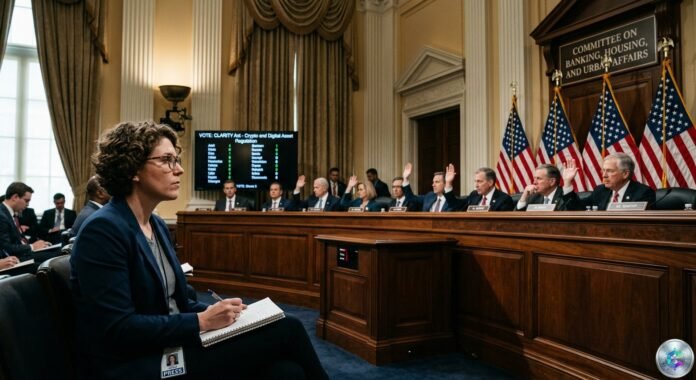
The U.S. Senate Banking Committee kicks off, this Thursday May 14, 2026, the markup session for the CLARITY Act, the most ambitious bill ever presented to regulate the crypto industry in the United States. With a 309-page text debated in committee and historic bipartisan support — 294 votes against 134 in the House of Representatives in July 2025 — this vote could seal the regulatory future of digital assets on American soil. The legislative window is narrow: failure before May 21, the Memorial Day recess, would push this opportunity to 2030, according to Senators Cynthia Lummis and Bernie Moreno. The American crypto industry is holding its breath, after years of regulation by enforcement carried out by the SEC under Gary Gensler, with dozens of lawsuits launched against companies without a clear legislative framework to guide them.
Background
The Digital Asset Market Clarity Act, better known as the CLARITY Act, was adopted by the House of Representatives on July 17, 2025, by an unprecedented vote. Since then, the text had been stalled in the Senate, blocked by two postponed markup sessions and tense negotiations around stablecoin regulation. The Banking Committee, led by Chairman Tim Scott, scheduled the vote for May 14, 2026 at 10:30 a.m., in Room 538 of the Dirksen Senate Office Building in Washington.
The most contentious issue in the text concerns rewards paid on stablecoin balances. American banks, united around the powerful American Bankers Association, deployed intensive lobbying in the weeks leading up to the vote: more than 8,000 letters were sent to Senate offices to denounce a text that, in their view, would threaten traditional bank deposits by favoring stablecoin issuances with yields. Traditional institutions fear a massive departure of their clients toward stablecoin products offering competitive yields. This battle between the traditional banking sector and the crypto industry is at the heart of the debate on Capitol Hill.
On the other side, industry giants — Coinbase and Circle at the forefront — supported a compromise developed by Senators Thom Tillis and Angela Alsobrooks, Republican from North Carolina and Democrat from Maryland. This compromise prohibits yields resembling bank deposit rates, but preserves certain activities called « bona fide activities » in the text, a formulation that will still need to be clarified by regulators. This common position made it possible to advance the text, despite resistance from the traditional banking sector.
The two previously canceled markup sessions had increased frustration within the crypto industry. Companies in the sector had sent a joint letter to the Banking Committee, urging legislators to advance the text before the Memorial Day window. More than a hundred firms signed this document, bringing together actors with sometimes divergent interests on other issues. This coordinated mobilization seems to have paid off, since the text debated this Thursday includes the Tillis-Alsobrooks compromise on stablecoins.
The Facts
The 309-page text — 31 pages more than the January 2026 version — establishes a clear legal boundary between two federal agencies that have clashed for years over the regulation of digital assets. The SEC, Securities and Exchange Commission, would retain its jurisdiction over new token sales and initial offerings, as well as over assets considered as investment contracts. The CFTC, Commodity Futures Trading Commission, would be responsible for secondary markets and trading on platforms.
This separation of powers is central to the architecture of the bill. The crypto industry has long complained about the regulation by enforcement carried out by the SEC, with lawsuits against companies and developers without a clear legislative framework. The CLARITY Act aims to end this approach by giving each agency a defined role and a precise legal basis. Paul Atkins, SEC Chair since 2025, personally urged Congress to move forward during a speech on April 9, citing an internal project called « Project Crypto » as the agency’s preparation for a regulated environment.
The White House economic adviser, Scott Bessent, published an op-ed in the Wall Street Journal to present the CLARITY Act as a national security issue. Without American regulatory certainty, blockchain developers and crypto companies continue to migrate to Singapore, Abu Dhabi, and other more welcoming jurisdictions. This issue of the flight of talent and businesses to more permissive countries was a key argument in the persuasion campaign conducted by the bill’s supporters.
Among the other key provisions of the text are cybersecurity standards for centralized intermediaries interacting with decentralized finance protocols, explicit protections for open-source developers against regulatory liability, an exclusion of peer-to-peer transactions from the broad scope of the text, and bankruptcy safeguards for clients holding crypto assets. The text also covers provisions related to illicit financing, a sensitive point for American intelligence agencies.
Predictions on the Polymarket prediction market gave, at the beginning of the week of May 14, approximately 60 percent chances of passage of the text during the committee vote. This figure fluctuated however depending on the news of negotiations between Republican and Democratic senators on ethical provisions related to public officials’ crypto holdings.
Analysis
Democratic resistance remains significant despite the text’s advancement. Senator Elizabeth Warren, from Massachusetts, filed 44 amendments in total, many of which aim to integrate ethical safeguards regarding crypto investments by the Trump family and other government officials. Democrats threaten to block the text without these guarantees, which adds a supplementary political dimension to the legislative debate.
A Senate staffer told Fortune: « Concerns are growing among Democrats: if ethics are not included in the text examined by the Banking Committee, they never will be. » This position illustrates the difficulty of finding a balance between the interests of a growing sector and the imperatives of government transparency.
Negotiations between the two parties multiplied this week to try to find common ground on ethical amendments. Republicans emphasize the protection of Main Street America and national security, while defending the goal of keeping crypto innovation on American soil. Committee Chairman Tim Scott said that protecting ordinary Americans was at the heart of the bill. For her part, Senator Lummis, who chairs the Banking Subcommittee on Digital Assets, publicly reaffirmed her commitment to the text on X with a single word: « Clarity. »
Steve Yelderman, legal counsel at Etherealize, remains optimistic despite the obstacles: « I think it will pass, given the great progress made on both sides of Congress and the support this bill is getting from the White House. That said, this is Washington, and anything can happen. » This caution well reflects the tense atmosphere of the corridors of the U.S. Senate.
Senator John Kennedy, previously opposed to the text because of his questions about stablecoin oversight, announced he would now support the CLARITY Act. This change of position constitutes a significant gain for the bill’s promoters and suggests that the arguments presented during hearings have borne fruit. The banking mobilization, although visible by the volume of letters sent, has not managed to derail the legislative process for now.
Market Reactions
As the vote approaches, the main crypto markets have followed American regulatory news with particular attention. The Polymarket prediction market gave approximately 60 percent chances of passage of the text during the committee vote, a figure slightly declining during the week. This evolution reflects the persistent uncertainty around negotiations between parties.
Crypto and blockchain companies sent a joint letter to the Banking Committee to support the bill, a sign of coordinated sector mobilization. More than a hundred firms signed this document, calling on the Senate to advance the text before the Memorial Day window. This sector unity is remarkable, as it brings together actors with sometimes divergent interests on other issues. For the market, the horizon of a clear regulatory framework is a signal that has been awaited for a long time.
In parallel with the examination of the CLARITY Act, the House Ways and Means Committee met on May 14 in closed session to discuss tax reform on crypto assets. This second legislative project is moving forward at the same time as the main text, illustrating Congress’s willingness to address the crypto question as a whole and to close a set of files that have been pending for several sessions.
Outlook
If the text is adopted by the Banking Committee on May 14, it will go before the full Senate for a vote before the summer recess. Chairman Tim Scott targets finalization between June and July 2026. The White House set a presidential signature before July 4 as a goal, a symbolically charged date that would show the government’s ability to legislate on innovative financial matters.
Margins are thin however. Legislators have filed more than 130 amendments in total, and banking lobbying remains active despite the compromise reached on stablecoins. The text will also have to clear the Congressional Budget Office, which evaluates the financial impact of each legislation and whose scoring can make or break a bill.
The stakes are considerable: the CLARITY Act would be the first federal law to establish a clear framework for digital assets in the United States. For the industry, it is a question of ending years of legal uncertainty and giving American companies a visibility on which to rely to invest and recruit. For federal regulators, it is a question of institutionalizing practices that have emerged outside any framework since the sector’s rise.
Failure this week would have lasting consequences. Senators Lummis and Moreno warned that a postponement beyond May 21 would push the next viable legislative window to 2030, or beyond due to the election calendar and midterm elections. For the American crypto industry, this is indeed a moment when everything is at stake.
Beyond the CLARITY Act itself, industry players are also watching the fate of the Genius Act, a separate proposal focused on stablecoin payments that could complete the regulatory framework. These two texts, if they succeed, would constitute a complete overhaul of the American approach to digital assets. A restructuring that could influence regulatory choices in Europe and Asia, where discussions on a similar framework are underway.

