


The Bitcoin ecosystem is navigating a pivotal transition in the second week of May 2026. Trading around the psychological threshold of $81,000, the market stands at the confluence of multiple exogenous and endogenous catalysts of paramount importance: macroeconomic data under pressure, a historic transition at the helm of the Federal Reserve, and an imminent legislative vote on cryptocurrency regulation in the United States. This report offers an exhaustive dissection of current market dynamics, integrating multi-timeframe chart analysis, liquidity heatmap order book analysis, and macro/on-chain fundamental assessment.
Macroeconomic Context: A Precarious, Multidimensional Equilibrium
Bitcoin’s resilience above the major psychological support of $80,000, despite a persistently hostile monetary environment, reflects a deep structural shift in institutional investor behavior. Historically, ten of the last eleven U.S. CPI publications have triggered short-term bearish corrections across risk assets. Yet the current configuration diverges radically from this statistical norm, suggesting a maturing market with institutional capital proactively absorbing macro shocks.
The latest unadjusted CPI data for April 2026 revealed an upside inflation surprise, exceeding market consensus expectations. This unexpected resurgence of inflationary pressures calls into question the narrative of rapid, linear disinflation, and substantially complicates the Fed’s monetary policy trajectory. The situation is further exacerbated by persistent geopolitical tensions in the Middle East — the U.S.-Iran diplomatic impasse has propelled WTI crude oil prices beyond critical thresholds, adding a significant risk premium on global energy inflation.
Facing this cocktail of pressures, U.S. equity markets saw broad-based declines. Bitcoin, historically correlated with tech indices during macro stress events, initially dipped in tandem before being aggressively bought back by market operators — a testament to robust underlying institutional demand.
A major endogenous event further complicates the equation: the Senate confirmation vote of Kevin Warsh to succeed Jerome Powell as Fed Chair, scheduled for May 15, 2026. This nomination introduces a potential directional volatility window estimated at 5%–10% for BTC. Market interpretation remains deeply divided: the bullish scenario anticipates a more rule-based, predictable monetary policy leading to structured rate cuts once disinflation is confirmed — weakening the dollar and boosting BTC toward $90,000 then $95,000–$100,000. The bearish scenario highlights Warsh’s inherently hawkish reputation on inflation, which the hot CPI print would empirically justify, risking a test of $75,000 support or a breakdown below the critical $79,500 demarcation line.
The Legislative Catalyst: The CLARITY Act and Institutional Adoption
Markets are equally suspended on the outcome of the legislative process surrounding the « Digital Asset Market Clarity Act » (CLARITY Act). The U.S. Senate Banking Committee is set for a crucial markup vote on May 14, 2026. This 309-page bipartisan bill represents the most consequential legislation ever crafted for the U.S. crypto industry, with the primary objective of formally delineating the jurisdictional boundaries between the SEC and CFTC — ending years of regulatory enforcement by litigation.
For Bitcoin, the central stake is not the commodity classification itself — never contested — but its irrevocable codification into sovereign federal law, providing absolute legal certainty for financial conglomerates and institutional asset managers. Investment bank models directly link the Act’s passage to massive institutional inflows: a final congressional approval could trigger up to $15 billion in additional net flows specifically directed at spot Bitcoin ETFs, justifying a revised medium-term price target of $143,000 for 2026. Current institutional demand is already exceptionally robust, with Bitcoin ETFs recording between $272M and $532M in daily inflows since the start of May.
However, the legislative machinery faces partisan friction. The Banking Committee, split between 13 Republicans and 11 Democrats, requires absolute Republican cohesion. Persistent disagreements over stablecoin yield regulations, treatment of non-custodial DeFi software developers, and government ethics standards threaten to delay the vote beyond the Memorial Day recess (May 21). Such a delay could freeze Bitcoin in a sterile consolidation channel between $74,000 and $80,000 for several quarters, stripping the market of its primary fundamental catalyst.
On-Chain Dynamics and Leverage Structure
On-chain analysis reveals a striking behavioral dichotomy between market participants. On the miner side, wallet reserves have declined steadily since the $72,000 rebound — active distribution near annual highs driven by the necessity to secure operational profits in a post-halving environment where block rewards have been halved. This selling pressure creates a mechanical ceiling that is difficult to pierce without a compensatory institutional inflow surge via ETFs.
In contrast, « new whales » — entities holding large BTC volumes accumulated over the last 155 days — display an average cost basis precisely at $80,300. This level acts as a psychological floor and fundamental structural bulwark, explaining the aggressive dip-buying observed every time price ventures below $80,500. Conversely, retail shows clear signs of exhaustion, with 245,000 active wallet addresses lost in just five days — the fastest network contraction since summer 2024 — facilitating the structural transfer of liquidity to high-conviction institutional portfolios.
On derivatives markets, the Estimated Leverage Ratio is climbing toward annual highs, signaling aggressive risk-taking in the current consolidation zone. While leverage is primarily institutional (3x–10x), exchanges now use dynamic volatility-adjusted margin models, meaning cascading liquidations can ignite endogenously for far smaller price moves than static calculations would suggest.
Liquidation Heatmap: An Asymmetric Powder Keg
The liquidation heatmap analysis (below) reveals a heavily asymmetric order book structure near the current price. On the upper side, intense scarlet-red bands stack densely between $81,600 and the $82,000 resistance, confirming an exceptional concentration of limit sell orders (sell walls). The Point of Control (POC) for the recent session sits precisely around $80,600, acting as a short-term gravitational magnet.
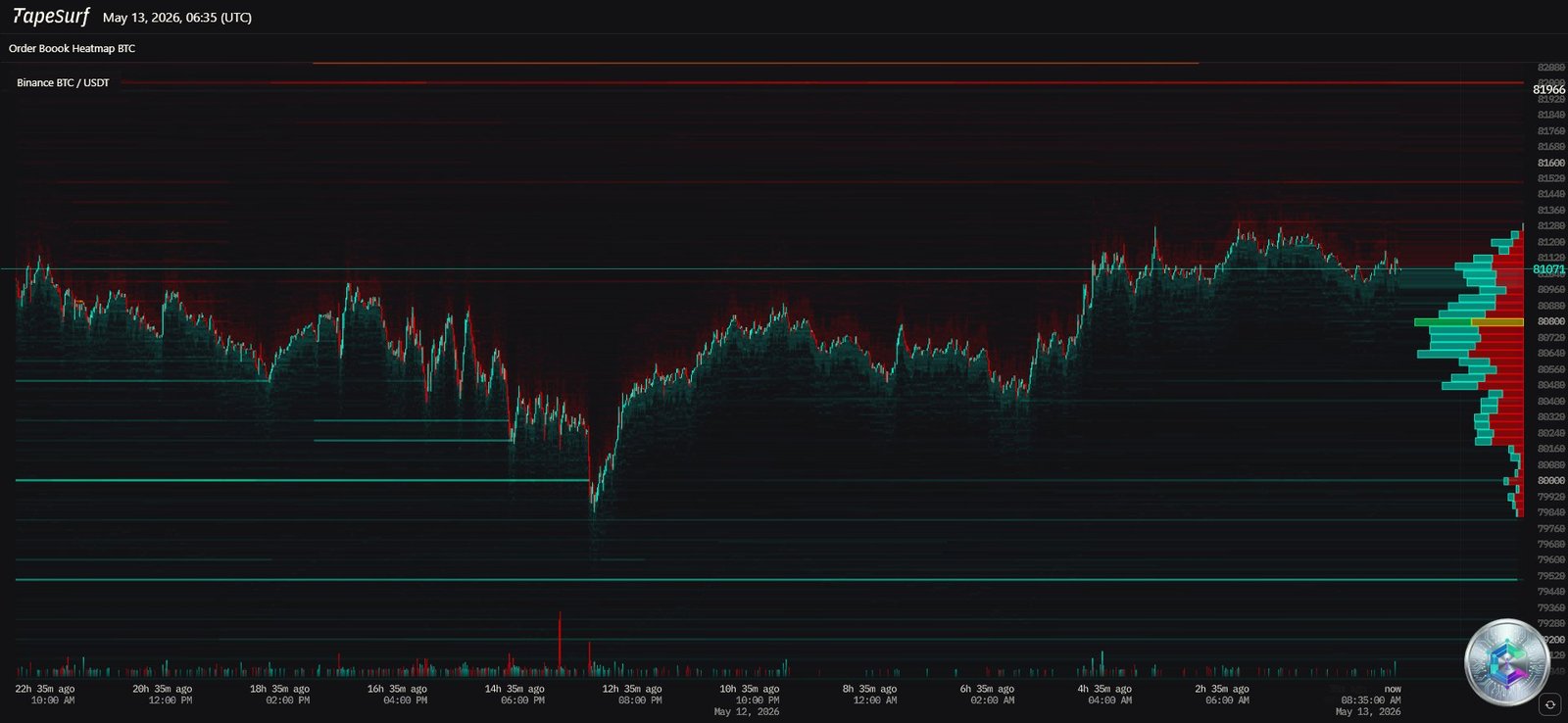
The quantitative data is spectacular. On the short side, a decisive close above $81,264 would put approximately $913 million in short positions at risk of forced liquidation. The algorithmic execution of these forced buy orders would trigger a « short squeeze » that could transform a modest technical move into a constrained-flow event of nearly $3.1 billion, vertically propelling BTC toward the $84,000–$85,500 zone.
Conversely, the long-side defensive architecture is quantitatively far more massive but structurally deeper. The loss of the ultimate defensive line at $73,610 would trigger a long liquidation cascade totaling $2.221 billion, precipitating the market toward $70,000 — and potentially $60,000 in the event of extreme panic and simultaneous macro-legislative failure.
Multi-Timeframe Chart Analysis
Daily Chart: The Test of the Trend
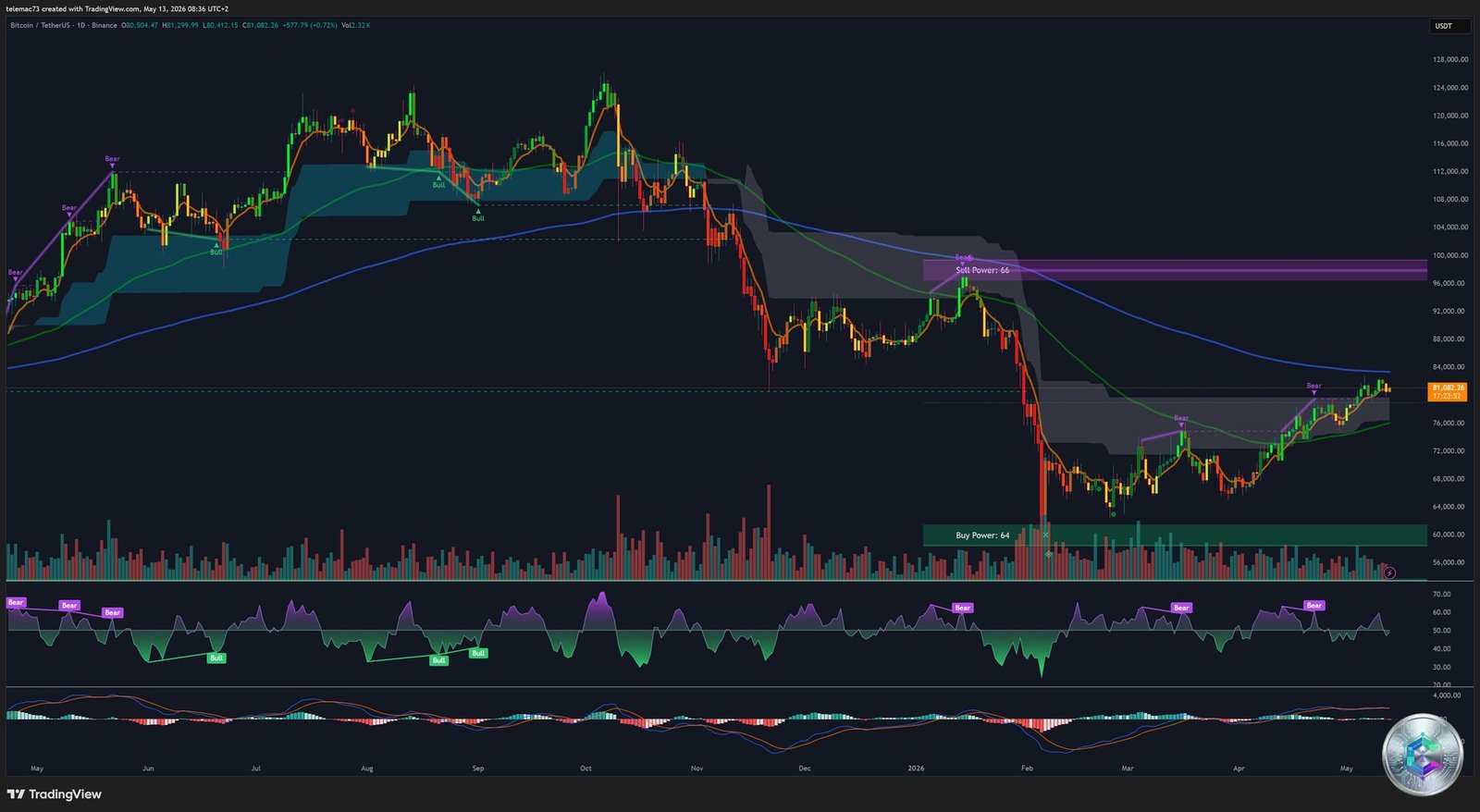
On the daily chart, Bitcoin is consolidating in a relative vacuum around $80,500, butting against a critical resistance: the 200-day Simple Moving Average (SMA), currently around $82,800. The asset has made two failed attempts to close convincingly above this long-term directional filter — confirming a transfer of the burden of proof to buyers.
The most perniciously bearish technical signal is the formation of a lower high: after a momentum peak at $82,499 on May 6, a subsequent rally attempt fizzled at $82,139. This asymmetric sequence signals diminishing intrinsic velocity. The RSI, oscillating apathetically around 50 with declining peaks, illustrates a classic bearish divergence. The MACD histogram is dangerously flattening near the zero line.
Yet these short-term weakness signals sharply contrast with extraordinarily bullish very-long-term metrics. The imminent MVRV ratio Golden Cross with the 200-day EMA — a signal that historically preceded 90%–400% rallies — argues for the maturation of a major accumulation base. Additionally, Bitcoin has only traded for a cumulative 49 days in the $80,000–$89,999 zone throughout its entire trading history: this « air pocket » of distribution history means that a loss of $79,500 could lead to a rapid, friction-free decline.
4-Hour Chart (H4): The Compression Triangle
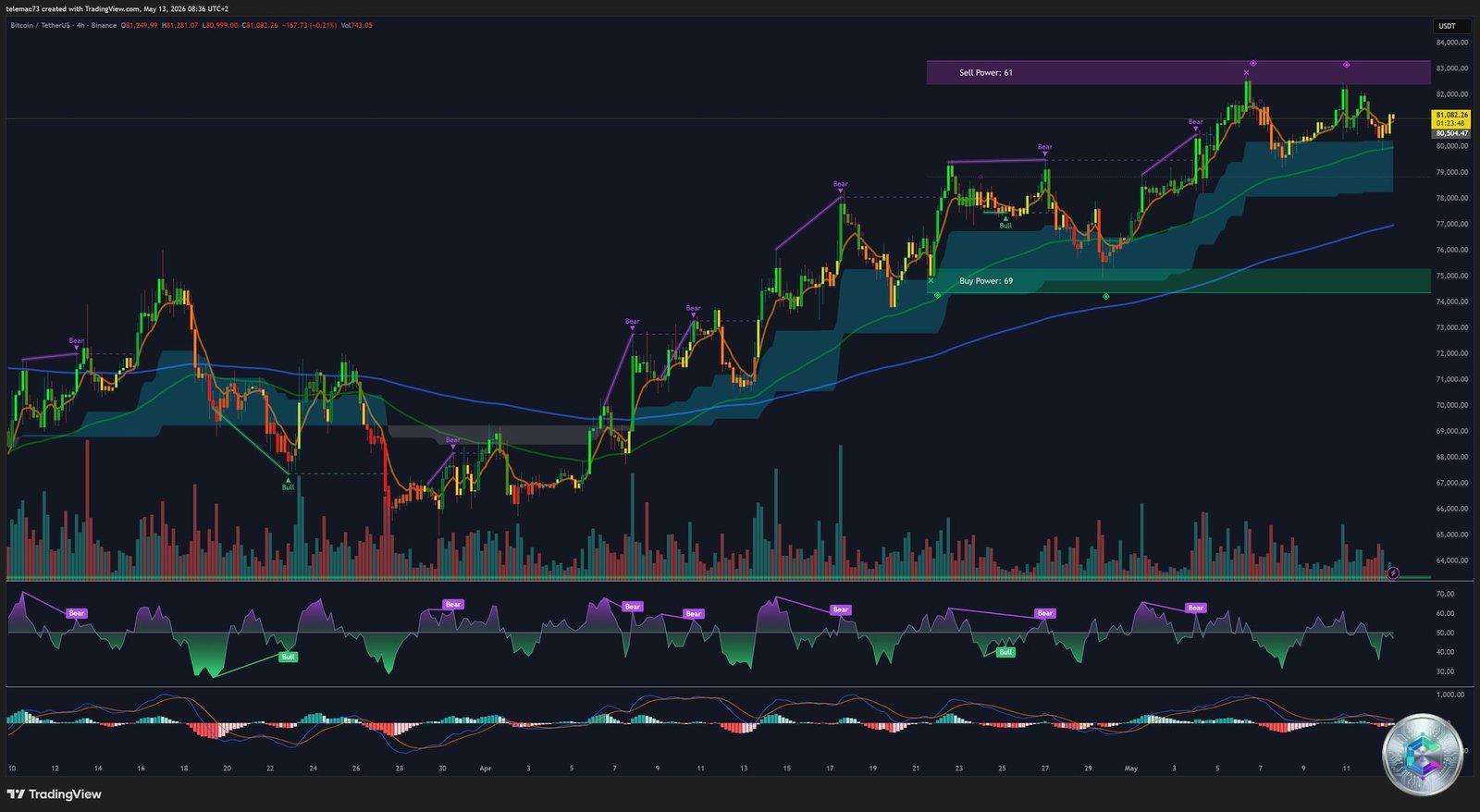
The 4H chart reveals a severe volatility compression, characteristic of the incubation phase preceding major macro shocks. Price is wedged in an indecision triangle bounded by two converging trendlines leading to an apex. A « Sell Power: 61 » institutional block is clearly defined in the $82,000–$83,000 zone, justifying successive rejections. Below, a larger « Buy Power: 69 » zone provides tactical support from $74,000–$75,000.
A notable analytical feature is the triangle’s angular asymmetry: the ascending support trendline (connecting higher lows) carries a steeper slope than the descending resistance line, suggesting buyers are slightly more proactive in raising their intervention levels on each dip. Nevertheless, the funnel-shaped consolidation will mechanically force an explosive resolution. The MACD has just validated a local Death Cross and the RSI is sliding below 50, with quantitative models tilting toward residual weakness.
15-Minute Chart (M15): Intraday Volatility and Traps
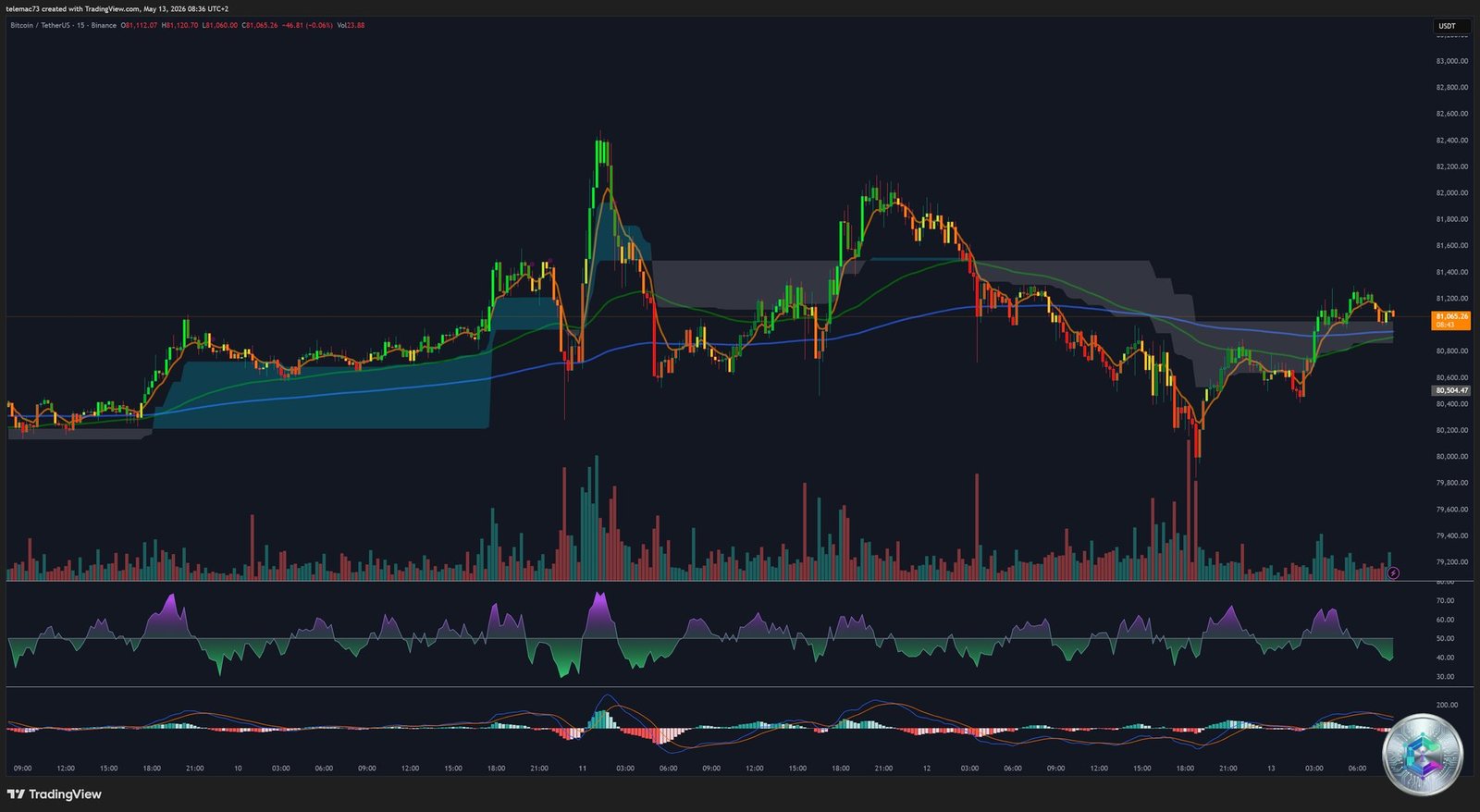
The M15 chart provides a raw reading of liquidity battles and HFT algorithmic execution. An extreme volatility episode produced a V-shaped plunge — a massive red candle accompanied by an atypical volume spike, typical of a margin buyer capitulation or a liquidity grab initiated by large wallets. Following this sweep, the asset recovered to stabilize above $80,500.
The subsequent price structure reveals a micro bear flag with a technical glass ceiling at $81,500 — a zone reinforced by the 100-period hourly SMA acting as dynamic intraday resistance. The M15 MACD oscillates frantically around zero with multiple false crosses, making pure directional trading excessively hazardous. Until Bitcoin can convincingly break above $81,500, intraday bullish momentum remains structurally fragile.
Key Levels Architecture — Support & Resistance Matrix
| Price Level (USD) | Category | Structural Significance |
|---|---|---|
| $85,500 | Final Resistance (Macro) | Theoretical expansion target in a massive short squeeze scenario. Breakout → path to $126,000+ |
| $84,000 | Intermediate Resistance | Kinetic stop post-forced short covering. Natural profit-taking target for momentum algorithms |
| $82,800 | Dynamic Resistance (Daily) | 200-day SMA. Cardinal directional filter — daily close above required to invalidate lower-high pattern |
| $82,500 | Pivot Resistance (H4) | Upper boundary of compression triangle. Sustained hold above = miner sell-side absorption confirmed |
| $81,600–$82,000 | Supply Zone (Order Book) | Major sell wall visible as intense red bands on Heatmap. Breach → liquidation domino effect upward |
| $80,600 | Equilibrium (POC) | Intraday volume Point of Control — current gravitational center between supply and demand |
| $80,300 | Fundamental Support (On-chain) | Average cost basis of new institutional whales. Smart money defended aggressively at every dip |
| $79,500 | ⚠️ Critical Break Line | Daily close below = formal end of bullish pause and onset of a violent corrective phase |
| $78,915 | Technical Support (Fibonacci) | 50% Fibonacci retracement of the prior impulse. First objective technical floor below $80,000 |
| $73,610–$75,000 | 🔴 Danger Zone | Breakdown of $73,610 floor → $2.22 billion in long liquidations cascade algorithmically |
Conclusion and Strategic Outlook
The holistic synthesis of technical, fundamental, and quantitative elements paints a picture of Bitcoin in mid-May 2026 as an asset at a critical cyclical inflection point. The convergence of an indecisive H4 compression triangle, coupled with a nascent lower-high formation on the daily and a systemic inability to close above the 200-day SMA, signals a temporary but real exhaustion of organic bullish momentum. The asset is caught between the on-chain whale support at $80,300 and the 200-day SMA resistance at $82,800: the kinetic energy accumulated within this $2,500 band virtually guarantees an explosive directional resolution.
The spark will inevitably come from the fundamental sphere. A CLARITY Act approval by the Senate Banking Committee would detonate the short squeeze and propel the asset toward new all-time highs, fueled by billions in unlocked ETF flows. Conversely, partisan legislative failure or hawkish rhetoric from Kevin Warsh would precipitate an exploration of the order book’s lower depths. The preservation of the $79,500 neuralgic line remains the absolute technical dogma for maintaining the validity of the short-term bullish hypothesis.
⚠️ Important Disclaimer: This article is written for educational and informational purposes only. It does not constitute investment advice, a recommendation to buy or sell digital assets, or an inducement to invest in cryptocurrencies. Digital asset markets are extremely volatile and carry significant risks of capital loss. Past performance does not guarantee future results. Please consult a qualified financial advisor before making any investment decision.

