

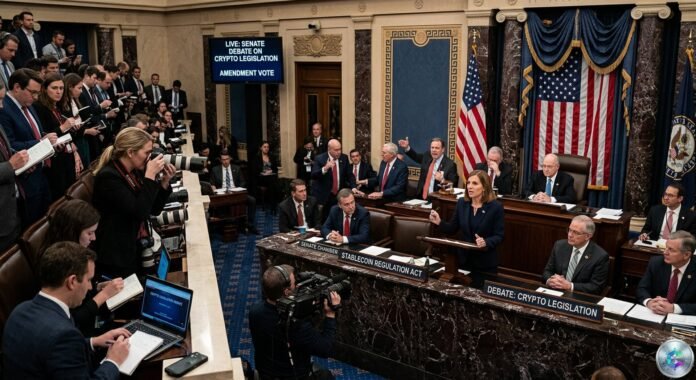
US CLARITY Act Stalled in Senate: Two Disputes Threatening Crypto Legislation
A last-minute agreement on the stablecoin yield issue was announced on May 2, 2026 by senators Thom Tillis and Angela Alsobrooks. This major compromise appeared to lift the main obstacle that had been blocking the CLARITY Act since January. Yet the text remains pending before the Senate Banking Committee, and its legislative future remains uncertain just weeks away from a critical deadline set by the White House. Estimates of the bill’s passage odds range from 25% to 60% depending on the source consulted, illustrating the uncertainty surrounding this major piece of legislation for the cryptocurrency sector in the United States.
Context
Since the GENIUS Act took effect in 2025, which established the foundations for a federal framework for regulated stablecoins, the US Congress has been trying to complete the regulatory edifice with a second major text: the CLARITY Act, or Digital Asset Market Clarity Act. This bill aims to clarify the division of jurisdiction between the SEC and the CFTC, establish disclosure requirements for digital assets, and define the overall legal status of the crypto sector in the United States. Without this legislation, the regulatory landscape for digital assets remains fragmented, with overlapping authorities and evolving policy positions at both federal and state levels.
But for months, the text has faced two major political obstacles that threaten to derail its passage before the end of the legislative year. The first roadblock concerns the highly controversial question of yield offered on stablecoins held by American customers. The second obstacle relates to conflicts of interest involving President Trump’s family, whose investments in the crypto sector are estimated at approximately $1.4 billion according to Bloomberg.
The stakes are considerable for the industry. Without a clear legal framework, American companies in the sector fear seeing the rules of the game established by other jurisdictions, or even by China, which has already advanced on certain aspects of cryptocurrency regulation in its own sphere of influence. As Patrick Witt, White House advisor for digital assets, stated: without rapid US action, the country risks following rules established abroad.
On May 7, 2026, at the Consensus conference in Miami, Patrick Witt reaffirmed that the Trump administration was targeting a vote before July 4, a symbolic date just days away from America’s 250th anniversary. « The best birthday gift for America would be clear legislation on digital assets, » he said. But analysts remain cautious about this ambitious timeline.
Key Facts
The stablecoin yield agreement. On May 2, 2026, senators Thom Tillis and Angela Alsobrooks released final compromise language on the stablecoin yield question. Section 404 language bars covered parties — digital asset service providers and their affiliates — from paying any interest or yield to US customers solely for passive stablecoin holdings. This broad language includes any form functionally equivalent to interest on a bank deposit, which had provoked the ire of the American banking industry.
Regulated stablecoin issuers already permitted under the GENIUS Act are excluded from this prohibition. Activity-based rewards — payments, transfers, market-making, staking, governance, loyalty programs — remain permitted, even if they may be calculated by reference to the customer’s balance or tenure, provided the reward is tied to qualifying activity. This nuance is crucial for players like Coinbase, which derives a significant portion of its revenues from USDC-linked rewards programs.
The banking counter-offer. At a White House meeting organized in March 2026, American banks proposed restrictions stricter than those in the GENIUS Act. Banking groups, led by JPMorgan under CEO Jamie Dimon, claim that allowing yields on stablecoins could trigger deposit flight estimated at $6.6 trillion according to a US Treasury study. Dimon publicly warned of systemic risks: « If you allow these players to do one thing without any regulation, and these other players to do another, the public will pay. It will get bad, » he said at a conference in Davos.
Donald Trump’s direct involvement. The American president weighed into the debate in March 2026, stating on social media that « the GENIUS Act is being threatened and undermined by the Banks, and that is unacceptable. » He added that « Americans should earn money on their money » and that « this industry cannot be taken from the American people when it is so close to becoming truly successful. » This statement was publicly welcomed by Coinbase CEO Brian Armstrong, who simply replied « Mark it up. » Coinbase shares (COIN) surged 15% that day, while JPMorgan and Bank of America posted slight declines.
Trump family conflicts of interest. The political dimension of this intervention is not without controversy. According to Bloomberg estimates, the Trump family holds approximately $1.4 billion in crypto sector interests, notably through World Liberty Financial, a platform whose son Eric Trump is co-founder. The family also holds a 20% stake in mining company American Bitcoin (ABTC). No Democrats voted for the text adopted by the Senate Agriculture Committee in January, precisely because of these perceived conflicts of interest. Ron Hammond, from Wintermute, stated: « For better or for worse, the president’s and family’s involvement in the crypto industry has generated a very mainstream narrative around the perceived corruption of this administration. »
The May 2026 agreement. Despite opposition, a preliminary agreement was announced on May 2, boosting CLARITY Act chances. Advisor Patrick Witt stated that the Senate Banking Committee should review the text that month, with a full Senate vote in June and a final House vote before July 4. However, Banking Committee chair Tim Scott has not yet announced a specific date for the markup, leaving observers uncertain.
Analysis
The May compromise represents a significant turning point in this months-long debate. Kevin Wysocki, from Anchorage Digital, summarized the dynamics with clarity: « If banks want a change, if they want rewards more limited, then they need a bill. So in some sense, banks need a market structure bill just as much or even more than crypto does. » This observation shows that the power balance is not as unbalanced as it may seem.
For stablecoin issuers like Circle, whose stock had dropped 20% during an earlier version of the text in March, the May compromise is a relief. The agreement allows activity-based rewards, which preserves part of Coinbase’s business model, which reported $1.35 billion in stablecoin-related revenues in 2025, largely thanks to rewards payment flows from its USDC partnership. The market reacted defensively: Coinbase shares rose in the first quarter of 2026, buoyed by hope for a clear regulatory framework.
On the regulatory side, the SEC, CFTC, and Treasury have been tasked with jointly issuing, within one year of enactment, a non-exhaustive list of permitted activities. Agencies must also produce, within two years, a joint report with the Fed, OCC, FDIC, and NCUA on dollar-denominated stablecoin adoption, their effect on Treasury yields, and the impact on bank deposit volumes and concentration. This clause gives the banking lobby a formal mechanism to revisit the issue if deposit outflows materialize, which explains why banks agreed to support the May deal.
Penalties are severe: up to $5 million in civil fines per violation, assessed by the Treasury Department. The text also bars covered parties from representing that stablecoins are investment products, that they are backed by the US government, or that they are FDIC-insured. These provisions aim to protect consumers against misleading representations about the nature of the products.
Market Reactions
Market reactions were immediate and contrasting. After the May 2 agreement, CLARITY Act passage odds were revised upward, with estimates reaching 55% according to some financial sources. Coinbase shares rose significantly in the first quarter of 2026, driven by hope for a clear regulatory framework that would allow the company to develop its activities in a more stable legal environment.
Tokens linked to decentralized finance and infrastructure cryptocurrencies also benefited from this momentum, with investors anticipating that clear legislation could accelerate institutional adoption. However, banking stocks like JPMorgan and Bank of America posted slight declines following President Trump’s announcements against the banking sector, illustrating the conflict of interests between the two industries.
Stablecoins have been gaining momentum since the beginning of 2026, with total capitalization continuing to grow driven by adoption in payments and electronic commerce. Traditional institutions, for their part, are equipping themselves to offer cryptocurrency custody services to their clients, a development that should converge with the regulatory framework being debated.
Outlook
Several scenarios remain on the table for the coming months. Best case: the Senate Banking Committee approves the text in May, the full Senate votes in June, the House confirms before July 4, and President Trump signs the bill. This scenario would allow American companies to finally have a clear framework to operate in the digital assets ecosystem.
Worst case: the text is postponed again, the legislative window closes with midterm electoral pressures, and the rules of the game remain unchanged for years. Ron Hammond, from Wintermute, tempers expectations: « The clock is ticking. There needs to be a deal. The conversation needs to turn from principles and red lines to actual text and concrete proposals. » Senator Bernie Moreno had warned in January: if Congress does not act before May, the effort could be indefinitely delayed.
Industry players remain mobilized. Summer Mersinger, from the Blockchain Association representing over 100 member companies, stated: « Our more than 100 members are 100% engaged in working with lawmakers on both sides of the aisle to deliver clear, workable market structure legislation that protects consumers and supports responsible innovation. » Crypto PACs like Fairshake have amassed millions for electoral campaigns, and midterm advertising should feature prominently candidates’ positions on the crypto question.
Another regulatory question looms. The SEC, under Chair Paul Atkins, is finalizing its own « Regulation Crypto » framework, currently under review by OIRA before publication. This regulation provides for three main components: an exemption for startups allowing them to raise funds during a defined period, a principles-based disclosure regime for larger fundraising efforts, and an investment contract safe harbor after the development phase. The market awaits these regulatory details with particular attention, as they could complete or influence the ongoing legislative debate.
Sources
- Clock is ticking: crypto bill’s 2026 fate hinges on Trump and stablecoin yields — The Block
- Trump sides with crypto in battle with banks over stablecoin yield — CNBC
- Senators Reach Stablecoin Yield Deal To Advance CLARITY Act — CoinMarketCap Academy
- White House Releases Stablecoin Yield Report, GENIUS Act Regulations Advance — Paul Hastings
- White House targets July 4 for Clarity Act passage — CoinDesk

