

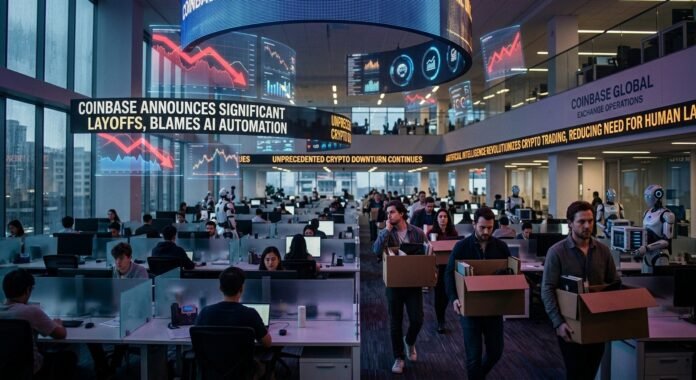
Coinbase Cuts 14% of Workforce as AI Reshapes the Crypto Industry
Coinbase, the Nasdaq-listed cryptocurrency exchange, announced on May 5, 2026 that it would eliminate approximately 660 positions, representing 14% of its total workforce of 4,700 employees. This sweeping restructuring, explained by CEO Brian Armstrong in an internal memo distributed on social network X, stems from two converging structural forces: the prolonged downturn in the crypto market and the accelerating transformation of work practices by artificial intelligence. The announcement comes amid an unprecedented wave of layoffs across the cryptocurrency sector, where several major players have carried out massive workforce reductions over recent months, reflecting a profound trend reversal after the expansion period of 2024 and 2025.
The scale of this restructuring surprised sector observers. Coinbase, which had long presented itself as the symbol of the maturation of the cryptocurrency market and had benefited from the historic approval of spot Bitcoin ETFs in the United States in January 2024, now explicitly acknowledges that artificial intelligence is modifying the very foundations of its operating model. Armstrong’s internal message, unusually frank for a public company executive, describes a company in the midst of profound change, seeking to transform itself to survive in an environment radically different from the one that had enabled its spectacular growth in recent years.
Background
The cryptocurrency market has been navigating a notable contraction phase since the start of 2026. After the euphoria of 2024, marked by the historic approval of spot Bitcoin ETFs in the United States, the sector is now grappling with particularly challenging market conditions. Trading volumes have declined significantly across all platforms, major digital asset prices remain under pressure, and institutional investor confidence continues to be fragile following a series of scandals and localized crashes that shook the sector over recent months.
Against this deflationary backdrop, Coinbase had reported approximately 4,900 full-time employees at the end of 2025, a figure slightly up from the previous year despite market difficulties. The May 2026 announcement brings that figure to under 4,100 people, representing a net reduction of more than 800 positions over several months. This represents the company’s second major workforce reduction, following the June 2022 layoffs that eliminated 18% of positions under similar circumstances during the previous crypto winter.
But this time, Coinbase’s leadership is not blaming the bearish market cycle alone. Artificial intelligence is now identified as a decisive factor in the profound redesign of the company’s structure, on equal footing with unfavorable economic conditions. This explicit recognition of AI’s transformative role by a major industry player marks a turning point in how the crypto industry approaches the technological question.
Several elements illustrate this conjunction of unfavorable factors. The total cryptocurrency market capitalization fell by more than 15% in the first quarter of 2026, dropping below the psychological threshold of $2.4 trillion, compared to more than $3.1 trillion at the end of 2025. Trading volumes on major exchange platforms declined in parallel, reducing the commission revenues that form the core of the economic model of Coinbase and its competitors.
Furthermore, recent macroeconomic data failed to contribute to any recovery. Real interest rates remain elevated in most developed economies, limiting appetite for risk assets in general and for cryptocurrencies in particular. Regulatory uncertainties, particularly in Europe with the progressive implementation of the MiCA regulation (Markets in Crypto-Assets Regulation), create a climate of uncertainty that restrains institutional investment in the sector and complicates the daily operations of platforms.
The Facts
Brian Armstrong communicated the decision through an internal memo published on X, detailing the two converging forces justifying this major restructuring. The tone of the message, unusually personal for a corporate announcement of this magnitude, was noted by sector observers.
First factor: crypto market volatility and the structurally cyclical nature of the sector. <>, the CEO stated. <> he continued, recalling that the company had weathered four crypto winters in thirteen years of existence.
Second factor: the impact of AI on productivity and work organization. Armstrong surprisingly emphasized this second aspect, considering it as important as market conditions in his decision. <>, he stated. <>
The severance package for affected US employees provides a minimum of 16 weeks of base pay, plus two additional weeks per year of service. Affected employees will also receive their next equity vesting, along with six months of extended health coverage via COBRA. This announcement was favorably received by analysts, who saw it as a demonstration of the company’s social responsibility and an attempt to minimize the negative impact on affected employees.
Coinbase shares (COIN) rose more than 3% in pre-market trading following the announcement, suggesting a positive investor reaction to the cost-reduction commitment and the prospect of a leaner and potentially more profitable structure going forward.
The restructuring is accompanied by a complete redesign of the operating model. According to several sources close to the matter, Coinbase plans to eliminate intermediate management layers and reorganize its teams around <> units, meaning structures centered around a very small number of employees, generally one to three, assisted by AI tools. This approach, directly inspired by startup practices during hypergrowth phases but pushed here to its extreme, aims to dramatically accelerate decision-making and execution capacity.
Analysis
This announcement illustrates a fundamental trend now affecting the entire technology sector, and cryptocurrency companies in particular, whose economic model and organization were built on assumptions of continuous growth and workforce expansion. AI’s capacity to multiply development team productivity is profoundly reshaping workforce planning assumptions and questioning traditional growth models.
This phenomenon is not unique to Coinbase and the crypto sector. Over recent months, numerous technology companies have announced massive workforce reductions, citing AI as the main accelerating factor. Block, formerly Square, announced the elimination of <> of its total workforce. Pinterest, CrowdStrike, and Chegg all proceeded with significant layoffs. Chegg, specifically, cited explicit competition with ChatGPT and large language models as the reason for eliminating 45% of its positions, in a case that generated significant commentary in the educational sector.
For crypto companies, this trend is particularly pronounced because their traditional economic model relies heavily on the ability to grow quickly, hire massively during growth periods, and benefit from leverage effects. The arrival of AI as a productivity factor is modifying these fundamental assumptions and imposing a deep reflection on the optimal size of these organizations.
Several sector sources, speaking on condition of anonymity, indicate that Coinbase has now launched a program of <> of its operating model rather than a simple short-term cost-cutting exercise. This program targets the elimination of intermediate management layers and the establishment of very small teams, often called <> in the jargon, centered around a minimal number of individuals.
The strategy announced by Armstrong is to make Coinbase an <> company, capable of operating with battle-tested squads rather than traditional pyramidal structures composed of many management layers. This direction reflects a major shift in the management philosophy of crypto enterprises, which have traditionally prioritized workforce growth as an indicator of health, credibility, and execution capacity.
Attentive observers note, however, that this transition carries non-negligible risks. Workforce reduction may temporarily weaken the company’s capacity to maintain rigorous compliance standards, particularly in an increasingly demanding regulatory environment in both the United States and Europe. Regulatory authorities, including the SEC and ESMA, are closely monitoring the practices of cryptocurrency exchange platforms, and any sign of deterioration in internal controls could attract severe regulatory sanctions.
Furthermore, the cryptocurrency sector job market in the United States could be affected by these structural changes. The influx of former Coinbase employees and others from similar companies could represent a significant portion of available skilled labor, and their simultaneous re-entry into the job market could intensify competition for remaining positions while exerting downward pressure on salaries in the sector.
Market Reactions
The Coinbase announcement is not an isolated event. During the first quarter of 2026, several crypto sector companies proceeded with significant workforce reductions, drawing a surprising parallel with the layoff wave that had hit the sector in 2022 during the previous crypto winter. This cyclicity of layoffs in the sector illustrates the still highly experimental nature of these companies and their continued susceptibility to market cycles.
Algorand, the blockchain led by Turing Prize winner and recognized cryptography figure Silvio Micali, announced the elimination of 25% of its workforce in late March, citing <> as the main justification. This decision surprised the sector, as Algorand is often viewed as one of the most technically sound blockchain projects, with a scientific approach that had attracted many talented developers.
Gemini, the Winklevoss twins’ platform, also faced major difficulties. After a first layoff wave of 25%, the platform proceeded with several additional rounds that brought its headcount from 250 employees to under 80 people in a matter of months. This severe contraction reflects the difficulties encountered by Gemini in an increasingly competitive environment, where platforms must constantly innovate to maintain their position.
Crypto.com cut 12% of its roles, approximately 180 positions, citing unfavorable macroeconomic conditions, persistent weakness in token prices, and the imperative need to integrate AI into its operational processes. The Singapore-based company, which had run a major marketing campaign including television commercials during the FIFA World Cup in Qatar, did not escape the general trend affecting the entire sector.
These layoffs are part of a broader movement affecting the entire technology sector. Block (formerly Square), Pinterest, CrowdStrike, and Chegg all announced workforce reductions in recent weeks, with AI cited as a common accelerating factor in these structural transformations. This convergence of layoffs across the entire technology economy suggests we are witnessing a profound reformation of the job market in the sector.
On the cryptocurrency market, Bitcoin’s price fluctuated around $77,000 in early May 2026, up 2% over 24 hours but still below its December 2025 highs, when it had crossed the psychological threshold of $100,000. Ethereum held near $2,280, representing relative stability in a volatile environment, while XRP traded close to $1.38, slightly up. The global cryptocurrency market remains volatile, with sometimes abrupt price movements in response to macroeconomic or regulatory news.
Outlook
For Coinbase, the challenge now is to demonstrate that this profound transformation can proceed without degrading service quality or eroding institutional client confidence. The platform manages billions of dollars in assets for clients ranging from asset managers and traditional asset managers to family offices and traditional corporations seeking exposure to cryptocurrencies. The trust of these institutional clients is a strategic asset that the company cannot afford to compromise.
Brian Armstrong sought to reassure stakeholders about the company’s ability to meet its obligations despite workforce reductions. <>, he stated. <> This statement aims to reassure employees, clients, and investors about the company’s long-term viability.
The drivers of this next adoption wave identified by the CEO include stablecoins, whose use continues to grow for cross-border payments and electronic commerce, prediction markets that are attracting increasing interest from institutional investors, and the tokenization of traditional assets, which could profoundly transform global financial markets in the years to come.
All these are areas where AI could indeed enable a smaller team to achieve results previously requiring far greater resources. The ability to develop and deploy increasingly sophisticated AI models could represent a decisive competitive advantage for the exchange platforms of the future, allowing them to do more with less while accelerating innovation.
Sector observers will watch for early signs of this transformation. Coinbase’s upcoming quarterly results, expected on May 8, 2026, will provide initial indications of the company’s financial health following this major restructuring. Analysts expect figures reflecting market difficulties in the first quarter, but will watch closely for prospects for the rest of the year and the company’s ability to generate growth despite the unfavorable environment.
The transformation announced by Coinbase could also have broader implications for the sector. If the model of an <> and structurally smaller crypto company proves functional and allows maintaining service quality while improving profitability, other players might be led to follow this approach, thereby accelerating a consolidation of the sector around leaner and more adaptable structures better suited to changing market conditions.
Immediately, the 660 employees affected by these layoffs will need to rebuild their careers in a job market that remains difficult. Skills developed at Coinbase, particularly in blockchain development, security, and regulatory compliance, remain highly sought after in the job market, but the recent concentration of layoffs in the sector could temporarily saturate demand and lengthen reclassification timelines.

