

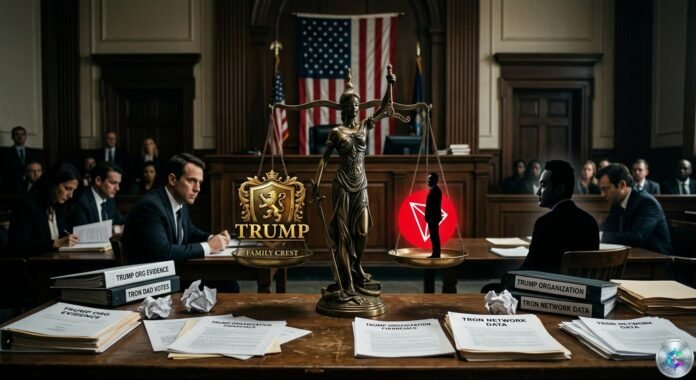
World Liberty Financial Sues Justin Sun for Defamation in Escalating Legal Battle
World Liberty Financial (WLFI), the crypto firm affiliated with the Trump family, has filed a defamation lawsuit against Justin Sun, founder of the Tron network, in California state court. The lawsuit marks a dramatic reversal in a conflict that saw Sun transform from one of the project’s most prominent financial backers into its most vocal public critic. The Tron creator, who denies all allegations, is fighting back with a federal lawsuit accusing WLFI of fraudulent schemes and manipulating its own investors.
Background
World Liberty Financial was established with a direct link to U.S. President Donald Trump and his family. According to the company’s governing documents, 75 percent of revenues from WLFI token sales flow to the Trumps. The project, co-founded by the president and his sons, sought to position itself as a decentralized finance initiative while retaining centralized features that have now become central to the dispute dividing management from key investors.
Justin Sun, founder of the Tron blockchain and a major figure in the crypto ecosystem, was among the earliest major investors in WLFI. In November 2024, his entity Blue Anthem purchased 2 billion non-transferable WLFI tokens for 30 million dollars. In early 2025, Blue Anthem received an additional 1 billion tokens in exchange for its advisory board participation. In January 2025, another acquisition of approximately 1 billion tokens brought Sun’s total holdings to roughly 4 billion WLFI tokens, making him the largest stakeholder in the project by a significant margin.
Relations between the two parties deteriorated sharply after WLFI froze Sun’s tokens in September 2025, a contested decision that triggered a series of cross-filed legal proceedings. Sun maintained that the asset freeze was imposed without legitimate justification and in violation of existing agreements. WLFI, for its part, stated the measure was taken in response to serious contractual violations committed by the investor and his affiliated entities.
On the regulatory front, Justin Sun reached a 10 million dollar settlement with the SEC in March 2025, resolving a civil action filed in 2023 that accused him of fraud, unregistered securities sales, and undisclosed celebrity promotions. The settlement was reached without an admission of guilt by Sun, consistent with standard practices in amicable resolutions with U.S. regulatory authorities.
The Facts
On August 31, 2025, hours before the public launch of WLFI tokens, a wallet associated with HTX, the exchange platform affiliated with Justin Sun, allegedly moved three blocks of approximately 100 million dollars each in USDT to a deposit address on Binance. WLFI alleges this fund movement constitutes evidence of a deliberate short-selling campaign and market manipulation orchestrated by Sun and his affiliated entities to drive down the price of WLFI tokens at the time of its market introduction.
On September 1, 2025, WLFI launched its tokens on the public market. The token price immediately dropped approximately 26 percent while open short positions increased by roughly 23 percent, a dynamic WLFI directly attributes to the short-selling campaign orchestrated by Sun. The company states that the wallets that moved funds to Binance were directly connected to Sun’s inner circle and that the timing of the operation was not coincidental but coordinated.
In April 2025, before the public launch even occurred, Justin Sun had already filed his own lawsuit against WLFI in California federal court. In that proceeding, Sun accused the project of embedding a hidden function in its smart contract that allowed freezing user assets without prior justification. He also states that WLFI threatened to destroy his tokens after he refused to invest further or promote the USD1 stablecoin at the scale desired by the project. WLFI called these allegations lies and pointed out that the freeze was linked to specific contractual violations.
In its defamation lawsuit filed in California, WLFI accuses Sun of violating token transfer restrictions, acquiring WLFI tokens for undisclosed parties through shell companies, and engaging in short-selling operations despite his advisory role and substantial position of locked tokens. WLFI is seeking damages for gross and unjustifiable fault. The amounts claimed have not been made public in the initial complaint.
Sun has denied all of these allegations. In a public statement aimed at his millions of social media followers, he called the defamation lawsuit a baseless public relations maneuver and reaffirmed his confidence in the outcome of the case. He maintains that all of his actions were consistent with his agreements with WLFI and that the token freeze constitutes retaliation for his refusal to comply with requests to support the USD1 stablecoin.
Analysis
The conflict between WLFI and Justin Sun emblematically illustrates the tensions running through the decentralized finance ecosystem. On one side, WLFI built its communication around a narrative of decentralization and user empowerment. On the other, the ability to freeze tokens without prior judicial approval, which Sun describes as a hidden blacklist function, reveals an effective centralization of control that the project’s official documents did not fully reveal to investors.
Beyond the specific legal arguments in this dispute, the entire question of DeFi project credibility is at stake. Sun’s allegations regarding the actual nature of WLFI’s control over its tokens raise broader questions about the protections afforded to investors in a sector where the boundary between genuine decentralization and misleading marketing often remains unclear. The scrutiny of U.S. regulatory authorities, particularly the SEC, on this type of structure is likely to intensify as these legal disputes progress and WLFI’s practices are documented in court proceedings.
Sun states that WLFI asked him to support purchases and distribution of the USD1 stablecoin on the Tron network, a request he refused. The USD1 stablecoin is central to the project’s economic model, with dollar-backed stablecoins generating substantial revenue through investment in U.S. Treasury bonds. WLFI denies this characterization and maintains that the freeze of Sun’s tokens was linked to proven contractual violations, not retaliation for his refusal to cooperate.
The short-selling question is particularly delicate from a legal standpoint. Sun’s representatives state he was never prohibited from selling his tokens and that the advisory board agreements contained no non-sale clause. WLFI, for its part, maintains that the advisory board charter explicitly prohibited short positions in WLFI tokens and that Sun accepted these conditions upon joining the board. Determining the exact wording of the agreements and terms of service will be decisive in resolving this central question.
On the political level, the Trump family’s involvement in WLFI gives this dispute a particular dimension that transcends simple commercial considerations. WLFI’s revenues are directly tied to the Trump family, meaning any legal proceeding involving the project automatically attracts American and international media attention. This media exposure risks fueling already heated debates about the use of proximity to political power for commercial purposes in the crypto ecosystem. The characterization of Sun’s public statements on social media will also be central: U.S. courts distinguish between defamatory factual statements and opinions protected by the First Amendment of the U.S. Constitution.
Market Reactions
The market reacted with moderate volatility following the announcement of the cross-filed proceedings. The WLFI token, which had already lost approximately 26 percent during its public launch in September 2025, did not experience significant movement following the announcement of the cross-filed lawsuits. Trading volumes on major exchanges remained in line with historical averages for this type of relatively low-liquidity digital asset. Financial analysts are closely monitoring this litigation, expecting developments in the coming weeks and months ahead.
On the Tron ecosystem side, the TRX token experienced mild selling pressure in the days following the conflict escalation, with investors concerned about potential impact on Tron’s partnerships with Western institutional players and the founder’s reputation in the context of a lawsuit involving the Trump family. This pressure remained limited and the token quickly recovered to previous levels after a few days of consolidation, suggesting the market does not anticipate lasting consequences for Tron’s operations.
Official reactions have been mixed and each party sought to control the narrative. Sun seized the opportunity to publicly denounce WLFI’s practices to his millions of followers on the X platform. WLFI, for its part, filed its lawsuit using precise legal language designed to prepare the ground for a longer and more technical battle before California courts. Sector observers expect the proceedings to be lengthy and complex, potentially spanning several years.
Outlook
Several central questions remain unanswered at this early stage of the proceedings. The exact wording of the token agreements between WLFI and Blue Anthem will need to be established by the courts during the discovery phase. Modifications made to WLFI’s smart contract and the exact circumstances of the freeze of Sun’s wallets will be the subject of thorough technical review likely involving blockchain experts and digital contract law specialists.
The outcome of the case will largely depend on the legal characterization of Sun’s public statements on social media, particularly his posts on the X platform that reached millions of followers. U.S. courts distinguish between defamatory factual statements and opinions protected by the First Amendment. The boundary between these two categories will be fiercely debated and each party will mobilize specialized legal experts in defamation law and freedom of expression.
For WLFI token holders and the crypto ecosystem as a whole, this dispute highlights a broader issue concerning the governance of decentralized finance projects. Tokens may be traded on public blockchains while being subject to private agreements and smart contracts controlled by the issuer, creating an information asymmetry that investors must now factor into their risk analysis. Regulatory authorities are increasingly attentive to these opaque governance structures that combine blockchain technologies and centralized controls. No court has yet ruled on the allegations of either party, and the trial promises to be a legal drama spanning many months.
Sources
- Trump’s World Liberty Finance (WLFI) Sues Tron’s Justin Sun – Everything We Know So Far – CryptoSlate
- Trump-Affiliated World Liberty Sues Justin Sun for Defamation After Tron Creator’s Lawsuit – CoinDesk
- Crypto Entrepreneur Files Fraud Suit Against Trump Family Firm – New York Times
- World Liberty Investor Justin Sun Claims Trump Crypto Venture Secretly Installed Tool to Freeze Holdings – Reuters
- Justin Sun vs WLFI: Tron-Founder Takes Trump-Backed WLFI to Court – Yahoo Finance
- World Liberty Financial: From Predicted Risks to Current Controversies – SSRN

