

US Treasury Yields Spike to Highest Levels in a Year: A New Problem for Bitcoin Liquidity
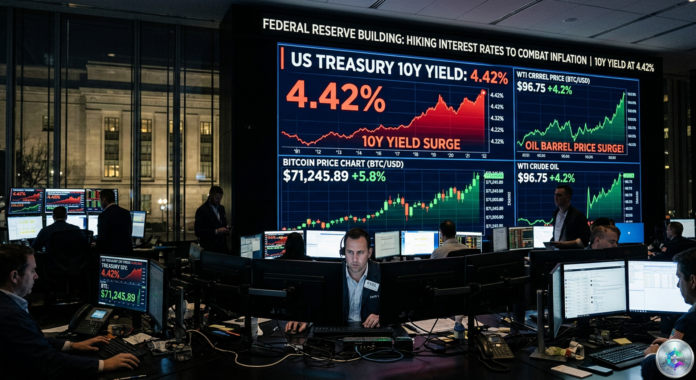
US Treasury yields have surged to their highest levels in a year, creating major macroeconomic pressure on the Bitcoin market. The 10-year yield crossed the 4.42% threshold, a level that makes risk-free placements suddenly far more attractive to investors. This dynamic significantly complicates Bitcoin’s situation, already facing surging oil prices and geopolitical uncertainty in the Middle East. The 30-year yield also climbed to 4.98%, signaling sustained tension in the bond market that transmits directly to risk assets including cryptocurrencies. The market now appears to face a two-front macroeconomic test: rising Treasury yields and climbing energy prices that show no sign of abating.
Context
Since the start of 2026, global financial markets have faced a synchronized rise in US Treasury yields. The 10-year yield reached 4.42% on April 29, 2026, its highest level in approximately a year, while the 30-year yield climbed to 4.98%. These increases come against a backdrop of persistent inflation in the United States, with headline PCE at 3.5% and core PCE at 3.2% in March 2026, levels that remain well above the Federal Reserve’s 2% target and that continue to constrain the central bank’s room for maneuver.
This rise in yields coincides with a marked deterioration in the oil market. Brent crude crossed the $126 per barrel threshold, its highest level since 2022, an impulsive increase that fuels inflation fears and reduces prospects for an imminent easing of the Federal Reserve’s monetary policy. The Strait of Hormuz, through which approximately 20% of global energy supplies normally flow, has remained closed to shipping since February 28, 2026, a situation that has led Middle Eastern producers to shut in 9.1 million barrels per day in April, according to estimates from the Energy Information Administration (EIA).
In this context, Bitcoin trades around $76,049, down 40% from its all-time high reached in October 2025. The total cryptocurrency market capitalization stands at approximately $2.54 trillion, with Bitcoin dominance remaining stable around 59.9%, reflecting a market still largely dominated by the leading cryptocurrency but where altcoins struggle to find their own dynamic. The core problem identified by analysts is straightforward yet complex in its implications: is the bond market raising the price of taking risk faster than crypto demand can absorb it?
The facts
Key market data on April 29, 2026 deserves detailed examination. The 10-year Treasury yield settled at 4.42%, a level approaching the zone where tests on Bitcoin at $80,000 become particularly difficult to sustain. The 30-year yield, which reflects duration risk and directly influences asset valuation multiples, reached 4.98%. The 5-year yield climbed to 4.05%. Real rates also adjusted upward, with the 10-year real yield at 1.96% and the 30-year real yield at 2.71%, levels reflecting structurally higher inflation expectations relative to the Fed’s target.
The Federal Open Market Committee (FOMC) decision on April 29, 2026 was in line with market expectations, with the benchmark rate held in the 3.5% to 3.75% range. However, this seemingly unanimous decision masks deep disagreements within the committee. Stephen Miran was the only member favoring a 25 basis point cut, while Beth Hammack, Neel Kashkari, and Lorie Logan objected to maintaining the central bank’s accommodative bias. This fracture within the FOMC is the most pronounced since 1992 and testifies to the tensions traversing the institution amid a particularly uncertain macroeconomic environment.
The EIA report projects a Brent peak near $115 per barrel in Q2 2026 assuming conflict de-escalation. However, the situation on the ground remains tense: the Trump administration indicated it would be willing to keep the Iran blockade in place for months, a prospect that keeps oil prices under upward pressure and precludes any rapid easing of inflation expectations. The Fed’s report noted that inflation was elevated in part because of increases in global energy prices, and that Middle East developments were creating high uncertainty.
Analysis
The technical analysis of the US Treasury market is crucial for understanding Bitcoin’s prospects. The 10-year yield at 4.42% now constitutes the first line of defense for risk-free assets. When bond yields rise toward 4.5%, the economic calculus for investors changes dramatically: a risk-free investment yielding 4.5% annually suddenly becomes far more attractive than a volatile asset like Bitcoin, which produces no cash flow, coupon, dividend, or direct economic benefit.
This competition dynamic between assets is amplified by the phenomenon of bond ETFs, which have attracted massive flows in 2026. Bond funds recorded $8.5 billion in net inflows in March 2026 alone, an amount illustrating the marked preference of institutional investors for the apparent security of US debt securities. These flows, which could have gone to Bitcoin ETFs, are being diverted to the bond market, depriving Bitcoin of essential fuel for its recovery and creating a structural headwind that is difficult to overcome without a significant shift in sentiment.
International Monetary Fund (IMF) research highlighted a structural phenomenon: a common crypto factor explains 80% of cryptocurrency price variation, and Fed tightening reduces this common factor through the risk-taking channel. In other words, Bitcoin does not benefit from a decoupling with bond markets; it is on the contrary strongly correlated to US monetary conditions. Bitcoin’s current macroeconomic identity looks more like a liquidity-sensitive tech beta than an inflation or dollar hedge, making it more vulnerable to real yield movements and to changes in the Fed’s policy stance.
The five channels of upward pressure from rising Treasury yields on Bitcoin are now well identified. First channel: higher discount rates make volatile asset valuation more difficult by raising the required return threshold for investors. Second channel: ETF demand faces competition from bond flows that offer yield with less volatility. Third channel: companies that have adopted Bitcoin reserve strategies in their treasury find themselves under financial pressure as the opportunity cost of liquidity increases. Fourth channel: appetite for leveraged positions decreases as borrowing costs rise, reducing market derivative liquidity. Fifth channel: general liquidity conditions deteriorate, making order flows less fluid and amplifying volatility.
The technical level of $78,100 to $80,100 now constitutes the key battleground for Bitcoin. A reclaim of this zone would confirm that spot demand, ETF flows, and positioning can absorb the macroeconomic shock. A rejection would instead confirm that the bond market is still setting Bitcoin’s ceiling, a bearish prospect that would close the path to any sustained recovery in the near term and force buyers to adopt a more defensive posture.
Market reactions
Bitcoin’s reactions to the rise in Treasury yields were rapid and marked. In the 48 hours following the Fed announcement on April 29, 2026, liquidity data revealed significant concentration of buy orders below the $66,000 level, signaling that buyers remain defensive and are reluctant to deploy capital at higher levels. This 48-hour liquidation heatmap shows a clear imbalance between supply and demand that tilts toward sellers in the event of a downward move.
Liquidations in derivatives products represented $361.56 million over 24 hours, an amount that may seem modest but reflects significant deleveraging activity in leveraged positions. Traders who had taken long positions with leverage found themselves forced to close them in the face of combined downward pressure from rising rates and Bitcoin price weakness. This deleveraging dynamic is particularly significant because it can trigger price movements disproportionate to fundamentals, creating cascading effects that amplify market moves beyond what traditional analysis would suggest.
Bitcoin dominance at 59.9% shows that capital remains concentrated in the leading cryptocurrency, but this concentration resembles a defensive reflex rather than a strategic choice. Altcoins did not benefit from Bitcoin’s weakness to gain market share, suggesting that crypto investors remain in a risk-off logic and prefer Bitcoin’s liquidity to the volatility of smaller assets. Ether, XRP, TRON, and Solana all declined in line with Bitcoin, showing no capacity for decoupling from the market leader.
Bitcoin ETF flows however showed certain resilience, with cumulative net inflows of $58.30 billion since their launch. This figure illustrates the structural interest of institutional investors in Bitcoin via regulated products, even if these flows remain insufficient to offset the immediate macroeconomic bearish pressure. The market appears to be waiting for a catalyst that could come either from a geopolitical easing or from a change in tone from the Fed on interest rates, and the absence of either keeps sentiment subdued.
Perspectives
Four scenarios emerge for the coming months, each with very different implications for cryptocurrency holders and investors.
The first scenario is a geopolitical de-escalation in the Middle East. If flows through the Strait of Hormuz improve and the Iran blockade eases, oil prices could decline faster than expected, reducing inflation expectations and allowing the Fed to consider easing its position. This scenario would be the most constructive for Bitcoin if real yields decline along with energy prices. The $80,000 level would become accessible again, and the $84,000 zone could be tested in a second phase as technical resistance gives way to buying pressure.
The second scenario relies on technical relief in the US Treasury market. Treasury operations and Fed reserve purchases could temporarily lower yields, creating a window of opportunity for risk assets. This scenario is described as mixed-to-positive because it depends on technical interventions’ capacity to reverse the structural uptrend in rates. If bond buyback operations from the Fed succeed in stabilizing the yield curve, Bitcoin could recover some of its relative attractiveness and technical buyers could push the price toward the key $78,000-$80,000 zone.
The third scenario is blockade persistence. If oil prices remain elevated beyond EIA assumptions and the 10-year yield crosses above 4.5%, Bitcoin would face a structurally unfavorable environment. In this case, the $68,000 support would be threatened, and a break below this level would expose the market to a deeper correction toward $65,000-$60,000. This scenario would imply a reconquest of Bitcoin dominance by sellers and a prolongation of the range-bound consolidation phase that has characterized the market since early 2026.
The fourth scenario is a technically-driven rebound led by flows. If spot demand and ETF flows absorb new available supply without breaking lower, a technical recovery would be possible, but its durability would depend on whether Treasury yield conditions improve. A rebound not confirmed by an improvement in macroeconomic conditions would only be a dead cat bounce, a technical recovery destined to be quickly sold by less patient investors who use any rallies as exit opportunities.
The critical signal to watch lies in the evolution of the 10-year yield. If it declines from the 4.4% to 4.5% zone, Bitcoin’s demand narrative will find oxygen. If it breaks higher while oil prices remain elevated, Bitcoin’s ceiling is likely to remain out of buyers’ reach for a long time. The interaction between these two variables now determines the bulk of market dynamics, and any investor conscious of macro risks must integrate this double constraint into their allocation framework.
Sources
- US Treasury yields spike to highest levels in a year adding new problem for Bitcoin liquidity — CryptoSlate
- Bitcoin falls below $68,000 as 10-year Treasury yield nears 1-year high of 4.5% — CoinDesk
- What Rising US Bond Yields Mean for Bitcoin — Yahoo Finance
- Bitcoin’s 2026 Flow Test: ETF Inflows vs. Fed Liquidity — AInvest
- Rising U.S. Treasury yields and a stronger dollar put pressure on Bitcoin — RootData
- Fixed Income News — Fidelity Investments

