

Polymarket: Less Than 1% of Wallets Capture Half of All Profits
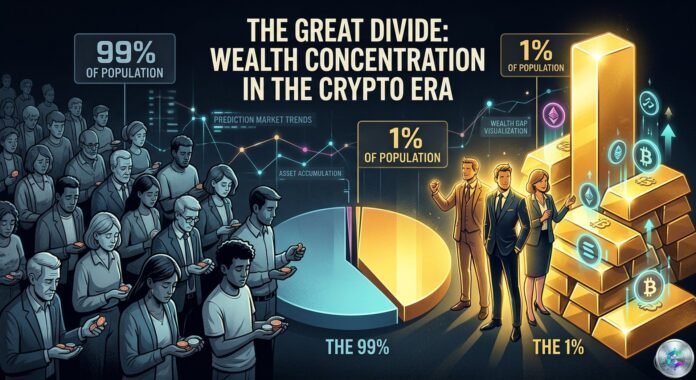
A study published by Solidus Labs in April 2026 reveals a profound structural imbalance on Polymarket, the blockchain-based prediction markets platform whose monthly volume regularly exceeds $10 billion. Between December 2025 and February 2026, researchers analyzed millions of on-chain executions to show that profits on the platform are distributed with dramatic inequality: barely 0.55% of maker wallets capturing half the net profits, while 0.26% of winning takers concentrate the other half. Over a period totaling $16 million in distributed profits, some $8 million were absorbed by this tiny minority of participants — a concentration ratio that rivals the most extreme inequalities observed in traditional financial markets.
This finding fits into a broader picture. According to data compiled by several independent sources based on 2.5 million active wallet addresses, only 7-8% of Polymarket traders are profitable. Among them, concentration is even more pronounced: 0.033% of addresses — approximately 840 identities — exceed $100,000 in cumulative gains. The picture painted by these converging studies raises fundamental questions about the very nature of decentralized prediction markets and their ability to fulfill their promises of democratizing financial information.
Background
Polymarket has emerged in recent years as the undisputed reference for decentralized prediction markets. The platform allows anyone to bet on future events — presidential elections, sports results, central bank decisions, geopolitical conflicts — by purchasing YES or NO tokens whose price reflects the implied probability the market assigns to the question. This market mechanism, derived from prediction market theory developed by economists like Robin Hanson, aims to aggregate dispersed information among participants to establish a price — and therefore a forecast — as accurate as possible.
With monthly volumes regularly exceeding $10 billion and a user base estimated at several million addresses, Polymarket offers unprecedented terrain for analyzing financial market behavior under pseudo-anonymous conditions. Every transaction is recorded immutably on the blockchain, providing total traceability that traditional financial markets cannot match. This apparent transparency, however, conceals radically concentrated dynamics.
In a prediction market, every participant is theoretically an « informed trader » — someone betting based on conviction forged through their own analysis of available information. Unlike traditional financial markets where market makers profit from the bid-ask spread with uninformed traders, almost everyone on Polymarket seeks to predict an outcome with conviction. This configuration creates a particular dynamic where competition for information is maximized — and where structural advantages weigh all the heavier.
Independent academic research from the London Business School and Yale University, published in 2026, analyzed all Polymarket transactions between 2024 and 2026 and concluded that only 3% of accounts generate the majority of profits. The authors described this dynamic as a « small informed minority » — an informed minority that drives price discovery, as opposed to the collective wisdom that prediction markets are supposed to embody. A precise pattern was identified: a minority influences prices, an even smaller minority pockets the profits.
The Facts
The Solidus Labs study covers the period December 2025 to February 2026 and relies on millions of on-chain data points. The conclusions are stark. Among approximately 2.5 million active wallet addresses on Polymarket, fewer than 8% are profitable. Among profitable addresses, concentration is extreme: 0.55% of maker addresses capture 50% of market-making profits, and 0.26% of winning taker addresses concentrate the other half of gains.
These figures fit within a broader context documented by several converging studies. According to data compiled by Cryptorank covering 2023-2025, only 2% of Polymarket addresses generate more than $1,000 in cumulative profits. Approximately 0.033% of addresses — roughly 840 identities on the platform — exceed $100,000 in gains. Among the most profitable traders, fewer than 0.26% generate more than $5,000 per month. And among these recurring winners, 53% quit after the first month of gains — suggesting that even temporary profits are difficult to convert into sustained income.
Another alarming finding highlighted by the study: wash trading may represent approximately 15% of volume on certain Polymarket markets. This practice involves simultaneously buying YES and NO tokens on the same event, generating artificial trading volume without real economic exposure. For the average trader, this volume manipulation complicates reading genuine market signals. For actors engaged in it, it allows accumulating activity statistics ahead of a potential airdrop of the $POLY token, whose allocation might be indexed to the trading volume generated by each address.
Separate research published by Business Insider in March 2026, conducted by Professor Joshua Mitts of Columbia Law School and Moran Ofir of the University of Haifa, identified 210,000 « informed » trades collectively generating $143 million in « anomalous » profits since 2024. The study covers the majority of Polymarket transactions between 2024 and 2026 — the first research to provide an estimate for the total amount won by these suspicious accounts. The twenty most suspicious trades alone represent approximately $16 million, with pronounced concentration in markets related to the 2024 US presidential election and Federal Reserve monetary policy decisions.
Analysis
Dominant traders do not necessarily result from illegal activity. They hold major competitive advantages that, individually, are legitimate but collectively create a profound structural imbalance. These advantages include substantial capital allowing them to absorb position volatility and exploit market opportunities safely without risk of liquidation, advanced technical infrastructure including arbitrage bots, low-latency connections to blockchain nodes, and real-time market monitoring systems, and optimized execution strategies inaccessible to average traders. These structural advantages explain why the majority of participants realize net losses — they face not equals but professionals equipped to systematically extract value.
The distinction between « insider trading » in the legal sense and « informed trading » is important. The Columbia and Haifa researchers deliberately use the term « informed » rather than « inside » because some of the largest analyzed trades were placed on markets where too many people influence the outcome for them to be rigged — such as the 2024 US presidential election. The term « informed » encompasses both savvy bettors who spot collective crowd errors and those with unfair advantages. This methodological nuance is fundamental to understanding the real scope of the study.
Certain studied accounts display particularly troubling patterns. The account known as « ricosuave666 » exemplifies the suspicious informed trader profile: in June 2025, this new Polymarket address began betting thousands of dollars on questions regarding Israeli military strikes on Iran. It pocketed approximately $155,000 on June 13, the day Israel actually carried out strikes on Iran. The account then remained dormant for seven months before resurfacing in January 2026 for new wagers, then being deleted after being publicly flagged. Researchers note that its most suspicious trade was ranked only 3,662nd among the most unusual trades in the sample — suggesting that even more extreme practices remain undetected.
Methodological criticisms must, however, be taken into account. Professor Harry Crane of Rutgers University, not involved in the study, points out that the « suspiciousness » ranking relies heavily on profitability rather than what the general public would consider suspicious. A winning trade receives disproportionate weight compared to a losing trade of the exact same type. This limitation means that some perfectly legitimate trades could be ranked as suspicious based solely on their profitability, while truly abusive practices that are less profitable would escape the researchers’ radar.
Market Reaction
Faced with these findings, Polymarket announced in March 2026 a formal ban on trades by persons holding stolen confidential information, illegal tips, or the ability to influence outcomes they are betting on. Founder Shayne Coplan had previously called it « cool » that Polymarket « creates this financial incentive to divulge information to the market » — a statement that takes on particular significance in light of the Mitts-Ofir study findings.
However, enforcement challenges remain considerable. The platform does not know the real identity of its users. Its regulated US subsidiary, operating under CFTC supervision, does not even process 10% of total volume — the vast majority of trading takes place on the offshore platform that collects no identifying information beyond email address. This architecture creates a gap between official rules and the operational reality of the platform.
Meanwhile, Solidus Labs signed a contract to deploy its HALO surveillance platform across more than 4,000 markets on Kalshi, Polymarket’s main regulated US competitor. This decision raises an open question: is it a direct attack on a competitor or legitimate highlighting of structural problems in prediction markets? Observers see either a maneuver by Kalshi to discredit Polymarket among regulators, or much-needed surveillance oversight. In response, Kalshi also announced sanctions against two users who violated its rules, including a video editor for MrBeast who had bet on words to be said on shows before their release.
Automated market makers clearly dominate profitability rankings. According to analyzed data, arbitrage bots systematically capture profits, leaving manual traders in a structurally disadvantaged position. This dynamic mirrors what has been observed in foreign exchange or futures markets, where algorithmic trading has progressively marginalized discretionary traders. The gap between retail traders and equipped professionals continues to widen.
Outlook
Several parameters deserve close attention in the coming months. The evolution of profit concentration on Polymarket will indicate whether the platform is succeeding in reducing informational asymmetries through its new rules, or whether the imbalance is deepening despite announced measures. Wash trading volume, difficult to measure but structurally linked to $POLY airdrop expectations, constitutes an additional confounding factor in assessing the platform’s real health.
The potential impact of a $POLY token launch on wash trading behavior warrants particular monitoring. Tokenomic incentives could either reduce volume manipulation practices — if the token is allocated primarily to legitimate participants — or amplify them if volume remains the primary allocation criterion. The history of past airdrops in the crypto ecosystem suggests that opportunistic behaviors generally dominated informational behaviors.
Structural differences between Polymarket and Kalshi in terms of surveillance will warrant careful monitoring. Kalshi, as a regulated US platform, has Know Your Customer verification mechanisms that could limit certain abusive behaviors. Lawsuits filed by several US states against Kalshi and other prediction markets, arguing they constitute unlicensed casinos, add an additional layer of regulatory complexity and could constrain one or the other actor to modify its practices.
For individual traders, the main takeaway remains the structural difficulty of generating profits on prediction markets against an informed and technologically equipped competition. The 84% of traders in net loss documented by several independent studies suggest that Polymarket, despite its demonstrated effectiveness as a truth-discovery engine, functions poorly as a profit vehicle for the average retail trader. Participating for recreational purposes, to hedge risks, or to test one’s own convictions remains a valid option, but consistently generating returns requires resources and infrastructure out of reach for most participants. The prediction market is primarily an information market — and information has a cost that the casual bettor is generally not prepared to pay.
Sources
- Polymarket : moins de 1% des portefeuilles captent la moitié des profits — CoinAcademy
- Informed traders on Polymarket netted $143 million in anomalous profit — Business Insider
- 84% of Polymarket Traders Face Losses; Profits Concentrated Among Few — Phemex
- Polymarket: Only 3.5% Of Traders Make Most Profits And The Rest Pay The Price — Cryptorank
- Polymarket PnL distribution reveals extreme concentration of profits — LinkedIn

