

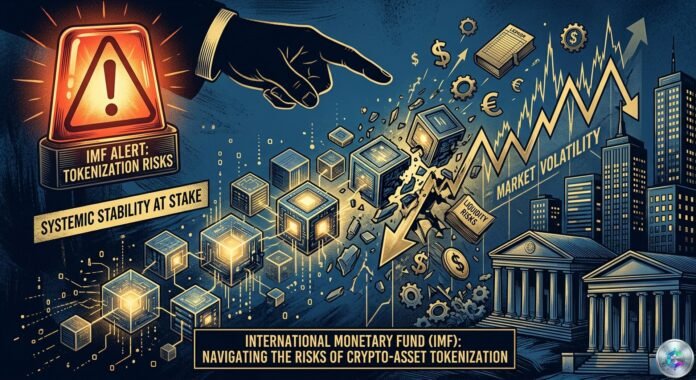
IMF Sounds Alarm on Tokenization: The April 2026 Report That Could Reshape Crypto Regulation Forever
The dream of a tokenized financial system has always been intoxicating: stocks that trade around the clock, bonds that settle in seconds, assets that flow across borders as easily as sending an email. But the International Monetary Fund just delivered a sobering reality check. In a landmark report published in early April 2026, the Washington-based institution warned that moving financial markets onto blockchain rails could accelerate crises faster than regulators can respond — and called for urgent policy action before the window closes.
The IMF’s Historic Warning on Tokenized Finance
The report, titled « Tokenized Finance » and authored by Tobias Adrian, the IMF’s Financial Counselor and Director of the Monetary and Capital Markets Department, frames tokenization as « a structural overhaul of financial architecture » rather than a mere technical upgrade. The distinction matters: the institution isn’t calling for a pause on innovation, but for a fundamental rethinking of how risk is managed in a world where assets exist as digital tokens on shared ledgers.
The numbers behind this warning are staggering. The tokenization of real-world assets has reached approximately $27.5 billion, with over $23 billion of that figure — excluding stablecoins — taking the form of tokenized U.S. Treasuries or money market funds, according to DeFiLlama data. Simultaneously, stablecoins now process $1.8 trillion in monthly volume, increasingly serving as the settlement bridge between crypto platforms and traditional finance.
The Settlement Buffer Problem: Why Speed Cuts Both Ways
At the heart of the IMF’s analysis lies a fundamental paradox. Current financial systems operate with settlement delays that, while inefficient, serve a critical stabilizing function. When a trade is initiated, regulators and central banks have a window — however brief — to detect anomalies, intervene during market stress, or deploy emergency facilities.
Settlement latency, long vilified as a friction point, quietly insulates the system from catastrophic cascading failures. Tokenization promises atomic settlement: transactions that execute instantly, without intermediaries, eliminating these delays entirely. The efficiency gains are real — counterparty risk diminishes, collateral requirements shrink, compliance rules embed directly into infrastructure.
But the IMF warns that this same speed could transform how crises unfold. « Stress events are likely to unfold faster, leaving less time for discretionary intervention, » the report states. « Therefore, ensuring stability requires that tokenized asset management remains anchored in safe settlement assets, legally recognized finality, and robust governance arrangements. »
The implications are profound. In today’s markets, a flash crash can be halted by circuit breakers that pause trading and give participants time to assess. In a 24/7 tokenized environment with automated smart contracts triggering margin calls and liquidations, there are no such circuit breakers.
Stablecoins: The Weakest Link in the Chain
The IMF identifies stablecoins as the most vulnerable component of this emerging architecture. These tokens — whose value is pegged to fiat currencies, predominantly the U.S. dollar — are increasingly being used as settlement assets across tokenized platforms. Their reliability depends entirely on reserves and redemption mechanisms, leaving them exposed to runs during periods of stress.
The parallel drawn with money market funds is deliberately ominous. Money market funds were long considered rock-solid — until September 2008, when the Reserve Primary Fund « broke the buck, » triggering a panic that required Federal Reserve intervention to prevent a complete meltdown in short-term funding markets.
The IMF fears stablecoins could follow the same trajectory: stable in normal times, but prone to catastrophic runs when confidence erodes. This warning carries particular weight given the role stablecoins already play in decentralized finance (DeFi).
The report cites the October 2025 flash crash of Aave, where the lending protocol experienced a 64% price drop in minutes as automated liquidations triggered a cascade of forced selling.
The Concentration Trap: Single Points of Failure at Systemic Scale
Beyond speed, the IMF flags concentration risk as a critical concern. A single shared ledger can replace dozens of bilateral links — but it also becomes a critical node whose failure could disrupt the entire market.
« From the financial stability perspective, tokenization presents a familiar trade-off in a new form, » wrote Adrian. « Atomic settlement and enhanced transparency reduce some traditional risks, but speed and automation introduce new vulnerabilities. »
The implications become clearer when examining who’s building this infrastructure. BlackRock and JPMorgan Chase are conducting live pilot programs for U.S. Treasury tokenization, anticipating higher fee revenue from simplified conventional asset trading. Nasdaq has received regulatory permission to list certain securities in tokenized form and recently partnered with institutional trading platform Talos to develop tokenized collateral management solutions.
Meanwhile, the New York Stock Exchange announced in January 2026 it is building a venue for round-the-clock tokenized stock trading. In March, the exchange revealed a partnership with Securitize to construct the platform.
Three Futures: Policy Choices That Will Define the System
The IMF outlines three potential development paths for tokenized finance. The first scenario envisions a unified system built around wholesale central bank digital currencies (CBDCs), where tokenized settlements flow through government-backed rails.
The second imagines a collection of incompatible national platforms, each with their own standards and regulations. The third — and most concerning — describes a landscape ruled by private stablecoins, where public safeguards gradually erode as private issuers capture market share.
This taxonomy matters because the outcome depends largely on regulatory choices made in the coming years. And time is running out, according to the IMF, which notes that « the current opportunity for policymakers to actively shape the emerging digital financial architecture is finite. »
The Five-Pillar Framework: A Roadmap for Safer Tokenization
The IMF doesn’t limit itself to warnings. The report proposes a comprehensive five-pillar policy framework to mitigate identified risks.
Pillar One: calls for anchoring tokenized settlement in wholesale CBDCs rather than private stablecoins, ensuring settlement uses the safest possible monetary form.
Pillar Two: advocates for consistent regulation based on the principle of « same activity, same risk, same regulation » — regardless of the technology underlying the transaction.
Pillar Three: demands legal clarity for tokenized assets, defining their standing and the rights attached to them.
Pillar Four: focuses on safe settlement assets — ensuring that tokenized markets use central bank reserves or equivalent instruments rather than privately issued stablecoins.
Pillar Five: requires legally recognized finality for tokenized transactions, preventing the reversal of completed settlements.
Wall Street Presses Forward Despite IMF Warnings
The IMF’s warnings arrive precisely as major Wall Street institutions accelerate their tokenization efforts. The Chairman of the Securities and Exchange Commission has expressed support for the concept, and major exchanges are building infrastructure that could see tokenized securities trade alongside traditional instruments within years.
This divergence between institutional warnings and private-sector enthusiasm highlights a growing gap between technological innovation speed and regulatory capacity. As the IMF notes, « without appropriate policy frameworks, tokenized finance could deepen fragmentation rather than improve efficiency. »
Conclusion: The Window Is Open, But Not Forever
The IMF’s « Tokenized Finance » report marks a watershed moment in the tokenization debate. For the first time, a premier international financial institution has documented in such detail the potential systemic risks of this technology — while providing a concrete policy roadmap for safer integration into the global financial system.
The market figures — $27.5 billion in tokenized assets, $1.8 trillion in monthly stablecoin volume — confirm that tokenization has moved beyond the experimental stage. The technology is now mature enough to raise genuine financial stability questions that affect markets worldwide.
The five-pillar framework offers a pathway for more secure tokenization development. But implementation will require unprecedented international coordination and, crucially, political will to regulate a sector that generates substantial profits for the institutions building it.
For investors and market participants, the IMF report should serve as a reality check. Tokenization offers genuine opportunities — faster settlement, reduced costs, greater accessibility — but the risks the IMF identifies are real and potentially systemic.
The question is no longer whether tokenization will transform finance, but how that transformation will be governed. Time is of the essence.
This article is for informational and educational purposes only. It does not constitute investment advice. Cryptocurrencies and tokenized assets are volatile: conduct your own research before making any financial decisions.

