


Institutional investors have spoken. And their message couldn’t be clearer: Bitcoin’s climb is far from over. On Tuesday, March 17, 2026, U.S. spot Bitcoin ETFs closed out their sixth consecutive day of net inflows—the longest bullish streak since October 2025. This dynamic reflects a major paradigm shift: after months of caution or even outright defiance, market sentiment has literally done a 180°.
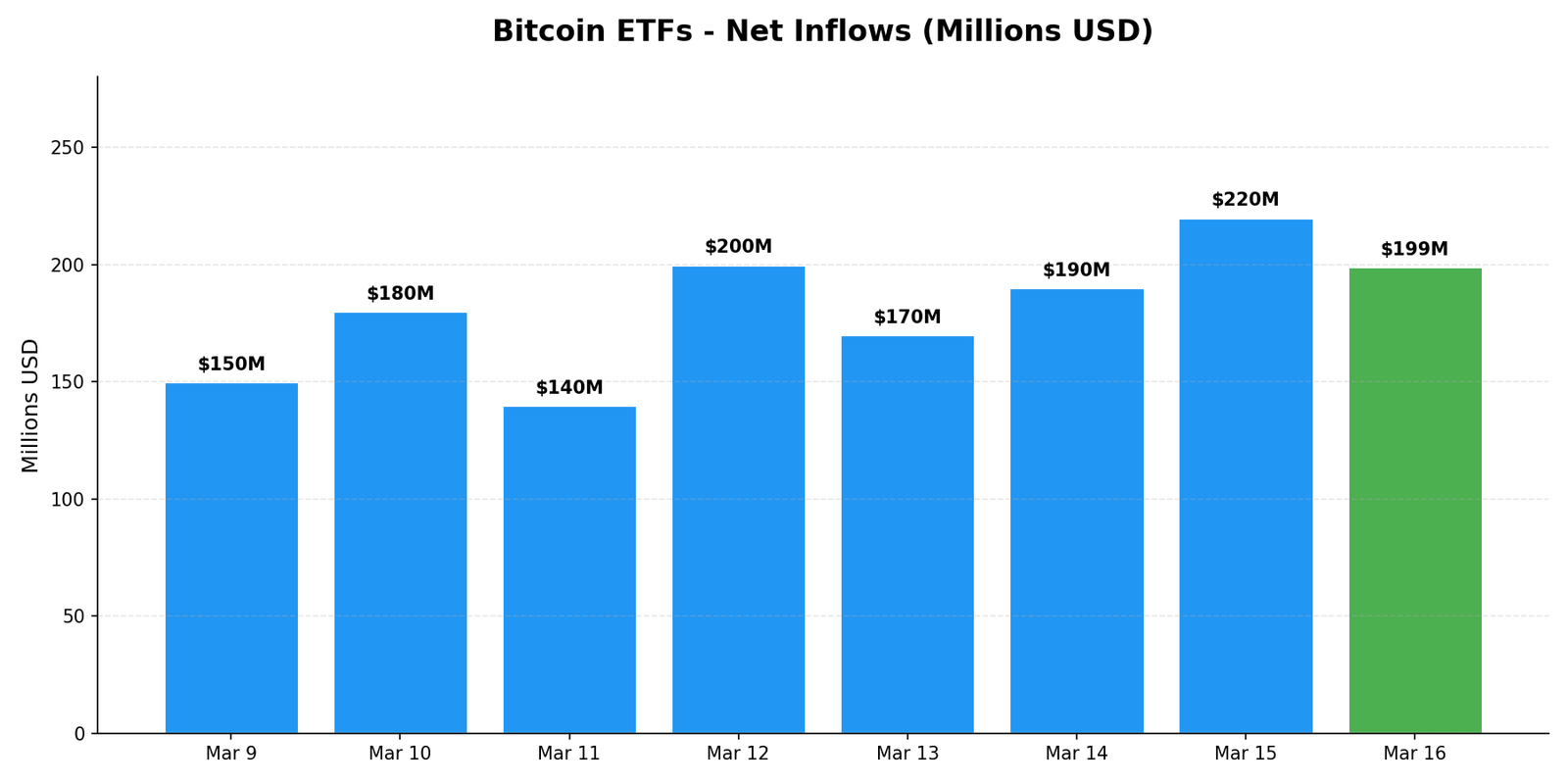
On March 16 alone, spot Bitcoin funds attracted $199.4 million in net inflows. Over the past week alone (since March 9), nearly $1 billion has flowed into these financial products that have become an essential part of the crypto landscape. An exodus toward the flagship cryptocurrency that has naturally translated into a sharp price surge: Bitcoin climbed 12.5% in just days, rising from $65,960 to $74,250.
Behind this rush lies a profound shift in market perception. FOMO (Fear of Missing Out) has reached its highest level since January 2, 2026. The Crypto Fear & Greed Index—the psychological indicator closely watched by traders worldwide—has officially exited the « Extreme Fear » zone, a signal investors are interpreting as a decisive turn toward optimism.
BlackRock and Fidelity Lead the Dance
In this context of renewed euphoria, two names logically top the leaderboard. BlackRock, the global asset management giant with its IBIT ETF, recorded $139.4 million in inflows on March 16. A colossal figure that confirms the institution’s central role in Bitcoin’s institutional adoption. Behind it, Fidelity follows with $64.5 million accumulated for its FBTC.
These two actors alone account for over $200 million in inflows on a single day—a symbolic amount that illustrates the scale of the current movement. Other issuers, like Bitwise (BITB), Ark Invest (ARKB), and Valkyrie, also post positive flows, even if their amounts remain modest.
An Unprecedented Historical Context
To understand the scale of the current movement, it must be placed in historical perspective. The last streak of consecutive inflows this long dated from October 2025, a period that saw Bitcoin consolidate its gains after a remarkable summer rally.
But the March 2026 dynamic is even more significant for a simple reason: it comes after a period of relative doubt that lasted nearly five months. Between November 2025 and February 2026, the market experienced a laborious consolidation phase. ETF inflows had dried up, Bitcoin fluctuated in a narrow range between $60,000 and $68,000.
Those who doubted were wrong. The nearly $1 billion injected since March 9 represents not only a return of confidence, but also and especially a paradigm shift in capital allocation.
Market Sentiment
The Crypto Fear & Greed Index, which had been oscillating for weeks in the red « Extreme Fear » zone, has crossed key psychological thresholds to reach more balanced, even slightly optimistic territory.
Several converging factors explain this transition:
- Regulatory clarity has gradually improved in the United States
- The Bitcoin narrative has evolved toward a full-fledged asset class
- Macroeconomic dynamics are favoring risk assets
FOMO is at its highest since January 2, 2026. But unlike previous cycles, this rise comes mainly from institutional investors—not retail speculation.
Toward New Records?
The six-day streak of consecutive inflows represents the longest since October 2025. Daily flows remain sustained, and institutional demand shows no signs of slowing.
Spot Bitcoin ETFs, by offering a regulated and accessible investment vehicle, have democratized Bitcoin exposure while making it compliant with traditional asset management standards. This structural evolution fundamentally changes market dynamics—and could well herald a new era for the flagship cryptocurrency.
Conclusion
The record streak of inflows into U.S. Bitcoin ETFs marks a turning point. With nearly $1 billion injected since March 9, $199.4 million on March 16 alone, and a 12.5% Bitcoin gain, the market clearly signals a strong investor comeback. This dynamic testifies to a maturing cryptocurrency market. Bitcoin has anchored itself in the financial landscape as a full-fledged asset class.

