


According to INTERPOL’s African Cyberthreat Assessment Report 2026, artificial intelligence is now involved in 55% of reported cybercrimes on the continent. Financial losses have doubled in one year to reach $484 million, while law enforcement agencies are alarmingly behind the curve.
🔑 Key Takeaways
- AI is now involved in 55% of African cybercrimes in 2025
- Losses doubled: $484M in 2025 vs. $192M in 2024
- Nearly 600,000 digital sextortion cases detected via deepfake
- 72% of countries report specialized scam centers
- African police readiness against AI tools remains “alarmingly low”
Cybercrime has gone industrial
Published on August 3, 2026, the fourth edition of the African Cyberthreat Assessment Report draws on data submitted by 36 countries that are INTERPOL members. This 40-page document describes a structural transformation: cyberattacks are no longer isolated acts but part of a cross-border criminal ecosystem, structured and increasingly industrialized. Generative AI, capable of autonomously producing text, images and voice, now serves as a force multiplier for criminal networks.
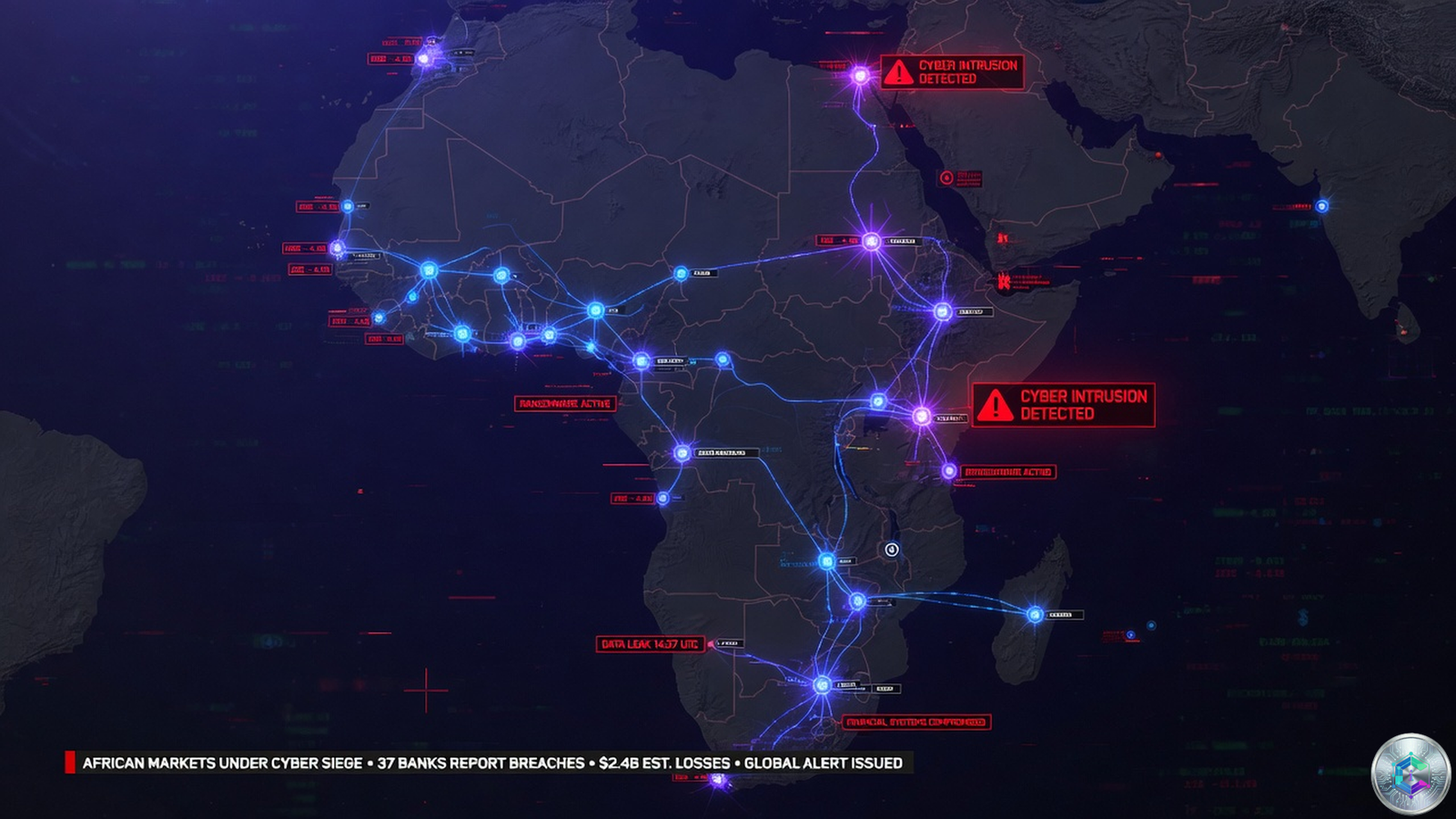
The organization estimates this industrialization rests on three pillars: attack automation, the scaling of phishing, and the large-scale exploitation of human vulnerabilities. Fraudsters leverage AI tools to run faster, larger and harder-to-detect attacks. According to the report, this shift translates into a near-doubling of financial losses across the continent.
| Indicator | 2024 | 2025 |
|---|---|---|
| Financial losses from cybercrime | $192M | $484M (+152%) |
| Digital sextortion cases detected | n/a | ~600,000 |
| Countries that adopted or revised cybercrime legislation | n/a | 17 |
| Arrests via Serengeti 2.0, Contender 3.0, etc. | n/a | >1,500 |
Generative AI reshapes fraud methods
Beyond attack volume, AI is reshaping the very nature of digital fraud. TrendAI, cited in the report as a partner, detected nearly 600,000 digital sextortion cases, largely fueled by deepfake content (AI-generated fabricated media, such as synthetic nude images or videos). In Côte d’Ivoire, the company logged 64,111 IP detections tied to sextortion campaigns, placing the country third on the continent for this type of threat.
Fraudsters are also exploiting synthetic digital identities: networks combine authentic personal data, often stolen, with artificially generated information to create fake profiles capable of bypassing biometric verification systems. These identities are then used to open bank accounts, secure loans through mobile services, or register SIM cards under false identities.
BEC (Business E-mail Compromise) scams are becoming more sophisticated thanks to AI, which produces highly credible emails in local languages. A Microsoft report published in October 2025 already warned that attackers were using AI to draft phishing messages and mimic public figures. The number of victims tracked in that study jumped from 35,000 to 87,000 in a single year.
“The rise of AI-enabled fraud requires urgent action. No single country can face this type of threat alone.”
Neal Jetton, Director of Cybercrime at INTERPOL
An uneven geography of threats
The report highlights sharp regional disparities. East Africa emerges as a major hub for mobile-payment fraud and ransomware attacks targeting critical infrastructure. Central and West Africa are particularly affected by BEC scams and romance frauds. Southern Africa, thanks to its high connectivity levels, attracts international criminal actors looking to maximize the impact of their operations.
| Country | Threat type | 2025 detections |
|---|---|---|
| Cape Verde | Ransomware | 16,997 |
| Côte d’Ivoire | Sextortion (IPs) | 64,111 |
| Nigeria | Ransomware | 5,822 |
| Mali | Sextortion | 3,494 |
| Mali | DDoS (H1 2025) | 4,145 |
On ransomware, Cape Verde recorded 16,997 detections in 2025, the second-highest level on the continent. Nigeria logged 5,822 and remains both a target and an operating base for several cybercriminal networks. In Mali, 3,494 sextortion cases were reported alongside 4,145 distributed denial-of-service (DDoS, a deliberate flood of traffic that takes a server offline) attacks detected in the first half of 2025. The report also cites the hack of Nigeria’s National Bureau of Statistics website in 2025, an attack that disrupted the release of economic data and fueled disinformation campaigns.
In total, 72% of countries participating in the study reported identifying specialized scam centers, mainly located in West and Southern Africa. These hubs exploit mobile-payment services, social networks and AI tools to reach victims worldwide.
An institutional response that is building but still falls short
Faced with the scale of the threat, INTERPOL flags a worrying gap. The organization describes law enforcement readiness against AI tools as “alarmingly low.” A large majority of African agencies surveyed admitted they had not yet integrated artificial intelligence tools into their investigative methods.
Yet concrete progress is being made. In 2025, seventeen African countries adopted or revised their cybercrime legislation. Several INTERPOL-coordinated international operations delivered tangible results: Serengeti 2.0, Contender 3.0, Sentinel and Red Card 2.0 led to more than 1,500 arrests, the seizure of hundreds of computing devices, and the recovery of more than $100 million. Red Card 2.0, run with Afripol (the African Union’s police cooperation mechanism) across sixteen countries, produced 651 arrests and the identification of 1,247 victims. Globally, Operation First Light 2026 led to the arrest of 5,811 people and the seizure of $293 million in illicit assets.
INTERPOL is calling on African states to strengthen cross-border cooperation, modernize their legislative toolkit and train more investigators in emerging technologies. The organization recommends harmonizing digital forensics capacity between countries and deepening public-private partnerships to anticipate these threats.
Conclusion: toward a structural, global threat
This report marks the fourth edition of INTERPOL’s African cyberthreat assessment, produced under an initiative funded by the UK Foreign Office. The backdrop is an accelerating digital transformation of the continent, which counted more than 1.1 billion mobile subscriptions in 2025, fertile ground for criminal networks now operating at industrial scale.
In the short term, the spread of generative AI models and falling access costs are set to amplify attack cadences. The central scenario for 2026-2027 points to a rise in BEC fraud and deepfake-driven sextortion, with contagion risks into other regions through African digital diasporas. The success of coordinated operations like Serengeti 2.0 shows, however, that a multinational response combining legislation, training and technical cooperation can deliver tangible results, provided it is sustained over time.
Sources
- Journal du Coin
- INTERPOL — African Cyberthreat Assessment Report
- APA News
- LSI Africa
- La Nouvelle Tribune
- Africa Radio
This article is published for informational and educational purposes only. It does not constitute investment advice. Do your own research (DYOR) before making any decision.

