

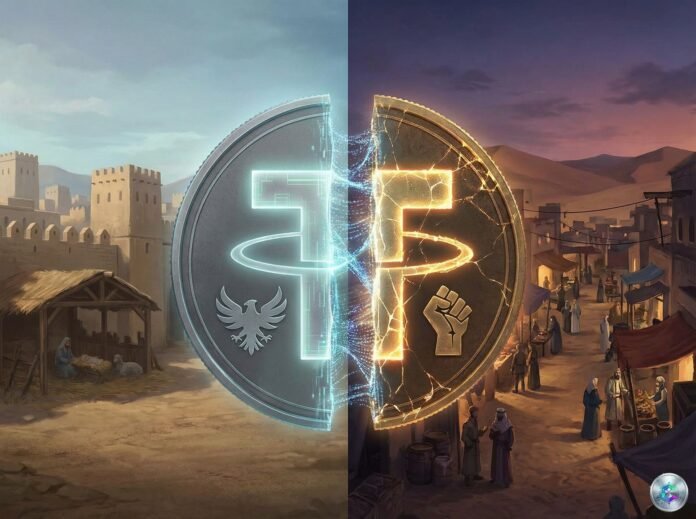
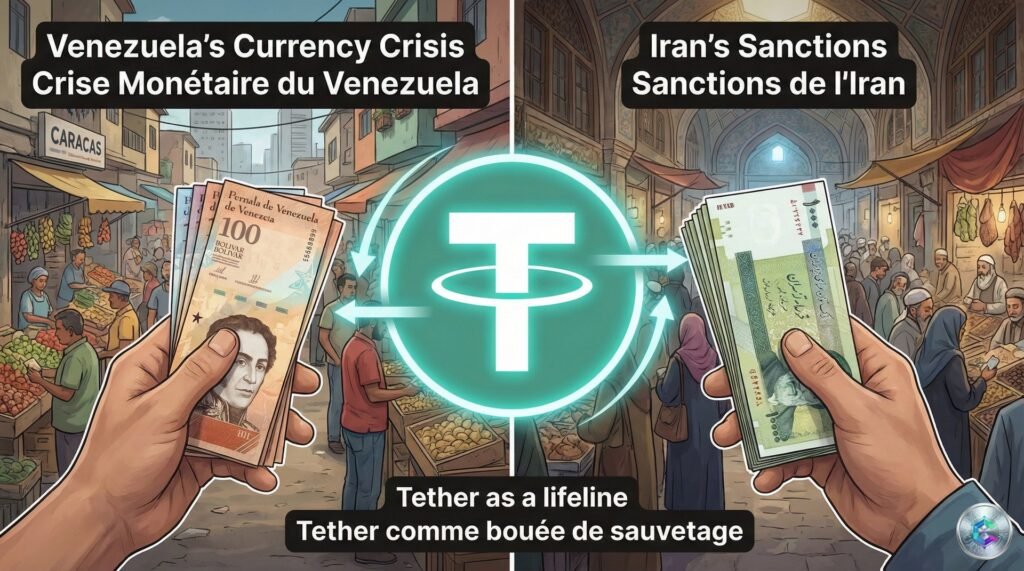
As Iran and Venezuela face unprecedented economic crises, stablecoins, particularly Tether’s USDT, reveal their paradoxical nature. For millions of citizens confronting hyperinflation, these digital assets represent a vital lifeline. But they also constitute a controversial tool enabling sanctioned entities to circumvent international embargoes.
Iran: When Cryptocurrency Becomes the Only Escape
Since early 2026, Iran has been experiencing an unprecedented period of turbulence. Massive protests have erupted across the country in response to the collapse of the Iranian rial, which has reached historic lows against the US dollar. The situation has dramatically worsened, with thousands of arrests and hundreds of deaths reported. The government has even cut off domestic Internet access to try to control the protests.
In this catastrophic context, cryptocurrencies have become essential tools for economic survival. USDT based on the Tron blockchain is the most widely used asset in the country, allowing the population to protect themselves against galloping inflation. According to 2025 data, approximately 46% of Iranian users employ cryptocurrencies as a hedge against high inflation.
Cryptocurrency adoption has not been without obstacles. A massive hack of Nobitex, the country’s largest exchange platform, resulted in estimated losses between $82 and $90 million. Additionally, the government has imposed an annual limit on stablecoins, authorizing maximum holdings of $10,000 and maximum purchases of $5,000 per person.
The IRGC Scandal: Over a Billion Dollars Transferred Through Shell Companies
An explosive report from TRM Labs published on January 9, 2026, reveals that Iran’s Islamic Revolutionary Guard Corps (IRGC) allegedly transferred over a billion dollars in stablecoins since 2023 through two UK-based shell companies: Zedcex and Zedxion.
According to TRM Labs’ analysis, although these two companies present themselves publicly as distinct entities, they actually function as « a financial infrastructure for the IRGC, » operating together within a « broader ecosystem of Iranian sanctions evasion. » Between 2023 and 2025, IRGC-related transactions accounted for 56% of the total exchange volume on these two platforms, with the vast majority being conducted in USDT on the Tron blockchain.
IRGC-related activity on Zedcex has seen spectacular growth: from $23.7 million in 2023 (60% of total activity), it rose to $619.1 million in 2024, with the IRGC’s share reaching 87%. In 2025, overall activity declined to $410.4 million, with the IRGC’s share falling back to 48%.
More alarmingly, blockchain records show that over $10 million in USDT was transferred directly from wallets linked to both Zedcex and the IRGC to addresses controlled by Sa’id Ahmad Muhammad al-Jamal, a Yemeni businessman sanctioned by the US Treasury in 2021 for smuggling Iranian fuel to finance the Houthis in Yemen.
Venezuela: When USDT Replaces Banks
Venezuela presents a similar case of massive USDT adoption, with slightly different motivations. The Venezuelan bolívar has collapsed over the past decade. In 2025, the dollar’s price increased by 479% over the year, driving runaway inflation that could exceed 500% according to private firms.
Venezuelan hyperinflation has reached historic peaks: 65,370% in 2018 according to the IMF, and up to 1,698,488% in December 2018 according to National Assembly estimates. Although inflation has somewhat stabilized, it remains at extremely high levels, with projections around 160% for 2026.
In this context, USDT has become so widespread that ordinary Venezuelans use this asset to pay for all kinds of daily services. As Mauricio Di Bartolomeo, a 71-year-old Venezuelan crypto entrepreneur, points out: « That’s how you pay your gardener and your hairdresser. You can use Tether for just about anything. »
According to Chainalysis data, Venezuela ranks 18th globally in terms of cryptocurrency adoption but rises to 9th place when adjusted for population size. Nearly 92.5% of crypto activity in Venezuela is driven by a critical need for remittances and stablecoin-based value preservation.
PDVSA: Venezuelan Oil Paid in USDT
The most controversial aspect of USDT use in Venezuela concerns Petróleos de Venezuela (PDVSA), the state oil company. According to several reports, PDVSA allegedly began requiring payments directly in USDT to avoid sanctions imposed in 2020.
Estimates suggest that the company accepts approximately 80% of all its oil revenues via Tether. At the end of the first quarter of 2024, PDVSA began requiring new customers to use digital wallets and make payments in USDT for spot oil transactions. In July 2024 alone, approximately $119 million in cryptocurrencies was sold to the private sector.
Tether’s Response: Intensive Collaboration with Authorities
Faced with these problematic uses, Tether has intensified its cooperation with the US government. According to an AMLBot report from December 5, 2025, Tether blacklisted approximately $3.3 billion in funds between 2023 and the end of 2025, including $1.75 billion in frozen Tron-based USDT.
Data shows that Tether blacklisted 7,268 addresses between 2023 and 2025, more than 2,800 of which were in coordination with US law enforcement. More than 53% of all frozen Tether tokens were on the Tron network.
On the weekend of January 11, 2026, Tether added to this figure by freezing $182 million in Tron-based USDT spread across five wallets. Specifically regarding Venezuela, reports indicate that Tether has frozen 41 USDT wallets linked to Venezuelan oil sanctions evasion, in cooperation with the US Treasury and the Financial Crimes Enforcement Network (FinCEN).
Paolo Ardoino, Tether’s CEO, emphasized: « Tether’s ability to track transactions and freeze USDT linked to illicit activities distinguishes it from traditional fiat currency and decentralized assets. We take seriously our responsibility to combat financial crime. »
The GENIUS Act: A New US Regulatory Framework
In response to these challenges, the United States adopted the GENIUS Act in July 2025, the first federal legislation on stablecoins. This law establishes a clear regulatory framework for payment stablecoins and imposes strict obligations on issuers.
The GENIUS Act explicitly subjects stablecoin issuers to the Bank Secrecy Act, requiring them to establish effective anti-money laundering (AML) programs and sanctions compliance. All stablecoin issuers must possess the technical capability to seize, freeze, or burn stablecoins when legally required.
The legislation provides for severe sanctions: illegal issuance of stablecoins is subject to civil penalties of up to $100,000 per day, and deliberate participation in a violation can result in penalties of up to $1,000,000 per violation, up to five years imprisonment, or both.
A Strategic Dilemma for Policymakers
This situation creates a complex dilemma. On one hand, stablecoins like USDT offer a vital lifeline for millions of ordinary citizens in Venezuela and Iran suffering from hyperinflation. On the other hand, these same tools enable sanctioned entities to circumvent international embargoes.
A TRM Labs report from January 2026 indicates that over the past year, there has been a 694% increase in cryptocurrencies received by sanctioned entities, particularly from Russia and Iran. Stablecoins represent 84% of all illicit transaction volume.
Nevertheless, the crypto economy as a whole remains largely composed of legitimate transactions. The illicit share of all crypto transaction volume remains below 1%.
Future Outlook
Experts agree that stablecoin use in Venezuela and Iran is likely to continue increasing. After Venezuelan President Nicolás Maduro’s arrest in early January 2026, several analysts noted that stablecoin adoption will likely persist as it will take considerable time to normalize financial infrastructure.
In Iran, despite sustained sanctions, the cryptocurrency ecosystem has shown persistent growth. Data shows that Iranian services received 11.8% more volume in mid-2025 compared to the same period in 2024.
However, Chainalysis analysis reveals growing isolation from the legitimate global financial system. The average number of transactional « hops » necessary for funds to move between Iranian services and compliant global exchanges has steadily increased, rising from 1.6 in 2021 to 4.1 in 2025.
The duality of stablecoins revealed by the situations in Venezuela and Iran underscores the complex challenges facing regulators and policymakers. The balance between protecting citizens from hyperinflation and preventing sanctions circumvention will likely define the future of stablecoin regulation in the years ahead.

