

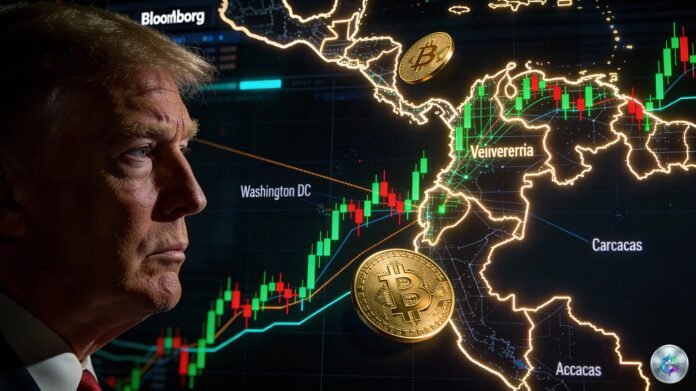
The American military intervention in Venezuela marks a historic turning point for financial markets and the crypto ecosystem. With the capture of Nicolás Maduro, the Trump administration is opening the door to major upheavals that will affect both sovereign bonds and the cryptocurrency market. In-depth analysis of short, medium and long-term implications.
A Geopolitical Earthquake with Massive Financial Repercussions
This weekend, the confirmation of Nicolás Maduro’s capture and the launch of the American military operation ended the status quo that had paralyzed Venezuela for a decade. For financial markets and the crypto ecosystem, this is no longer political speculation but a real forced regime change that opens up massive arbitrage opportunities and equally significant risks.
The Trump (2.0) administration’s action is not solely aimed at political change: it is structurally financial. The stated objective is clear – to manage Venezuela to repay debt and flood the oil market.
The Bond Market: The Opportunity of the Decade?
Venezuelan sovereign bonds, notably Venezuela 2027 and PDVSA bonds, in default since 2017, were trading for just a few cents (2 to 5 cents on the dollar). The situation has radically changed.
The Trump Effect: Since the late 2024 election and particularly the last 48 hours, these bonds have experienced a spectacular surge. The market anticipates a rapid restructuring orchestrated by Wall Street.
The Opportunity: Distressed debt funds are massively accumulating these securities. If Trump installs an internationally recognized transitional government, the recovery value could rise from 5% to 40-50% of nominal, representing considerable potential gains for investors.
The Risks: A prolonged legal battle remains possible. Trump could prioritize repayment of American companies like Chevron before foreign bondholders.
Oil: Between Risk Premium and Supply Shock
Trump has announced his intention to sell large quantities of Venezuelan oil reserves. This market flooding strategy will have differentiated impacts depending on the time horizon.
Short-Term Impact: The geopolitical risk premium is currently pushing crude prices up. Security uncertainty creates tension in energy markets.
Medium-Term Impact: If the United States manages to restart PDVSA’s infrastructure via Chevron (the only American major remaining on site under special license), this will create a significant bearish supply shock on barrel prices.
The Winners: Chevron and American oilfield services companies (Schlumberger, Halliburton) who will obtain lucrative contracts to rebuild Venezuelan oil infrastructure.
The Privatization of Regime Change
Erik Prince’s influence, founder of Blackwater, is central to this administration. His proposals for « corporate colonialism » or private management of migration and security crises suggest that the Venezuelan transition could be partially privatized. This approach means lucrative contracts for the private military-industrial complex, financed by the country’s future oil revenues.
Venezuela: Laboratory for the Digital Dollar
This is where the analysis becomes crucial for the crypto ecosystem. Venezuela is already the 11th country in the world in terms of cryptocurrency adoption. Trump’s intervention will radically transform the nature of this adoption.
The End of the « Sanctions Evasion » Era
Until now, PDVSA used USDT (Tether) to sell its oil while circumventing American sanctions. With American control, these circumvention circuits will be dismantled or « whitewashed ». USDT will no longer be a resistance tool for the regime but will become the dollarization tool for the population.
USDT: The New National Currency?
The Venezuelan economy is already « Tetherized » – the private sector massively uses USDT for everything from salaries to imports. A likely scenario is emerging: rather than reprinting devalued Bolivars, a pro-American transitional administration could officially adopt a « Crypto-Dollar » (USDC or regulation-compliant USDT) as a temporary legal currency.
This approach would allow immediate monetary stabilization without the complex logistics of paper cash, while massively legitimizing the stablecoin industry in the eyes of global regulators.
Bitcoin: The Ultimate Safe Haven
As airstrikes and political uncertainty shake the country, Bitcoin is fully playing its role as an uncensorable safe haven. The global crypto market has wavered in the face of war risk, but locally, the premium on BTC and stablecoins is exploding.
Venezuelans are actively seeking to secure their assets out of reach of any asset freeze, whether from the old regime or new occupiers. This dynamic reinforces Bitcoin’s narrative as the ultimate protection against confiscation and political instability.
Investment Strategy: The 3 Time Horizons
Short Term (2-8 Weeks): Extreme Volatility
Crypto: Watch out for violent variations in BTC due to geopolitical developments. USDT will remain above $1.00 on Latin American P2P markets due to strong demand.
Meme Coins: Trump-related tokens (TRUMP, MAGA) and those associated with the Cronos ecosystem (recent Trump Media/Crypto.com partnership) could outperform through pure narrative speculation.
Traditional Finance: Long position on oil volatility. The initial blockade will tighten prices before they fall with the restart of production.
Medium Term (3-12 Months): Reconstruction
Distressed Debt: For investors with access to emerging market debt ETFs or specialized products, this is the strategic moment. Venezuelan debt restructuring will be the major « Macro Trade » of 2026.
Stablecoin Adoption: Monitor on-chain transaction volumes in Latin America (Chainalysis/TRM Labs data). If the USA officially authorizes stablecoins for humanitarian aid or reconstruction, this will massively legitimize the industry in the eyes of regulators.
Long Term (1-5 Years): The New Model
Tokenized Resources: Trump has mentioned selling Venezuelan reserves. Given his pro-crypto entourage, we could see attempts to tokenize oil reserves (RWA – Real World Assets) to raise capital quickly from global retail investors, bypassing traditional institutions like the IMF.
Centralization Risk: Venezuela could become a US client state, using a CBDC (Central Bank Digital Currency) or a Stablecoin with strict KYC, killing the libertarian aspect of local crypto.
Conclusion: A Hostile Takeover of a Sovereign State
The Venezuela operation is not simply a military intervention – it’s a hostile takeover bid. Trump is « buying out » a bankrupt country to restructure it according to American interests.
For the crypto investor, the narrative changes radically. Venezuela shifts from a « Gray Zone / Black Market » usage to a potential « Digital Dollarization Laboratory ». Smart money will closely monitor the official integration of stablecoins into the reconstruction economy and the movements of American oil majors.
This geopolitical upheaval could serve as a model for future economic interventions combining military hard power and financial soft power, with cryptocurrencies playing a central role in reconstruction and stabilization.
This article is published for informational purposes and does not constitute financial or investment advice. Markets present significant risks and any investment decision should be made after consultation with qualified professionals.

