

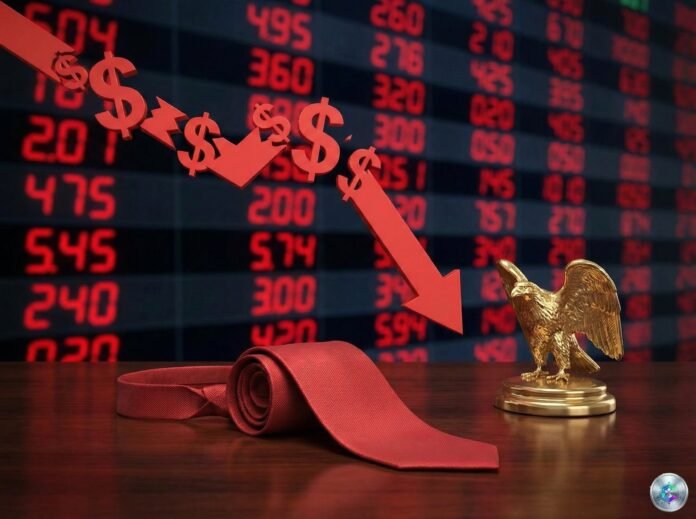
January 27, 2026 marks a turning point in American monetary history. As the U.S. Dollar Index (DXY) hit its lowest level since February 2022 at 95.566 points, a surprising presidential statement rang out: Donald Trump called this situation an « excellent thing. » This unusual stance reveals a deliberate economic strategy that disrupts the traditional U.S. monetary doctrine.
Historic Depreciation Accelerates
The numbers are undeniable: after losing more than 9% in 2025, the dollar fell another 2.5% in January 2026. This downward trajectory has translated into significant movements across currency markets. The euro broke through the psychological threshold of $1.20 for the first time since 2021, while the Swiss franc reached a 10-year high. Against the Japanese yen, the greenback declined more than 3% in two sessions.

This depreciation comes at a time when the dollar was considered overvalued. At the beginning of 2025, based on the real effective exchange rate, the U.S. dollar had reached its highest level since 1985. The current correction could therefore be interpreted as a return to more balanced levels.
The Mar-a-Lago Doctrine: A Deliberate Devaluation Plan
Behind this presidential acceptance of a weakened dollar lies the « Mar-a-Lago doctrine, » a strategy formalized by Stephen Miran, an influential economic adviser in the Trump administration. A former hedge fund manager, Miran holds a unique position, serving on the Federal Reserve board while remaining an adviser to the White House.
This strategy explicitly aims to recreate the conditions of the 1985 Plaza Accord, which enabled a coordinated devaluation of the dollar. The central objective is to reduce the U.S. trade deficit by making American exports more competitive in the global market. To achieve this, the administration is considering a combination of high tariffs and controlled dollar depreciation.
Winners and Losers
American companies that generate a significant portion of their revenues abroad are among the main beneficiaries of a weakened dollar. Export-oriented sectors, such as manufacturing and agriculture, should also benefit from this situation with more competitive prices.
However, American consumers face a rising cost of living. Imported goods become mechanically more expensive, creating inflationary pressure that extends to inputs necessary for domestic production. This situation is particularly concerning in a context where inflation remains a major source of concern.
Tensions with the Federal Reserve
Relations between the White House and the Federal Reserve have reached an unprecedented level of tension. Jerome Powell, whose term as Fed chair ends in May 2026, is the subject of a criminal investigation launched by the Justice Department, widely perceived as political pressure aimed at influencing monetary policy.
At its meeting on January 27-28, 2026, the Federal Reserve is expected to keep its key rate unchanged in the range of 3.5% to 3.75%. This decision reflects the institution’s concerns about persistent inflation and a labor market that remains robust.
International Repercussions and the « Sell America » Movement
The rapid appreciation of the euro against the dollar is raising concerns within the European Central Bank. François Villeroy de Galhau, governor of the Bank of France, indicated that policymakers were closely monitoring the euro’s appreciation and its potential impact on declining inflation.
Analysts diagnose a « crisis of confidence in the U.S. dollar » that manifests as a « Sell America » movement, characterized by capital outflows from American assets. Gold took advantage of this dollar weakness to set new records, surpassing $5,300 per ounce, while silver also broke through the symbolic barrier of $100 per ounce.
Systemic Risk: Toward the End of the Dollar as Reserve Currency?
Beyond short-term fluctuations, the most fundamental question concerns the dollar’s status as the world’s reserve currency. In March 2025, the International Monetary Fund estimated that more than 57% of global reserves were denominated in dollars. This proportion, while still a majority, represents a significant decline from the 2000s, when it exceeded 70%.
The status of world reserve currency provides the United States with what French economist Valéry Giscard d’Estaing called an « exorbitant privilege »: the ability to borrow at lower rates than their economic fundamentals would justify. However, this privilege comes at a cost: structurally high demand for the dollar tends to maintain its value at an elevated level, which penalizes American exporters.
Implications for Cryptocurrencies
The cryptocurrency market is reacting in contrasting ways to dollar weakness. In principle, a weakened dollar should benefit Bitcoin and other crypto-assets. Some analysts predict that the second quarter of 2026 could mark a return of bullish momentum for Bitcoin, with targets between $150,000 and $220,000 by year-end.
However, reality proves more complex. Bitcoin is going through a difficult period at the start of 2026, with prices struggling to stay above $90,000. The relationship between Fed monetary policy and Bitcoin price remains paramount, with high interest rates making secure investments more attractive.
Conclusion: A Risky Bet with Uncertain Consequences
Trump’s strategy regarding the dollar’s decline reveals a deliberate but highly risky economic approach. While the objective of reducing the trade deficit by making American exports more competitive is clear, the associated risks are multiple and interconnected.
In the short term, a weak dollar fuels inflationary pressures. In the medium term, the « Sell America » movement reflects a loss of confidence by international investors. In the long term, the very status of the dollar as the world’s reserve currency could be threatened.
Historical experience suggests that competitive devaluations rarely produce the expected benefits on the trade balance, particularly in the context of globalized value chains. For investors and businesses, this period of monetary uncertainty requires heightened vigilance and adapted hedging strategies.

