


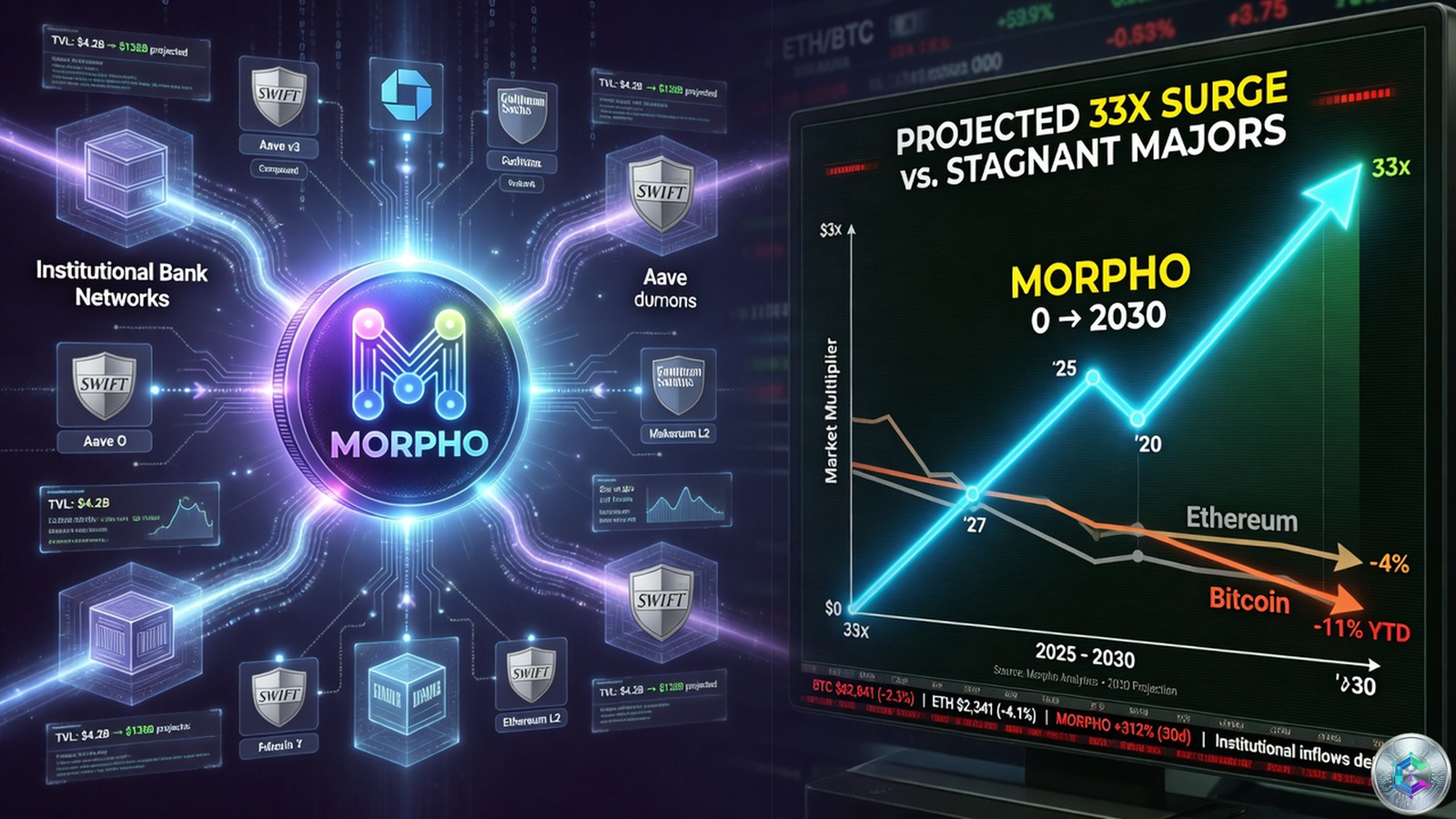
Standard Chartered has initiated coverage on Morpho (MORPHO) with a price target of $60 by 2030, representing a potential 33-fold increase from current levels. This bold forecast is part of a broader thesis on DeFi expansion driven by real-world asset tokenization, with total value locked (TVL) potentially reaching $2.7 trillion.
🔑 Key Takeaways
- Standard Chartered projects Morpho to hit $60 by 2030, a 33x surge.
- DeFi TVL could grow 37x to $2.7 trillion, fueled by real-world asset (RWA) tokenization.
- Morpho stands out with modular architecture and strong institutional adoption via Coinbase, Apollo, and others.
- Risks include competition, regulation, and broader crypto market conditions.
The $2.7 Trillion DeFi Opportunity
At the core of Standard Chartered’s bullish thesis for Morpho is a sweeping forecast for the entire decentralized finance (DeFi) sector. The bank expects total value locked (TVL) across DeFi protocols to grow 37-fold, reaching approximately $2.7 trillion by 2030. This expansion would be driven by two converging forces: the continued tokenization of real-world assets (RWAs) such as US Treasury bills, money market funds, and corporate equities, and the growing share of those onchain assets actively deployed within DeFi lending and trading markets.
For context, tokenization of real-world assets has already attracted serious institutional attention. BlackRock’s tokenized money market fund BUIDL became accessible through UniswapX in February 2026. Citigroup has projected the tokenized securities market could reach $5.5 trillion by 2030. Standard Chartered itself has previously forecast that non-stablecoin tokenized RWAs would grow to $2 trillion by the end of 2028. Yet only approximately 3% of stablecoins and 10% of tokenized RWAs are currently being used within DeFi protocols—a utilization rate that Kendrick projects will rise to 30% by 2030.
This gap between issued and actively deployed tokenized assets is precisely where Morpho’s infrastructure play becomes critical. The protocol’s two-layer architecture—Morpho Blue as the immutable lending primitive and Morpho Vaults as the curator allocation layer—is designed to absorb institutional capital flows and route them into productive onchain lending markets.
How Morpho Stands Out in the DeFi Lending Landscape
Morpho has emerged as one of the most architecturally innovative lending protocols in decentralized finance. Rather than the traditional monolithic pool model used by protocols like Aave, where every supplier shares a single pool with governance-controlled risk parameters, Morpho splits its architecture into two cleanly separated layers.
Morpho Blue is a minimal, immutable smart contract—roughly 650 lines of code—that allows anyone to deploy isolated lending markets with customizable parameters: the loan asset, collateral asset, liquidation loan-to-value ratio (LLTV), price oracle, and interest rate model. Once a Blue market is deployed, its parameters cannot be changed by any governance vote or central authority. This immutability is the core security proposition.
Morpho Vaults sit above Blue as the strategy and curation layer. Vault users deposit a single asset—typically USDC or another stablecoin—and professional curators allocate those deposits across multiple Morpho Blue markets to optimize yield. Leading curators include Steakhouse Financial (which runs the Coinbase USDC lending vault), Gauntlet, MEV Capital, Block Analitica, and Apostro. The result is a protocol that routinely generates 100 to 300 basis points higher USDC yield than monolithic alternatives like Aave.
In April 2026, conservative Morpho Vaults were yielding approximately 4-5% on USDC, while more aggressive strategies reached 6-8%. By comparison, Aave’s unified USDC pool offered 3-6% during the same period.
| Protocol | USDC Yield (April 2026) | TVL (April 2026) | Model |
|---|---|---|---|
| Morpho | 4-8% | $10 billion | Modular isolated |
| Aave | 3-6% | ~$40 billion | Monolithic |
Institutional Adoption: The Coinbase Inflection Point
The pivotal moment in Morpho’s transition from a crypto-native protocol to enterprise-grade infrastructure came with the September 2025 integration of Coinbase’s USDC lending product. Coinbase, the largest US cryptocurrency exchange, began routing US retail customer deposits through a Morpho Vault curated by Steakhouse Financial. By April 2026, Coinbase Loans was managing over $1.6 billion in collateral powered by Morpho Blue, and the integration had expanded to the UK market.
This single integration accomplished what years of marketing to institutional investors could not: it demonstrated that Morpho’s infrastructure was production-grade, battle-tested at scale, and capable of handling the operational complexity of a regulated exchange’s customer-facing products.
« I think the next opportunity for generational wealth in digital assets is going to come via the DeFi protocols. I estimate that the amount of tokenized assets active in DeFi will 37x by the end of 2030. »
Geoffrey Kendrick, Global Head of Digital Assets Research, Standard Chartered
The institutional momentum did not stop there. Apollo Global Management partnered with Morpho in Q4 2025 to launch onchain credit vaults targeting institutional RWA exposure. Bitwise, Gemini, Crypto.com, and Société Générale Forge followed with their own Morpho integrations. By April 2026, Morpho’s TVL crossed $10 billion, and its user base expanded from 67,000 to over 1.4 million.
Morpho V2 and the Future of Market-Driven Rates
Beyond current infrastructure, Morpho’s next major evolution is V2—a redesign of how lending markets are formed that fundamentally changes the relationship between the protocol and rate discovery. Morpho V2 shifts rate determination from the protocol to the market itself. Instead of a formula dictating how supply and borrow rates respond to utilization, V2 allows participants to express their own views on risk and return directly.
V2 also introduces fixed-term loans, cross-chain lending markets, and support for any type of loan structure—institutional primitives expected from traditional credit markets. Paul Frambot, Morpho’s co-founder and CEO, has described V2 as the step that will « radically expand what’s possible by giving markets and curators more freedom than ever. »
The DeFi Sector Gets a Major Banking Endorsement
Standard Chartered’s coverage of Morpho is part of a broader pattern. The bank has published a series of bullish DeFi research reports throughout 2025 and 2026, covering Aave, Uniswap, Ethereum, and other protocol-native tokens. Each report follows a similar thesis: tokenized RWAs entering DeFi will drive a structural expansion of the sector’s TVL by an order of magnitude.
For Aave, Standard Chartered set a $3,500 price target for the AAVE token by 2030—a roughly 45-fold increase. For Uniswap, Kendrick assigned a $100 price target by 2030, implying roughly 40x upside.
What Would Have to Be True for $60 Morpho
As with any long-term cryptocurrency price forecast, the $60 Morpho target requires a cascade of assumptions to prove correct—and investors should treat these projections with appropriate caution.
First, tokenization of real-world assets would need to accelerate dramatically. Standard Chartered’s $2.7 trillion DeFi TVL projection represents a 37-fold increase. Second, Morpho would need to maintain its competitive position as a premier lending infrastructure provider. Third, broader crypto market conditions would need to support a sustained multi-year uptrend. Finally, the Morpho token’s utility and demand drivers would need to strengthen.
Regulatory developments, particularly the CLARITY Act in the US, are a key factor. Passage would create a federal framework for digital assets, reducing legal uncertainty for institutional capital. However, researchers caution that tokenization itself does not guarantee deep or unified markets.
Morpho’s modular architecture versus Aave’s monolithic alternative has real consequences for risk management, yield generation, and institutional appeal. Morpho’s isolated markets contain losses to specific Blue markets, while Aave’s model exposes all suppliers to shared risk.
The Verdict: High Conviction, High Risk
Standard Chartered’s $60 price target for Morpho by 2030 is among the most aggressive DeFi token forecasts ever published by a bulge-bracket investment bank. The thesis rests on a coherent chain of logic: tokenization of RWAs will drive a 37-fold expansion of DeFi TVL; Morpho’s institutional-grade infrastructure positions it to capture a disproportionate share of that growth; and the resulting revenue and utility accrual will drive the MORPHO token dramatically higher.
The Coinbase integration, Apollo partnership, and wave of institutional adoptions provide concrete evidence that the institutional adoption thesis is not theoretical. Yet the path to $60 requires multiple simultaneous outcomes. The risks are real, the competition is fierce, and cryptocurrency markets have a well-documented history of defying even the most well-resourced forecasts.
What is clear is that Standard Chartered’s endorsement validates a narrative that decentralized lending infrastructure is becoming a legitimate institutional asset class, and that the protocols building the rails for that transition merit serious analytical attention.
Sources
- BlockBeats/Bitget: Standard Chartered Bank has initiated coverage of Morpho with a target price of $60
- CoinDesk: Ether to hit $40,000 by 2030, Standard Chartered says
- TradingView/Cointelegraph: Tokenization could push DeFi assets to $2.7T by 2030
- Eco: Morpho Protocol Explained 2026
- Morpho.org Blog: Morpho 2026 by Paul Frambot
This article is published for informational and educational purposes only. It does not constitute investment advice. Do your own research (DYOR) before making any decisions.

